Friday, August 14, 2020

More Soils and Crops and a Challenge

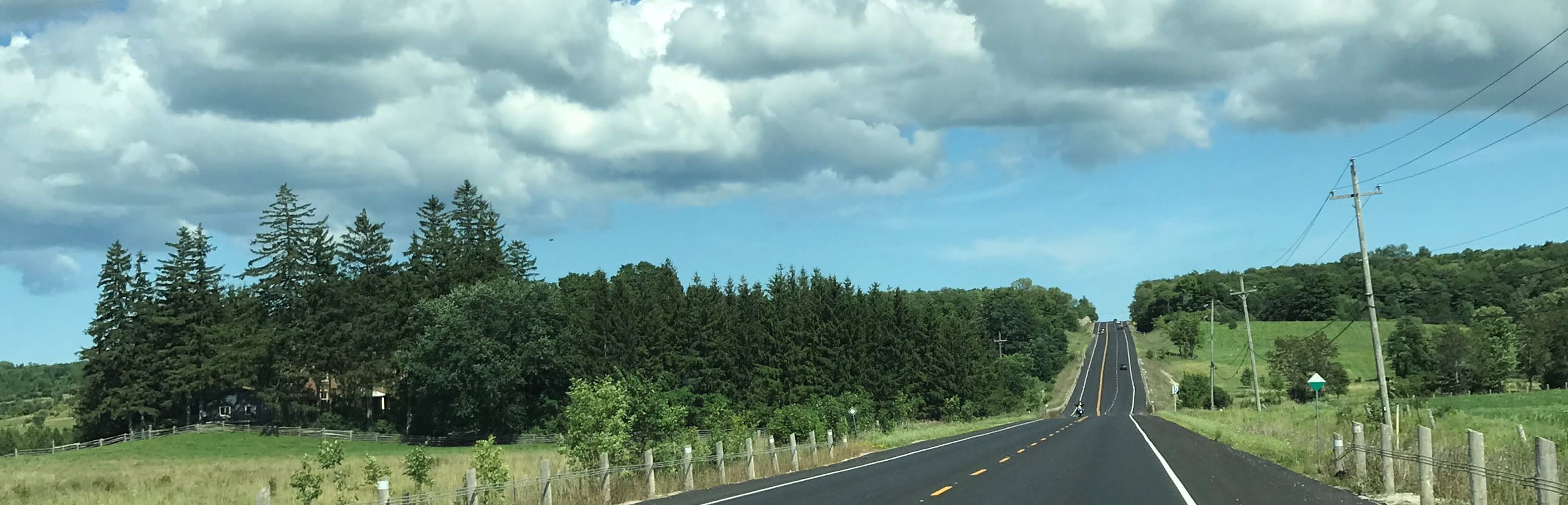
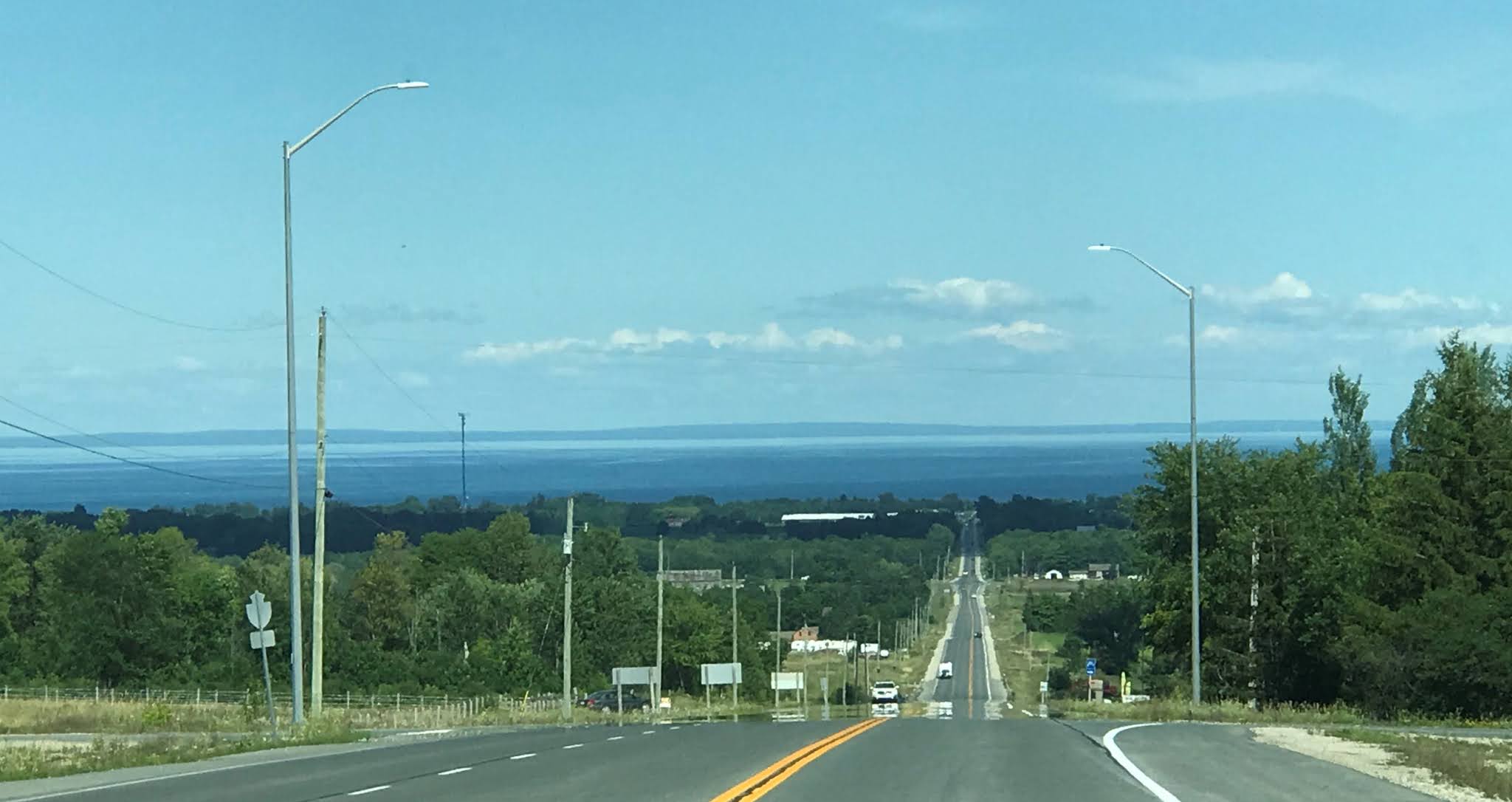
Today we'll do the drive from Meaford to Owen Sound and see what we see.  Remember I sit in the passenger seat, so if we're driving west I'm looking out toward the north.  And there's a lot of variety as the landscape changes from flat fields to up over some drumlins and then the escarpment to back down off the escarpment and into Owen Sound.

Those flat fields of sandy well-drained soils just west of Meaford are good for crops as well as apples,  Right across the road from one of the two biggest orchards is this field of soybeans looking good.  Last year this was in corn.  

That hill in the distance is an outcrop of the Manitoulin Formation, separate from the main escarpment further west.  The Meaford army base is located almost entirely up on that bedrock island.

Then we head up over the ancient Algonquin shoreline and over a couple of drumlins and we start seeing patches of wetland in between those hills.


The forest, rather than cropland, is never far away here.

And then we're up over the Niagara Escarpment at the tiny village of Woodford and onto very different rocky land to the west for a few miles.

Here it's continuous forest right to the highway, though there are several mysterious driveways disappearing into the woods.  I always wonder what sort of place they have in there.

The rock is often near or at the surface, so though the land may have been naively cleared for farming a century or more ago, it's all regrown back into forest or scrubland now.

And then we're back into some flat fields and good soil for about two miles.  There are some good fields here that were in wheat last year, and corn this year.

But the most interesting thing as we rise onto one of those drumlins on the north side of the road is the organic veggie farm that also has ducks, chickens and free range pigs.  We always watch to see if the pigs are out in their pasture.  They've been hiding under those trees in the background over the hot days in July.

*******************************************

I discovered the other day a fitness challenge through which you can do 'virtual' online exercise like running or biking to complete world famous hikes.  The one I saw advertised was the Camino de Santiago pilgrimage in northern Spain at 500 miles or so, which I have written about here and watched several videos of.  There was nothing to say you couldn't do it in a wheelchair.

So with Mrs. F.G.'s encouragement I signed up.  It seems a bit hokey; you get a fancy medal when you finish (which you pay for), but what I've discovered is the motivation!  These are advertised as a way to make your exercise S.M.A.R.T. - specific, measurable, achievable, relevant and time specific.  Lots of experience shows that setting specific goals over a limited time increases your continuing motivation to exercise.

Of course in a wheelchair I can't do it very fast.  Even going downtown and along the waterfront as I did yesterday, (pictures in a day or two) only adds up to 4.5 km. and takes an hour and a half.  If I've got to go 770 km. to finish the Camino, and I can't do it over the winter, or even every day of the week, it's going to take me at least a year and a half to finish this!!  But already I find I'm trying to go for longer rides, and Mrs. F.G. is chasing me out the door to get my km. in, so it's working for me; I'm getting more time outside and more fresh air.

On the Conqueror Events website there are  currently 11 challenges you can undertake, including places like the Appalachian Trail and Hadrian's Wall Path across northern England.  The only downside I see so far is that their website is very slow, and the map won't load at all, so I can't see where I am on the route.  But I've done 30 some km, and I'm enjoying it.  Makes this fall's hospital fundraising run of 5 km seem easy.  I think I'll sign up.


Wednesday, August 12, 2020

Soils and Crops in August

Now that we're back to physio in Owen Sound once a week we're driving Hwy 26 regularly, and I'm constantly noticing the state of the fields and crops.  The landscape changes quite dramatically over the 20 minutes and I always find it interesting even though I've seen it many times before.

I'll start at the Owen Sound end today and tomorrow we'll drive the other direction.  There's just a short stretch of farmland after you come down between the rocks of the Niagara Escarpment before you hit the city.

And this year a large field has just been allowed to come up in Queen Anne's Lace.

Just before the first traffic light on the outer edge of town there's an small awkward shaped piece of land, so the farmer uses it to store his hay bales ready for winter.

And those hay bales (along with others) will go to feed one of the several herds of beef cattle we see out in the fields, often a popular approach to farming where the soil isn't good enough for cash crops.

We pass through the valley of Keefer Creek where 2 or 3 of those cattle herds can be seen, and soon after, down over the big hill to see the view of the bay at Meaford.  The flat lands down there are the best farmland in the whole drive.

Down here are the apple orchards, several hundred acres of them.  The soil here is sandy, under the beach deposits of post-glacial Lake Algonquin which was considerably higher than today's Georgian Bay.  The apples like the good drainage of the sands; they don't like wet feet!  This land is also flat, which is good for any crops.  This map shows those sandy deposits (in yellow) curving around both Meaford and Thornbury, as well as the post-glacial beaches (the red lines).  

The sand deposits extend all along the shores of Georgian Bay, with big indentations forming ares of flat sandy soils around both towns, with the same result, two big semi-circles of apple orchards.  The moderating influence of Georgian Bay also helps by delaying blossoms in the spring, reducing the risk of frost.  As well there's some cold air drainage down off the surrounding escarpment toward the bay, which also reduces frost risk.  So those are the reasons why Thornbury and Meaford are the biggest apple-growing area in Ontario.  It's one of the clearest relationships between soils and crops that you'll find anywhere.


Tuesday, August 11, 2020

Hummingbird!

Yesterday I saw my first Ruby-throated Hummingbird that stayed around long enough for photos.  We've seen quite a few that dashed past, perhaps stopping for an instant, but none have stayed to feed, even though we had a Hummingbird feeder up for a couple of months.  But now that the first bloom on our Butterfly Bush has emerged, there it was, hovering up and down to visit for several minutes.

I grabbed for my phone pretty fast when it arrived, hoping I could get it set before it sped off.

But it hovered for a full minute or two, allowing me to get several photos.  These are the best of about 25 photos.

And that wasn't enough, it also stopped at the Hostta that's still in bloom to investigate several blossoms.

Mind you, along the way there were lots of photos like this or worse as it hid on the other side of the flower.  Rain this morning and thankfully it's a bit cooler than the sweltering heat of yesterday.


Monday, August 10, 2020

More Hostas!

Regardless of their interesting flowers, Hostas, big and small, are the backbone of our garden all summer long.  We had over 300 at our former home, but only brought 'a few' here, about 50 or 60.  Digging them all up was one of the last really physical tasks I did before ending up in a wheelchair!  With their widely varying leaves they're best known just for their foliage.

A lot are just green, but a large number have two-tone leaves like these too.

This is one of the two patches mostly in the shade of the house at the back.  If you look carefully you can see at least 6 different Hostas; there are about 10, densely packed among other plants.  We have really used these two patches as holding beds, and now with our expanded garden we're ready to move a lot of the plants out, leaving more room for the others.

Here are four different Hostas just at the far end of that bed, along with a single leaf of a fifth one.

The front bed doesn't have quite as many because Mrs. F.G. planted several shrubs and that beautiful blue grass, but you should be able to see three easily.  There are another 10 down the side of the house, and another 8 of the tiny ones in our scree garden.

The leaves range from very large ...
to small and narrow,....
to tiny and bright green in spring when this picture was taken.
Some are dark green and wrinkly...
and some are mixed colours.
If you look carefully at these you'll see that the closer leaves are dark in the centre with a lighter yellow border, but the ones in the background are the reverse, yellowy centre and dark borders.
And some are just light, almost yellow green.

But I still like the tiny ones best.

And I haven't told you the best thing about the Hostas, because they are almost the ideal garden plant.  Since their leaves spread out so well, they usually do not need weeding.  And they grow best in the shade.  They are occasionally subject to pests though; deer like them.  At our previous home most of our Hostas grew in the shade along the old fencerow, and the deer would come along and simply eat every flower stock off.  We never had to cut down the dead stalks!   


Sunday, August 9, 2020

Hosta Flowers

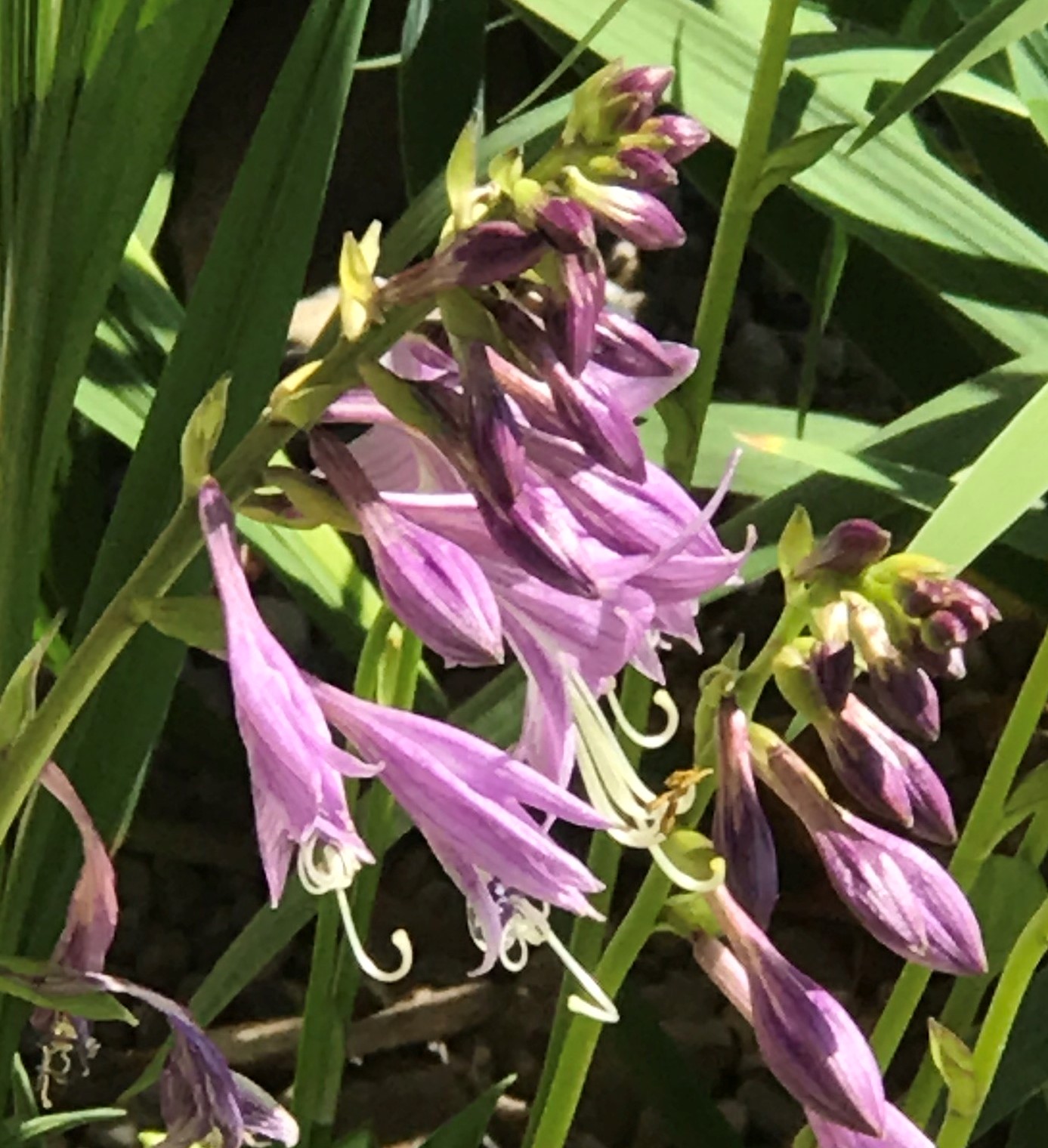
 The other big group of flowers we've seen in the garden over the past month have been the Hostas.  We have a lot, and there always seem to be several in flower, though we're down to the last 5 or 6 now.  Personally I favour the smaller Hostas like those in the scree garden at the front door, perhaps because I can get really close to photograph them  

These are the tiny purple ones I favour, right at the front door beside the sidewalk.
With these my view almost straight down gives a quite different perspective.

Some have so many flowers they appear all jumbled together.
This is one of our favourites with tall dignified flowers and interesting leaves to boot.

Still it's the small ones out front that are my favourites.

Saturday, August 8, 2020

The Clematis in Our Garden

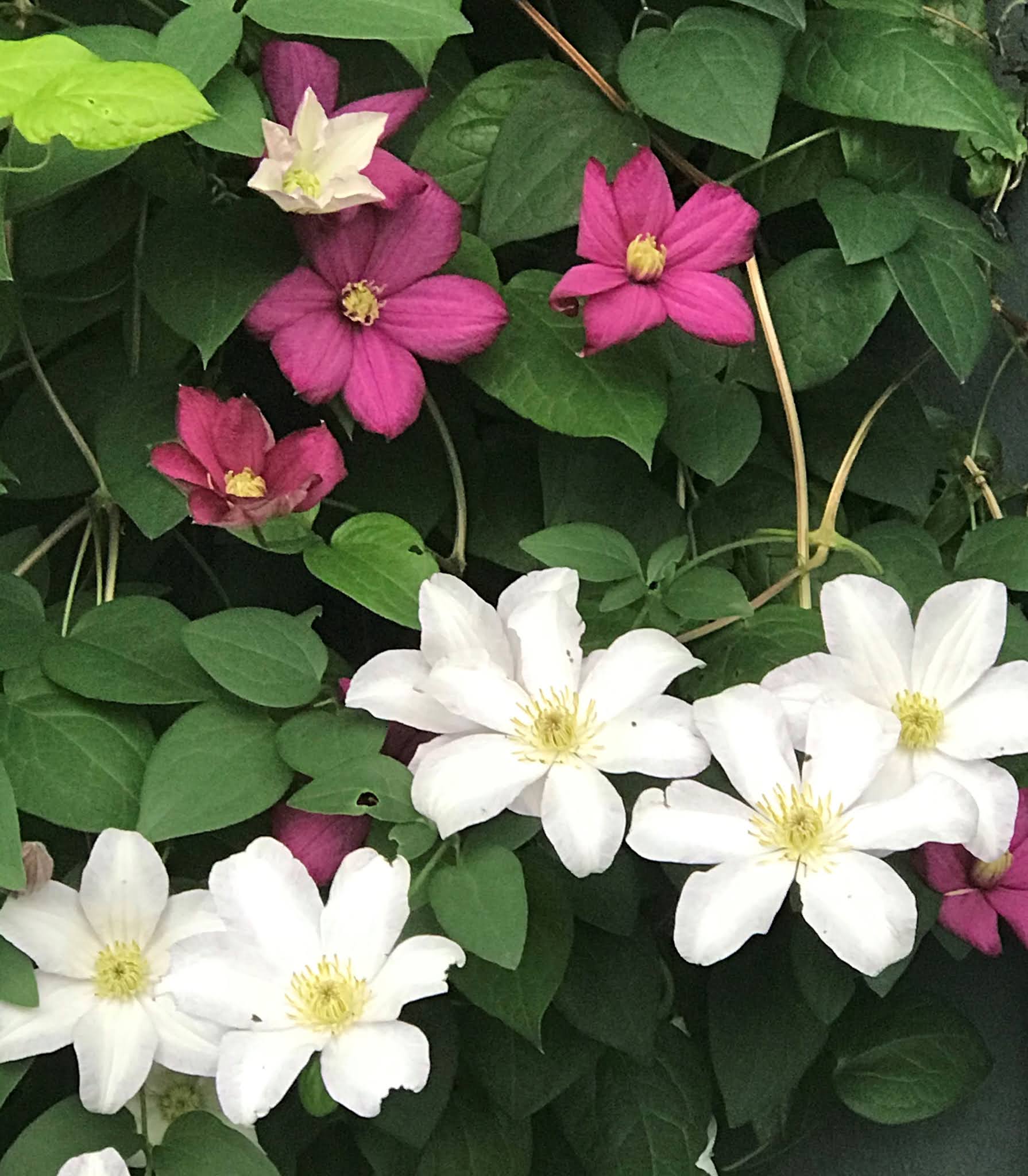
 I'm trying to get caught up showing you the plants blooming in our garden, in between the other things I write about.  I've almost missed the Clematis season, though there are still a few blooms out there.  We have 8 Clematis plants altogether, but two bloom in spring, and I'll share 4 of the others with you which are still in bloom a bit now.

Two of them, one white and one purple, are growing on a trellis against the shed, with two almost yellow Hostas at their feet.

Personally I find that Clematis get more interesting the closer you look at them.

It's amazing what an iphone can do.  Mrs. F.G. is the photographer or all of these.

In this photo you can actually see the difference between the outer stamens and the inner pistils.

This Clematis grows on the side of the house.

I've always said 'Clem-a-tis', but I often hear 'Clem-atis'.  Take your pick.

Two hot days here over the weekend, hoping for cooler but still sunny next week.