Friday, April 9, 2021

Sandhill Cranes!

Driving along this road we almost always watch for Sandhill Cranes; this is the area where we've seen them most often.  They've become part of our personal bird-watching habit, and if you see one close they are certainly spectacular birds.  And if you hear one they're even more notable.

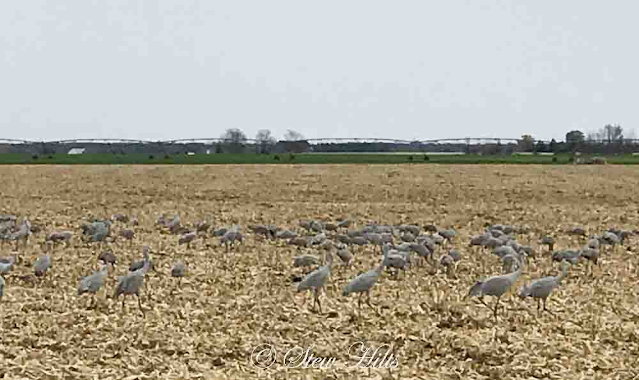
This was our first view of the cranes.  Can you spot them, large brown birds at least 3-4 feet tall?  Do you have eyes as sharp as Mrs. F.G.?

This cropped picture might help you.

And here they are.  These two photos are cropped from the first picture, just for your viewing enjoyment.  Just for my own enjoyment, I went back over our past photos of the cranes, to gather together the times we've seen these birds.

We saw a pair near here just two years ago, when the soybeans were growing well, slowly working their way through the field eating what grubs they could find.  This was late June, 2020.

Perhaps our most interesting sighting was 10 years ago, when we saw this pair with a young one, a little later in the season, and further west on the same road.  Can you see the tiny light brown chick, in between the two adult birds?  This was in mid-May, 2012.

And of course there was our spectacular sighting of Sandhill Cranes gathering together for migration in November.  We estimated that we saw close to 2000 all within one large concession, feeding on leftover corn in the fields.  From what I've read they return to specific sites year after year to gather into larger flocks during migration, and this field appears to be just such a site, about an hour east of here.

And here's back to the pair we sighted on Sunday, the best phot I could get this time without cropping til it gets blurry.


Thursday, April 8, 2021

An April Sunday Afternoon Drive

On Sunday we took off for a long drive through the countryside.  Wanting something different this time we drove west around Owen Sound and north to the village of Kemble.  We're missing their maple syrup festival which has now been cancelled two years in a row.

This is the Bighead River at our first crossing.  We now live in the Bighead River valley.  The 'valley' in my blog title actually refers to the Beaver Valley, one small watershed to the east, where we used to live and where most of my good photos come from, but I often refer to the whole area as the Beaver Valley 'region'.

This is the second crossing, a couple of concessions west.  I once joined a canoe/kayak group putting in here and floating downstream for several miles in early April.  Obviously the water was higher that year; we could easily float across that line of stones across the river.

It's not uncommon around here to find curves in roads like this, going around hills rather than over them, although this curve was rebuilt a few years back so you don't even have to slow down anymore.  But there are still lots of roads that don't go through at all, either because of large wetlands or the Niagara Escarpment.

It's a rolling agricultural landscape, often half forested, a lot of it just used for pasture (or not used at all anymore). but the point of the picture is the three Turkey Vultures.  Uncommon 20 years ago, they've become one of our most common birds; there's often one in sight, soaring overhead hardly ever flapping their huge wings.  They have nearly a 6 foot wingspan held in a very shallow 'V', unlike large hawks which hold their wings flat.

These fences reflect both a well-off landowner, and cattle, the most common farm use around here, almost always beef cattle.

I'm always struck by this farm as we drive by, high on the slope of a drumlin with little around it.  Looks pretty exposed to the winter winds to me.

And here is another.  We've actually been into this farm.  He used to make the most ornate fancy birdhouses, like Disney castles.  These fields are smooth enough for copping, almost the only crop fields on this road all the way to Owen Sound, though it's a pretty steep slope.  They're probably rented out now.

We saw the flashing lights first and we thought it was an accident.  It's a bad corner.  But it was just a 'ride check'.  I couldn't believe people would be drinking in the middle of Easter Sunday afternoon!  Maybe they were after those folks who feel a bottle of wine with dinner is fine.


Tuesday, April 6, 2021

Continuing Construction

Across the golf course I watch the continuing construction of a road which will be followed by houses on both sides, splitting the golf course nearly in half (or 2/3-1/3).  I find it interesting to try to follow the steps they're going through.

First they had these dump trucks going back and forth, and then I began to see a bulldozer slowly moving each direction.  I think they may be bringing in gravel for the roadbed.

Then the big red excavators appeared, apparently putting in the underground services.  If it's like our street they put in water, storm and sanitary sewer pipes (you can see them lying on the ground), gas, hydro, phone and internet lines to every lot before the first house gets built.

They've been working at this a long time, though it does mean laying down the main runs along the street, and all the short junction runs to house lots on each side of the street.  Must take a lot of coordination.

The piles of dirt kept getting bigger and then smaller again.  They had four separate excavators working on this.

After they finished all that you could see these vertical white stand pipes, presumably marking every lot.  This picture was taken in the rain and is a little distorted, especially the roofline of those homes.  

Steadily warmer days here and I'm hoping to get outside a bit.


Monday, April 5, 2021

A Brown Creeper!

I'll bet most of you have never even seen a Brown Creeper or know what it is, though it's more common than you'd think.  It's perfectly camouflaged you see, and terribly hard to pick out when it's poking its way up a tree trunk, which is where you're most likely to see it.  But I'll bring you up-to-date on our other bird observations too, which have actually been remarkably few.

Our little flock of Chickadees are our most common visitors, and they're still passing through briefly several times a day.  I have lots of pictures of them at the feeders, but less often sitting in their natural habitat - a tree!  They will disappear for nesting in the woods soon.

The White-breasted Nuthatch is usually with them, but it's very hard to get a good picture, it moves so fast.

Occasionally we see a Downy Woodpecker or a Red-bellied Woodpecker like this one.

And last week a Song Sparrow arrived back.  Perhaps our most common sparrow, I know it for its easy-to-recognize melodious song, which it typically sings from the top of a shrub all day long in warmer weather.  You can see it has two dark cheek patches, and a dark spot on its breast.

And this is the Brown Creeper.  I picked the photo which I thought was easiest to see against the very similarly coloured bark to show you first.  This is heavily cropped, but taken with my Nikon rather than my iphone.

I've cropped it even more here to show you the downward pointing bill which it uses to dig tiny bugs out of the bark.  This bird can almost be identified by its behaviour, as it hitches its way up the tree in short hops, probing into the bark crevices as it goes.

So now that you know what it looks like, can you find it on this original photo?

This cropping should help you.  Brown Creepers are not terribly rare, though I've only seen one once or twice before in my life.  But they sure are hard to spot.

To end on a more colourful note, here's a Cardinal that only visited once, but soon I'll be hearing it calling from the tops of trees on my rides.


Saturday, April 3, 2021

"How Are You?"

It seems to me that we go through life asking and giving polite but meaningless greetings to everyone we meet, even those close to us.  But when I get asked 'How are you?', I don't always feel like answering with something positive (or even something polite).  For it seems to me that the person asking has by-passed my disability and is treating me like any other able-bodied person.

Setting aside the fact that I'm in a wheelchair, and a power chair at that, they ignore the fact that I'm limited in where I can go, how I can get there and what I can do.  They probably don't realize that I'm in constant pain, such that riding down the sidewalk hurts.  It would never cross their mind that I might be discouraged, or feeling badly about my lost ability to travel.  Or that I might simply be having a bad day.

A few times recently I'll admit I've been really tempted to answer 'Well, I'm having a sh&$!y day thanks, spending all day in this f&%$@*!g wheelchair, and to tell the truth it's a sh)(*&y life altogether!'

Thankfully I haven't stooped to that level of depravity yet.  but I have found myself answering 'Well, I'm surviving', which isn't a very inspiring answer at all, though perhaps it tells them where I'm at.  For much of my life I've made a point of answering 'I'm great!', which seems more positive at least.

This is multiplied when you're talking to someone close to you who knows quite well what you're going through and yet asks the same old question, 'How are you?'  With them you can be more honest and tell them how tough life is, or what a difficult time it is for you just now.

Of course my current cynicism may all just reflect being stuck inside for the winter, made worse this year by even things like church being cancelled due to the pandemic.

I do think there are ways the question could be asked more honestly.  Even asking 'How are you today?' implies that you know the bigger picture, but you can honestly ask how is it just now.  This works well for people you see fairly regularly.  Asking 'What's new?' is similar and opens the door to a sensible answer.

However, the fact that I might be tempted to give an impolite answer to the question in the first place raises the important question of how you do stay positive in the face of life-changing injuries.

If there's one big surprise in the past three years, it has been how my brain immediately adapted to my new situation.  Right from the beginning I have thought not about what I've lost but about how to adapt to my new situation.  My 'self' doesn't reside in my whole body, it resides somewhere in my brain (or maybe my soul).  I can be happy or sad, discouraged or successful regardless of the fact that most of my body no longer works.  In that context I can honestly answer I'm great' unless I'm having one of those really bad moments.

I'm not sure that family caregivers, spouses or adult children, react the same way.  Their life has been limited entirely through something that's happened to someone else.  They have no control over it, they just have to give care.  And therefore I think it's more stressful for family caregivers than for the disabled or ill family member themselves.

All this is to say that I need to measure my days based on my own definition of great, even if it's very different from what you might consider great.


Friday, April 2, 2021

April Fools!

 It was nature that played an April Fools joke on us yesterday.  We woke up to a light snowfall and the view out the window had turned white.  And it stayed at least half white all day as the temperature was below freezing.

It wasn't much, and typical for April here.  It will be all gone today and then temperatures are supposed to rise to near 10°C and stay there.

Our poor crane/heron/ostrich is feeling cold again.  It was looking forward to warmer weather.

Happy Easter everyone!


Thursday, April 1, 2021

More on Global Shipping Chaos

 In the last post I tried to outline the complexity of modern international shipping from the local point of view - that is, you buying your new exercise bike at your local store.  But there are some global patterns involved here, as well as a pandemic that has caused so much chaos in society.  I realize this won't interest many of you, so I'm really writing this just for myself. 

To begin with the global container shipping industry has grown faster than the rest of the system. There aren't enough containers to go around, and there are more enormous container ships than there are ports which can handle them.  Both the biggest ports and the factories that manufacture containers are in China.  The biggest ships can totally overwhelm the smaller terminals, leaving other ships offshore, waiting their turn to unload.

One of the Vancouver container terminals (another in the background).

Then along came the pandemic.  Shipping dropped suddenly as business slowed, then it recovered, taking personal protective equipment to poorer countries in Africa, where those containers are often still sitting, empty, because there's no profitable reason to go back and pick them up.  As the pandemic unfolded, consumers started buying exercise bikes, treadmills, laptops and ipads, anything they could get to make a stuck-at-home life better, all usually produced in Asia someplace.  Shipping to Europe and North America particularly to the U.S. skyrocketed unexpectedly.

But the trip bringing those consumer goods to the U.S. was much more profitable than taking bulk goods like soybeans back to China.  So containers in Asia were in high demand and empty containers were left on the west coast because ships didn't want to wait for a low value cargo like soybeans from Chicago or Kansas to be loaded.  

The cost of shipping went up accordingly.  Containers that cost $1000.00 to ship last June cost $4500.00 last month!  Shipping companies have made terrific profits and retailers absorbed huge losses along the way.

It strikes me as supremely ironic that those clothing companies that outsourced clothing manufacturing to Asia over the past three decades in order to make better profits are now complaining about the cost of importing that clothing back into the country!  And the workers are still making the pittance of a wage they get paid.

The container port at Delta, south of Vancouver.

The global shipping pattern is heavily skewed by the most profitable route, that from China to the west cost of the U.S., particularly the Los Angeles area container terminals.  Among western countries, the U.S. has the largest trade deficit, and it's huge.  The U.S. imports far more in consumer products than it exports.  While the EU, the U.K., Canada and Japan's trade balances all go up and down by a few billion, and are frequently positive, the U.S. trade deficit is over $700 billion.

I was interested to see that the trade balance between the U.S. and Canada is typically positive in Canada's favour, but interestingly we tend to trade the same things to each other, thanks to our integrated manufacturing sectors - vehicle, machinery, energy products and plastics.   

I should also point out that the great Lakes ships I've occasionally posted pictures of are all bulk carriers, ships that carry products like coal, grain, iron ore and salt loaded directly into the holds of those ships.  Although there have been container ships on the Great Lakes, the limited size of the St. Lawrence Seaway and the Welland Canal has made it uneconomic.

The much-scraped Algoma Compass, wintering in Owen Sound.

Sorry if this post hasn't interested you in the least, but I found it fascinating to delve into this, partly perhaps because our daughter works in this field.  I'll be able to have a more interesting conversation with her now.

Meanwhile, here in Meaford it snowed for April Fools Day, and  we're moving back into a 4 week lockdown  - I think I've had enough!