Saturday, August 4, 2012

Goldfinch, Wrens and Chipping Sparrows

I've been lucky enough to be in the right spot with my camera several times the past month, and got decent pictures of several of the birds around the house and meadow.


Goldfinch

The goldfinch is both the brightest and most musical of these, and it's our most common bird all year round. One of the few birds that sings while it flies, it bounces across the meadow in flight, calling out a varied series of notes in it's almost constant song. Their tweeting to and forth sounds very much like a group of birds in conversation.


Chipping Sparrow

The chipping sparrows are one of the birds most tolerant of people; a pair nested in a cedar this year right at the edge of our deck. They're very small birds, with a song that's a straight trill. I often see them pecking around on the driveway, but this one landed on a fork handle while I was standing very close with my camera. I got off three shots and this one wasn't too blurred.


House Wren

The house wren is more unusual. Though we often here one in the spring (they are one of the most beautiful songsters around, with a beautiful melodious call), we've never had a pair stay all summer. This one was making a second next in a birdhouse, but if I crept any closer it immediately vanished.

Friday, August 3, 2012

2nd Broods

A number of birds around the yard - those like chipping sparrows, the house wren, robins, and mourning doves, which all nest comfortably close to people - have now brought off their 2nd broods, another sign that the seasons are changing.


Our cabin has large hemlock beams that stick out at the ends where the robins and doves like to nest every year. One day recently I was up the ladder under the roof repairing a window frame, when I looked over my shoulder and there was a mourning dove - sitting on her nest, less than 2 feet from my head. She just sat there frozen, while I climbed down the ladder and climbed back up with my camera. I just took one shot, not wanting to bother her, but I've never been so close to a nesting bird!

Wednesday, August 1, 2012

Finally, a Monarch

I was out with my camera early one morning, and along came a monarch butterfly. I've seen several fluttering by the past few weeks, but never one that sat still for more than a second! This one picked a joe-pye weed blossom, and just sat there, stretching its wings back and forth. So finally I got my summer picture of a monarch. On the first picture below you can clearly see two swellings in the black veins closest to the body, near the bottom end of the body. These mark it as a male.


In this side view you can see the double row of round white spots on the outer edge of the back underwing. You can also see that there is no black vein cutting at right angles across the wings. These features mark it as a monarch rather than the otherwise very similar viceroy.


Monday, July 30, 2012

Sculptures in the Forest!

Before I return to the valley (we're actually already back), let me tell you about the astonishing, lttle-known sculpture forest at Haliburton School of the Arts. The sculpture trail has 22 modern sculptures, in a trail through the forest, wrapped around the Haliburton school, and I was blown away by the quality of the sculptures!


'Kennisis: Horse and Rider', by Bill Leishman, is the most stunning sculpture there, standing near the welcoming front doors. Bill is the innovative ultra-light pilot who first flew with migrating swans.


This heavy duty steel box, etched with outlines of tree leaves and ferns, is actually a resonant chime in disguise, 'Sound Vessel: Forest', by Metalgenesis, a team of Don Dickson and Amy Doolittle. I expect relatively few observers stick their arms through the holes to move the musical chimes, but being curious, you know what I did.


'A Walk in the Woods in Haliburton', is by Ellen Farrow. Holding a Canadian maple leaf to its chest, this symbolic hiker rested on another boulder down the trail - many of the sculptures were mounted on natural boulders in the forest.


The other one that intrigued me was the 'Redwing Frond' by Darlene Bolahood. In the early morning sun, it was stunning against the blue sky.

Sunday, July 29, 2012

Learning Better Photography

Just back from an intense, educational and inspiring week at Haliburton School of the Arts, and we're both exhausted! I took a course on photography and travel writing, so I'm hoping it will help me improve my blog, both with better photos and better writing! 


Grass in the early morning light

We had two instructors, who were outstanding. I moved a long way beyond the 'auto' setting on the camera, and learned about white balance, ISO settings, and depth of field. I'm now shooting mostly in 'aperture-priority', and have significantly improved my range of options for pictures.


Water spray

One morning we were challenged to get out with our cameras by 6.30 a.m., to take advantage of the early morning light, so these pictures were mostly taken then. It's the magic hour for photography, and I'm determined to make a date with myself to get out early at least occasionally to take advantage of it.


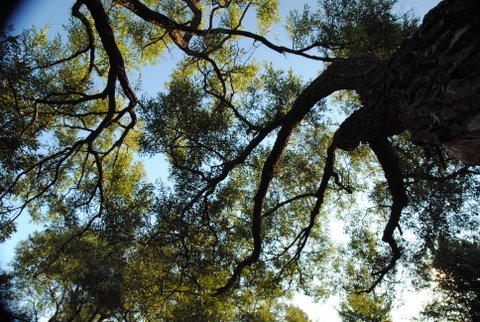
Willow trees

We also practiced close-ups, using a combination of aperture and shutter-speed settings to get the close-up while leaving the background blurry, and sometimes focusing on just part of a subject, like this.


Woodfern

Friday, July 20, 2012

Eugenia Falls

Stopped by Eugenia Falls today, having heard a rumour that they were shutting the power plant for a week, and all the water flow would be going over the falls - usually a fairly small trickle of its former self. And they were right! It's flowing with more water than I've ever seen.


Eugenia Falls is on the Beaver River, in the village of Eugenia, where the famous Eugenia Gold Rush occurred in the last century. In the early 20th Century most of the water was diverted through pipes to a power plant on the edge of the escarpment several miles north. Two dams back up the water to form Lake Eugenia, and normally only a small amount flows over the original falls. But today is was almost like the spring flood.


The falls has carved a deep but short valley known as Cuckoo Valley, westward into the Beaver Valley itself. This is the view west - note the river, a light spot on the bottom left of the picture.

Tuesday, July 17, 2012

Inglis Falls

The best known waterfalls in this area is Inglis Falls, at Owen Sound. A group of us went on a photo expedition there today, and I practised getting photos from different perspectives, crawling over the boulders at the base of the falls to get close.

The first is the conventional view of Inglis Falls; the rest are my different perspectives.