I've been wondering what to fill this winter's posts with, and I've decided on Scotland (unless you just want pictures of the weather outside our back window week after week). I've covered the Arctic, Iceland and a variety of other topics the past few years, all while sitting here at my computer to come up with ideas and photos. This year I'm trying to write a photo book on the two big trips we took to Scotland, so I thought you might be interested too.
This ragged looking rocky hill is one of the most famous sites in Scotland. Known as Dunadd, it's the site of a fort in the centuries before Scotland existed, capital of the kingdom known as Dal Riata, a diffuse area taking in the north-east corner of Ireland and a large swath of south-west Scotland. (On a clear day you can see this corner of Scotland from Ireland).
The crest of the hill was where the ancient kings of this kingdom were crowned, placing their foot in a footprint carved in the solid rock, as I tried to do. Archeological research has revealed evidence of a sea-going kingdom with trade goods from as far away as the Mediterranean - this in the 5th century!
Nearby is evidence of much older civilization, standing stones from several millennia ago. The Kilmartin valley here is full of such ancient evidence, though it is most spectacular on Orkney, which we will visit later.
Our next stop was the tiny Isle of Iona, site of St. Columba's early church and abbey in about the year 563 A.D. I had been reading a lot of novels on Scottish history, including the life of St. Columba (or Colmcille), so I was well aware of this; the story is quite an inspiration for me. St. Columba is given credit for bringing Christianity to Scotland; his biography written two centuries later by one of his successors, is one of the earliest writings on the early life of the area now known as Scotland.
Iona became an important centre for Celtic art as well as religion, with carved stone crosses being notable. "Celtic' crosses (with the ring around the centre) originated on Iona. Only a few remain, after Vikings destroyed most of them during their first raid in 795 A.D.
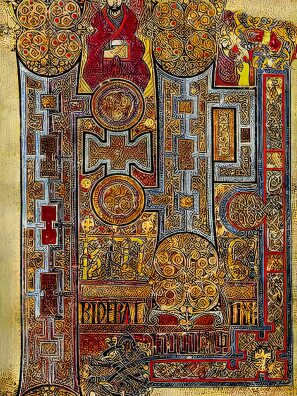
One of the 'illuminated' pages of the Book of Kells.
In addition illustrated manuscripts were produced, including one of the most famous, the Book of Kells, now on display in Dublin and later said to be 'the most precious object in the Western world'.
Iona is also the burial place of at least 49 Scottish kings from the early middle ages, including MacBeth (yes, there really was a real MacBeth). The 'Street of the Dead', along which funeral processions walked, is visible in the foreground of the picture of the Abbey above.
I should pause for a moment and say a little about this, our first trip, taken with our daughter and a friend, both teenagers. Here they are standing among the old stone walls of the nunnery on Iona, established several centuries after the abbey. We landed in Glasgow and drove north, eventually completing a giant circle through the highlands and back down to Edinburgh. In the process we were inspired to visit again at the earliest opportunity!
Iona is reached by a short tiny ferry ride from the Isle of Mull, and we took the back road on our return, getting a quick lesson on the narrow one-lane roads of Scotland, as well as a lesson on Scottish weather!
It had been raining all day, but as you can see the sun did shine in Tobermory, known for its colourful waterfront houses, the next day after we enjoyed that horizontal smirr (pronouced 'shmir') the day before.
We took the much larger ferry from Mull back to the town of Oban on the mainland, to continue our journey north. All the Hebrides, the western isles of Scotland, depend on ferries to get around.
Dundas.JPG)
Stew%20In%20Dundas%20(2).JPG)
Standing%20Stones.JPG)
%20Iona2.JPG)
%20Jona%20Cross.JPG)
Jona.JPG)
K&J%20Jona.JPG)
%20Shoreline.JPG)
%20Tobermory.JPG)
%20Ferry.JPG)