Tuesday, January 7, 2014

The Extremes of Winter

We've now reached about the most extreme winter conditions we ever get.  This is the heart of the winter season.  After surviving the heavy snowfall and snow squall warnings, we now have wind chill and blizzard warnings.  All the schools in Grey County are closed; all the roads are officially closed.  They've pulled the snowplows off the roads because of the poor visibility.  It's not safe to plow, let alone drive.

This is the typical visibility today looking out our driveway.  I did get out with the dog twice, but they were short walks, only 15 minutes - and I learned what 'wind chill' is really all about.  It was -24­°C, feeling like -35 with the wind chill, and when I took a glove off to try a picture with my cell phone my hand was quickly frozen.  The cold wasn't so bad (with all the layers I had on), but that wind was bone-chilling.

This is the visibility out to the main road out back.  This level of poor visibility isn't really the problem though.  When a snow plow goes by with a wind like this blowing, it raises the snow in the air, and the wind swirls it around the plow in a dangerous white-out.  Then there's no visibility for driving.  It isn't snowing in these pictures; it's just snow being blown around in the air.

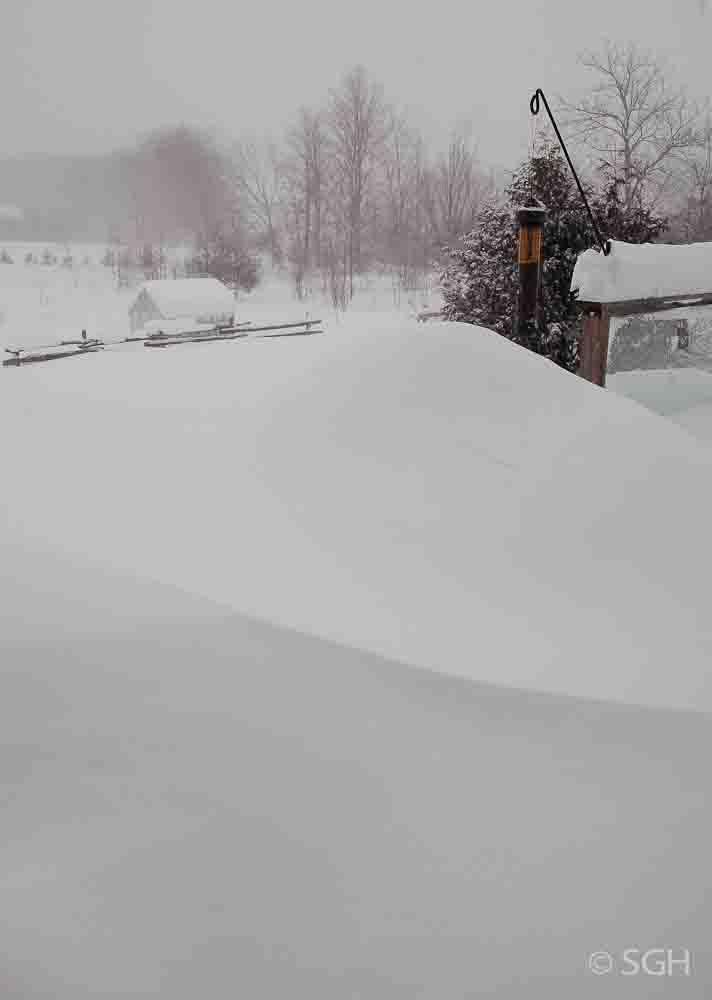
And with the wind come drifts.  Not just a gentle snowfall accumulating, but snow piled in places where it usually isn't, like on our deck.  You can see the feeder hanging there, but there were no birds today!

Winter in North America is a battle between 2 (or sometimes 3) air masses.  Warm moist air comes north from the Gulf of Mexico or thereabouts, and cold air comes down out of the Canadian arctic.  They meet somewhere around the northern states, the Great Lakes, or Ontario, Quebec and the Maritimes.  At the moment the arctic air mass is winning, plunging not only us but much of the U.S. into very cold temperatures.

And why do we have such strong winds and severe wind chill?  Because there's a big difference in pressure between the two air masses that brought warmer air to the NE states over the weekend, and the arctic air following it.  The atmosphere always tries to even out the pressure differences.

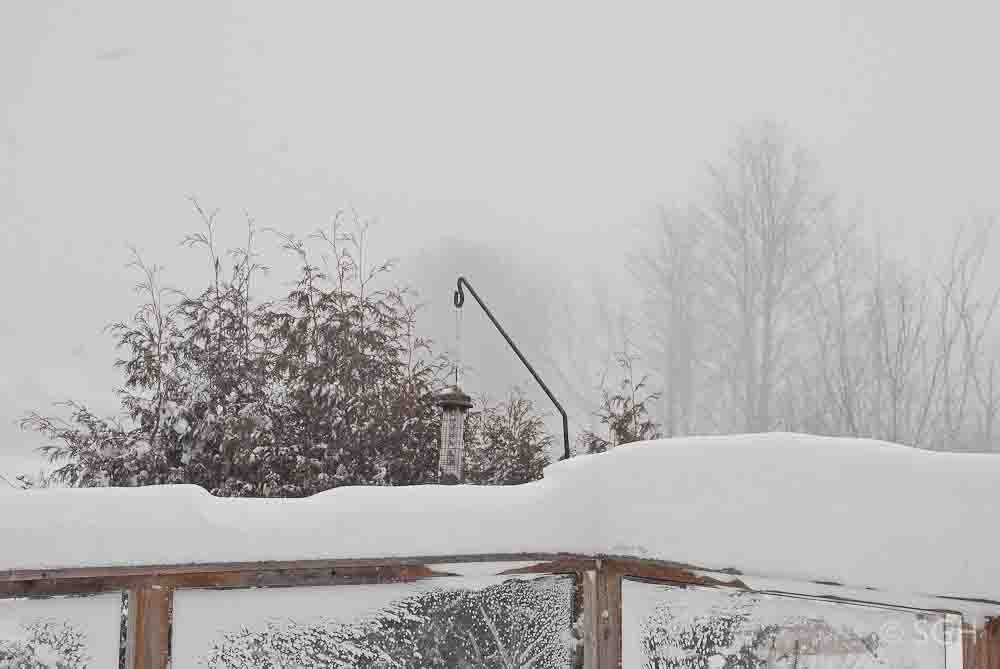
The snow is piled at least 16" deep on the railing here, and that's just since yesterday, as I cleared the deck on Sunday (to be ready for the new snow!).  Meetings were cancelled.  It was a good day to stay inside and read or write, which is just what I did.

 
In spite of all this, there are signs of life.  Walking the dog I got back with it still light out.  I thought it was getting close to 5 p.m. - it was 5.30!  Longer days are here already.

Though I'm tired of hearing that 'climate change isn't happening after all'.  NOAA scientists suggest that it's actually the warming of the arctic overall that leads to the weakening of the normal winter polar vortex over the pole, enabling it to break apart and come visiting us!  (See the links from Fred's interesting post on frost quakes at 'Fragments from Floyd').

 Linking to:
http://ourworldtuesdaymeme.blogspot.ca/


Monday, January 6, 2014

Snow Beasts!

It snowed another 8-10" last night, and has snowed on and off (whenever we're under one of those lake streamers) all day today.  It was so snowy that our snowshoe hike was cancelled!  Lots of snow, but no safe parking.  So I went snowshoeing in the woods by myself and soon encountered the 'snow beasts'.

It was slow going, even on larger snowshoes.  I sank in about a foot in the very light powder snow, the accumulation of two nights of new snowfall.

But once in the woods, where there's little wind and more shelter, the snow was piled up on every branch, forming the huge white snow beasts I've come to expect, especially down in the swamp.

This one looked like a huge white rodent perched on a branch behind these two trees.

And any fallen or leaning tree, with more surface to catch the snow, accumulated large piles of the white stuff.

It's not really a swamp, though in spring there are some wet patches and pools, but it's a crowded mix of new growth, some planted pines, and a few dead trees still standing.  It seemed to catch the snow in all directions, on every branch.

Snowshoeing depends heavily on the snow conditions.  With a bit of an icy crust like two weeks ago you might walk right across the surface.  This was the opposite, and in the swamp the snow was at least 2 feet deep, and sometimes 3 or more.  I sank down a foot to 18" with each step, and that gets very tiring.

So I didn't go far, but turned around and passed these other snow beasts on my way back to the trail I'd made on the way in.  It's breaking fresh trail that's the hard work; once back to my earlier footsteps it was reasonably easy going.  Even one pass with snowshoes makes it enormously easier for those following.

These two looked like huge hippos, perched on the branches of fallen trees.  A very snowy day for a walk.


Sunday, January 5, 2014

Sunny Skies

I've just discovered the blog meme 'Sunlit Sunday', hosted at 'My Little Home and Garden' just for the three winter months.  Sounds like a good idea to me.  As a photographer I understand how precious those cold, snowy but clear sunny blue-sky days can be during the winter months; they never seem to come often enough.  So here are a few sunny day pictures, most taken on Friday when the temperature was frigid, but the sun was bright.

A bit of Lower Wodehouse Creek

Meantime, it's an old-fashioned winter here, with piles of snow around the streets in town 3 or 4 feet high, and 15 feet high in the corners of the small parking lots.  We got a fresh 4-6" last night, and I spent 2 hours blowing and shovelling snow today.

A farm field to the west of us; snowshoe tracks along the woodland edge.

Those frigid arctic temperatures don't generally bring much snow, and true to form, the 3 days of -20°C or lower this week brought no new snow.  But now it's warmed up (to about -10°)and tonight one of those 'Colorado lows' arrives; we're forecast to get another 6-10".  It started snowing about 3 p.m. and is still coming down steadily.

An elm tree still sparkling from the ice storm.

There are both a 'Snowfall Warning' and a 'Snow Squall' warning on the Weather Network.  Heavy snow tonight from the low pressure system (relatively warmer air from the southwest), to be followed by more arctic blasts from the northwest, bringing those lake effect bands of even more snow tomorrow.  And there's a predicted 'Wind Chill Warning' for tomorrow too.

More ice storm sparkles.

If you've never been in a real snow squall, you probably won't know what it's like.  Because these blow in bands across the landscape, visibility can suddenly drop to zero, and you're simply lost in a white world, unable to tell even where the road is, but too worried about vehicles behind you to slow down and stop, unable to see where you can pull off the road safely.  So snow squall warnings are something we pay attention to!  Simple heavy snowfalls are no real problem and 'snow days' are common.  I think someone said we had 20 such days with schools closed last year.

 The sun shining through the woods.

Today both the 'Snowfall Warning' and the 'Snow Squall Warning' use the term 'life-threatening' because of the forecast severe windchill of the arctic blast tomorrow.  I can't recall reading that term in weather warnings here ever before.  If you got stuck in the snow on a road that was closed, you might be in severe trouble.  Some roads around here have standard signs warning of winter road closures, mainly because of the severe westerly winds that usually accompany the 'lake effect' snow squalls.

One of many roadside sugar maples.

In any case, I'm looking forward to the 'more snow' part of it (if not the snow squalls and wind chill).  I was out cross-country skiing today and the woods was a wonderland of snow and trees, piles of it.  Conditions for skiing were excellent.  After another big snowfall they can only get better; it's turning out to be a 'good winter' for those of us who like it!

A few of the valley from the 16th Sideroad.  

You can see here how the snowplows take advantage of days without new snow to push back the upper half of the snow ridge along the road, to make room for more snow in the next storm.  They came around and did this earlier this week once the ridge got 3-4 feet high.  After tonight's storm, they'll be glad they did!

                                                                         Linking to:
http://mylittlehomeandgarden.blogspot.ca/

Saturday, January 4, 2014

Winter Shadows

On a clear sunny day, winter shadows are always quite striking.  With no leaves to get in the way, there's no generalized 'shade', but direct stark shadows of every tree, undulating across the snow of the forest floor, all marching in the same direction.

 I think the best shadow shots are taken directly into the sun, although you have to be careful to hide your camera lens in the shadow behind a tree trunk to avoid sun flares.

In this one you can see the frost on the shrubs and saplings in the woods, which was really what I was trying to capture - shooting from the car window in -23°C temperatures yesterday.

Shadows taken the other direction are still interesting, but they don't seem to have the same stark darkness, though you can certainly tell the shape of this big old maple from its shadow on the open field.

 Even across the road tree shadows are interesting.  In places they line up like a horizontal army of trees, etched in blue on the road, a picture you would simply never get at any other season.  Of course the white snow helps a lot with the contrast!

It warmed up a lot today, and was only -10° or -5°C, so it was a perfect day to get out (these pictures were shot yesterday and last Monday).  So I joined a group touring the new cross-country trails nearby.  I was left in the dust almost immediately, but this time I went all the way to the end of the trails and back, finding a companion along the way who was also skiing at my pace.  In spite of the blustery wind in your face part of the way back, it was a great ski!

Friday, January 3, 2014

Parhelia and Cryoseisms

We woke this morning to sundogs out the window, and news reports of frost quakes in southern Ontario.   And a temperature of -29°C, the coldest I can remember here.  The sundogs or 'parhelia' were striking this morning, perhaps the brightest I've ever seen.

This wide shot shows the pair of sundogs off to the right and left of the sun.  They're caused by fine ice particles sometimes called 'diamond dust' in the atmosphere in very cold temperatures.  If the tiny ice crystals sink to the lower atmosphere and line up vertically, they form sundogs like this; if they're higher and not lined up, they can form a halo around the sun or moon.  Sorry about the sun flare in this shot.

The westerly sundog was most spectacular when I first saw them, and out in the open so I could get a picture while poking my camera out the door into the frigid arctic atmosphere!

The easterly sundog was partly obscured by the trees that sometimes hide my sunrises, but still very bright.  Note that the colour banding is opposite in the two parhelia, the red closest to the sun on each.

But they did foreshow a bright sunny cloudless day, with brilliant blue skies.  It was too cold for me for snowshoeing or skiing, so I went on a 'photography drive' (after putting on as many layers as I could).  This could have been any of the numerous roads I drove down, cold, crisp and sunny.

In patches here and there I found quite a bit of frost on the trees.  I had been assuming that frost occurs uniformly when it does, but I'm wrong.  It obviously develops in local patches as small as a few acres when conditions are right.  This entire woodlot looked frosty.

And as for the 'cryoseisms' or frost quakes, they are heard rather than felt, in the form of loud booms overnight or early on very cold mornings.  There have been numerous reports of such frost quakes across southern Ontario these days, apparently caused by moisture in the ground suddenly freezing and expanding.  After reading about it, I realized I probably heard one the other night, when I heard a loud boom, and put it down to ice falling off the roof - but none had fallen.

I was interested to find this distribution map when I looked up 'cryoseisms' in Wikipedia.  Apparently they occur in this band, from Wisconsin through into New England, and (missing from this map), Ontario and Quebec (as well as Alaska).  I would guess this is the part of the continent that has enough moisture in the soil, combined with sometimes extremely cold winter temperatures, to make this happen.  Interesting!

Linking to:
http://skyley.blogspot.ca/

Thursday, January 2, 2014

Wodehouse Creek Part II

Further downstream from yesterday's pictures, Wodehouse Creek flows through a large pond, through the hamlet of Wodehouse, and on toward the sinkholes.  But surprisingly, this creek appears to be getting smaller as it flows downstream!

This photo looks north from Sideroad 7, and this is about the size of the entire creek at its normal flow, not 15-20' wide as a mile further upstream but only 6-8' wide.  And the creek has been joined by a significant tributary along the way.  I've watched this for several years now, and though I'm not a hydrologist, I'm quite convinced that the stream gets smaller as it goes downstream, except when its in flood.

This picture, and the rest, looks south from the same bridge.  Straight into the sun, but I think it's a beautiful picture none-the-less.  During the spring flood stage this is all a lake, backed up because all the water can't fit down the sinkhole, but here its a small stream carving its curves through the ice and snow.

A closer look at the beautiful curves and shadows in the afternoon sun (shot straight into the sun, but I successfully used the spot remover to eliminate the sun's flare). 

The only possible explanation for this creek getting smaller is that there are other sinkholes, beyond the well known and visible sinkholes just downstream.  They must be either in the creek itself or in the pond upstream, they allow it to lose some of it's flow. I don't know how I'd ever find such things, but maybe I'll go hunting during the summer when I could walk along the stream itself.

By the way, Wodehouse is pronounced 'Woodhouse', and is named after the Earl of Kimberley, a British politician who was among other things Secretary of State for the Colonies in the 1870's.  His family name is Wodehouse; the nearby village of Kimberley is also named after him.


Wednesday, January 1, 2014

Wodehouse Creek

The other day I snowshoed in the old 10th Sideroad, now used only by walkers or snowmobiles.  I passed my favourite big old sugar maple (Monday's post), and eventually came to the creek.  Wodehouse Creek is that magic creek that arises in an enormous spring about 3 miles upstream, and disappears in a sinkhole about 2 miles downstream -a karst drainage system if there ever was one!

Along this part of it's path, it meanders through a small valley in a largely sugar maple forest, but though the creek averages 15-20 feet wide, only an intermittent narrow channel that hasn't frozen over yet is visible.  We've had lots of cold weather (it was -20°C this morning), and lots of snow.

Since this creek is spring-fed and flows quite fast, sometimes it never freezes completely.  Like most creeks, it alternates between riffles and pools, and speeds up around some of the bends.  The calmer sections are more likely to freeze, while fast flowing water keeps an open channel.

There were numerous little 'windows' into the black water under the ice, here pouring over a rock in the channel - but I wouldn't trust any of the ice on this creek with all that fast-flowing water underneath!

Although the forest around it is entirely deciduous (almost entirely sugar maple), there's a band of hemlock trees along the creek itself, attracted perhaps by the cooler temperatures along the water, down in the valley.

And for the short distance I slogged through deep snow in small snowshoes, there were lots of beech saplings, holding on to the leaves through the winter as always.

These narrow creek channels in the snow always seem to make an attractive winter picture to me, but I always also feel it's slightly ominous, the water black, and a lot of flow underneath what seems like such a peaceful blanket of white, a study in contrasts.

I only went off-trail along the bank of the creek for a short distance, feeling I might pitch face-forward into the snow at any moment.  Around this bend a couple of years ago I thought I saw an otter track, which would be really unusual here - but I've never seen one again.  This will be one place I will often go back to explore.

Linking to:
 http://ourworldtuesdaymeme.blogspot.ca/