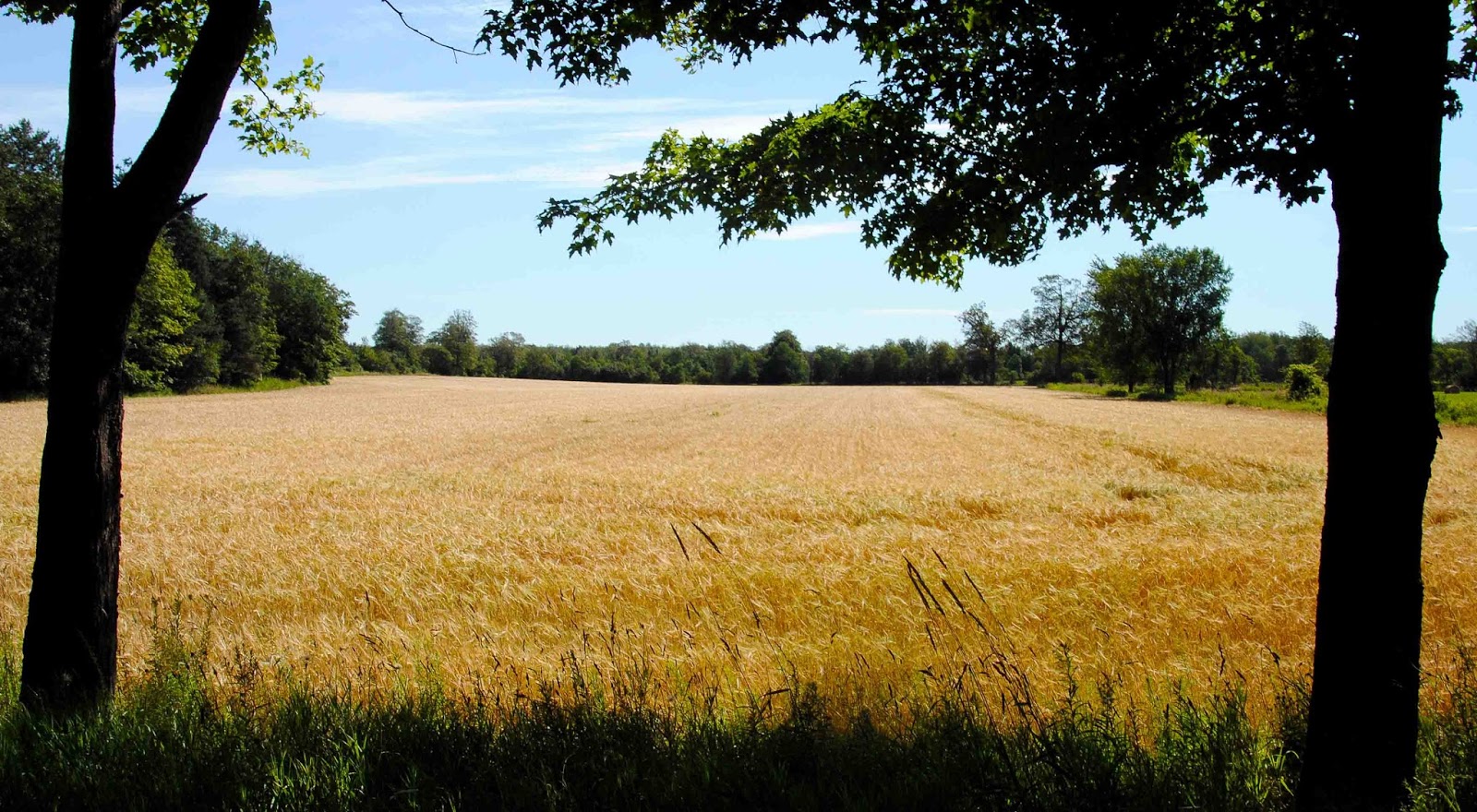
Much of the landscape around the Beaver Valley is farmland, and like much of southern Ontario is characterized by mixed farms - some cropland, some livestock, a lot of hayfields, and some pasture. Most of the hay is already harvested, and even a second cut is in on some of the dairy farms. But soon the other crops, at least the grain crops - wheat, barley, mixed grain and oats will start. It's a busy time of the year for farmers, and its always interesting to watch how the harvest is progressing.

Wheat fields will usually be the first harvested, here running in narrow rows to the back of the field. Most of this is probably winter wheat, that is it was planted late last fall and had the chance to germinate and grow a bit before winter, giving it a head start for this year. Wheat is after all, a cold climate crop, abundant all over the Canadian prairies, easily surviving our winter as a young grass. I actually had to hunt to find a nearby wheat field; the high price of corn has made it the crop of choice around here this year it seems.
Wheat, like oats and barley, is a grass, and it's the seeds that are actually harvested, used of course to make flour, and thus a mainstay of our diet. As you can see here, the seed heads of the wheat are clearly visible, with no 'awns' to speak of, unlike the barley plants, below.
Barley fields are looking ready for harvest too. Neither barley or oats are normally as popular crops in Ontario as wheat, which usually brings a better return, but around here barley seems to be very popular this year. It's used largely as livestock feed, but some of course is used in brewing! Canada actually ranks higher as a barley producer than as a wheat producer internationally, ranking #2 in 2006.
Barley fields have that beautiful wavy grain blowing in the wind. Unlike wheat, barley does have long 'awns', (long needle-like or hair-like projections from the seed head), which contribute to that wavy look of a barley field on a windy day.
Oats look quite different than wheat or barley, with the individual seeds spread out separately on the inflorescence of the plant. And fields of oats also tend to have a bluish-green colour, as here, at least until the grain ripens.
In this case barley and oats have been planted together, as 'mixed grain'. You can see the shorter barley stalks in this picture, below the oats, already ripening to a light golden brown.
And occasionally I see a field that is simply oats, again with that slight bluish green colour, and the same seed heads where each seed is visible individually. We grow fewer oats than barley, and nearly half of what we grow is used on-farm as livestock feed.
You can see there is no layer of barley stalks below these oats silhouetted against the sky. Traditionally oats have been a food crop for horses. I remember my parents talking of giving the family horse it's ration of oats.
Farming is a big part of our world around the valley;
check out other things around the world here: