The Red Prince (another new apple variety) is a great example of the new trends in apple production and marketing. Introduced only a few years ago, it is Ontario's first genuine winter apple. And I'm eating one as I write this.
The Red Prince was first discovered in an orchard in Germany. It is a naturally occurring cultivar of Yellow Delicious and Red Jonathan. It was named after the orchard owner, Mr. Princen, with a nod to the deep even red colour of the apple.
Irma and Marius Botden, who ran a tree nursery in Holland, immigrated to Canada in 2001. Before immigrating they negotiated the right to be the only growers of Red Prince in Canada, and they brought rootstock from their own nursery with them. This is the high density orchard they planted some years ago, the only source of Red Prince apples in Canada.
The orchard looks better in the early fall, with green leaves and apples. The high density rows and relatively small trees are much easier to harvest - with a return per acres double that of a conventional orchard, as I mentioned yesterday.
The straight narrow rows with access space in between allow for maximum reception of sunlight, which promotes the growth of apples. It also helps with the 75%n reduction in pesticide use.
We were reminded of this story when Mrs. F.G. bought a bag of apples a week or two ago. Looking up the 'Red Prince' on the internet provides quite a lot of detail. Unusually, this is the best apple for sales in the winter. Indeed, it is stored or 'cellared' (like a fine wine) and only available after Jnauary 1st (and only in Ontario).
It is a wonderful apple for eating, especially at this time of year. If you can find it in your local supermarket, I urge you try it. I think it's already become my new favourite.
Monday, March 11, 2019
Sunday, March 10, 2019
What's Old is New - Espaliered Apples
That demolished orchard we saw on our drive down the valley surprised me enough that I headed for the internet to see what I could learn. From recent publications by Ontario's Ministry of Agriculture and food I learned that apple farming is changing rapidly here in Ontario. On the one side production is shifting to high density orchards, and on the other hand consumer preferences are shifting to new varieties.
Ontario's apple production used to rely on older varieties like Northern Spy and Red Delicious. However in recent years the return from these varieties has ranged "from disappointing to disastrous". Consumers have shifted rapidly to new varieties like Honey Crisp (my favourite0 and Sweet 16.
If you could read the price tags you'd see Honey Crisp at $70.00 a bushel, and Spartan (an older variety) at only $31.00 a bushel. You might think Honey Crisp is an expensive apple (and you'd be right). But turn it around and see it from the farmer's point of view, there's an apple that will double my return. He'd be thinking of planting a few of those new trees sooner rather than later! And that's exactly what farmers are doing.
This is that field of downed apple trees that got me thinking about all this. Once you make the decision to renew your orchard, it's an easy step to plant at high densities.
Right across the road is this high density orchard, the first planted in the Thornbury area I believe. The down side is the cost. Planting 1000 trees per acre with all the associated fencing costs $10,000.00.
There other rising costs too, like labour. All orchards here depend on migrant workers, usually from Mexico, to do the harvesting and sometimes the pruning. These trailers provide acommodation on one farm near here.
Some orchards are now being planted at 2000 to 3000 per acre, unheard of densities until now. Why? The return from a high density orchard is about double the return from a traditional orchard. Here's where the 'espaliered apples come in. A trellis system of fencing will allow each individual tree to be tied up and grow vertically - a lot of work. Add deer-proof fencing around the outside and you're ready to harvest - after spending as much as $45,000.00 per acre.
So in the future I expect to see more and more orchards like this, including the demolished orchard across the road. And you'll be eating a range of tasty new varieties rather than the traditional ones.
Ontario's apple production used to rely on older varieties like Northern Spy and Red Delicious. However in recent years the return from these varieties has ranged "from disappointing to disastrous". Consumers have shifted rapidly to new varieties like Honey Crisp (my favourite0 and Sweet 16.
If you could read the price tags you'd see Honey Crisp at $70.00 a bushel, and Spartan (an older variety) at only $31.00 a bushel. You might think Honey Crisp is an expensive apple (and you'd be right). But turn it around and see it from the farmer's point of view, there's an apple that will double my return. He'd be thinking of planting a few of those new trees sooner rather than later! And that's exactly what farmers are doing.
This is that field of downed apple trees that got me thinking about all this. Once you make the decision to renew your orchard, it's an easy step to plant at high densities.
Right across the road is this high density orchard, the first planted in the Thornbury area I believe. The down side is the cost. Planting 1000 trees per acre with all the associated fencing costs $10,000.00.
There other rising costs too, like labour. All orchards here depend on migrant workers, usually from Mexico, to do the harvesting and sometimes the pruning. These trailers provide acommodation on one farm near here.
Some orchards are now being planted at 2000 to 3000 per acre, unheard of densities until now. Why? The return from a high density orchard is about double the return from a traditional orchard. Here's where the 'espaliered apples come in. A trellis system of fencing will allow each individual tree to be tied up and grow vertically - a lot of work. Add deer-proof fencing around the outside and you're ready to harvest - after spending as much as $45,000.00 per acre.
So in the future I expect to see more and more orchards like this, including the demolished orchard across the road. And you'll be eating a range of tasty new varieties rather than the traditional ones.
Saturday, March 9, 2019
Valley Drive Part II
We continue our drive down the valley with a few extra pictures thrown in for good.
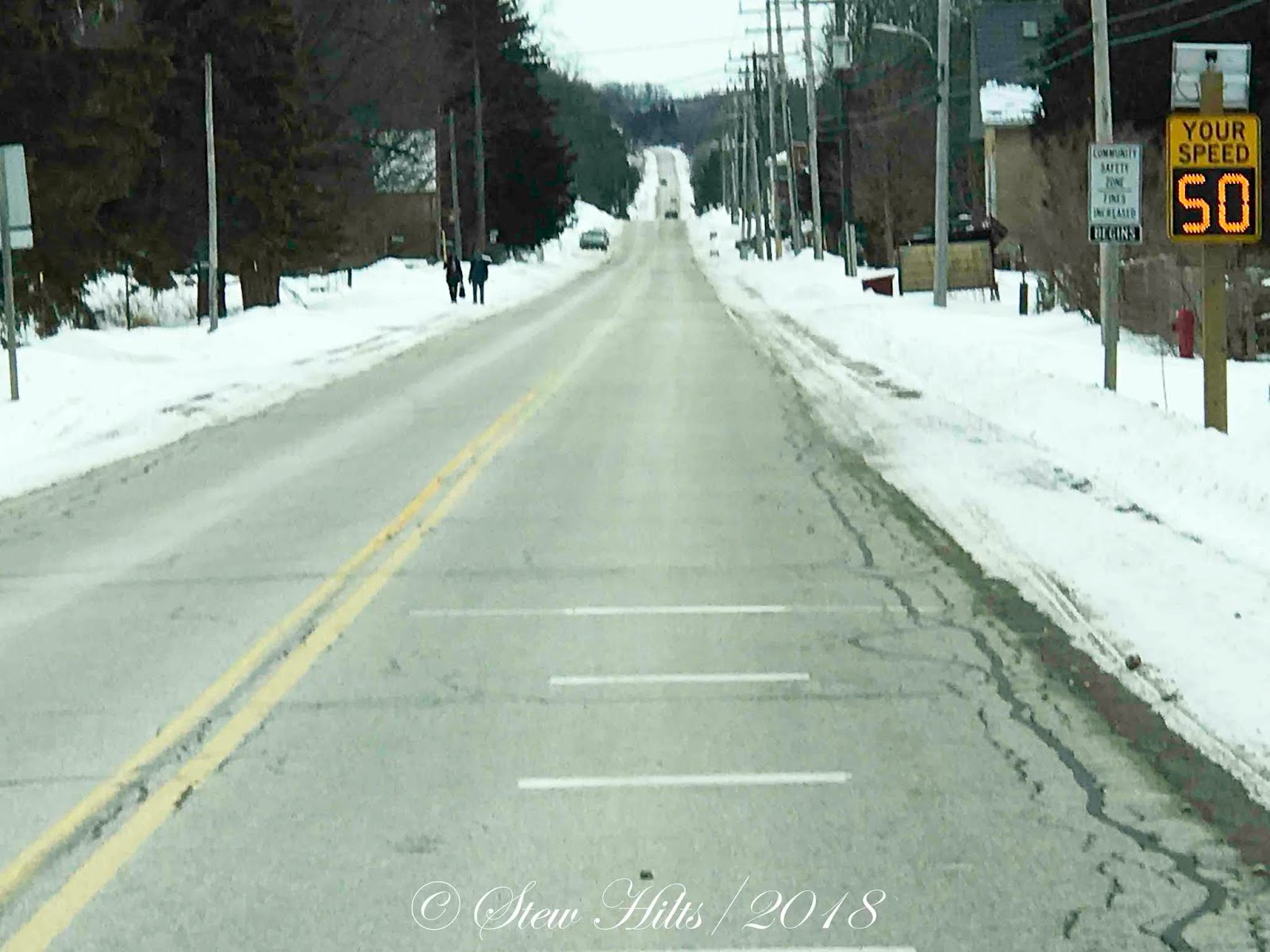
Continuing down the valley we came o the village of Kimberley, close to our former home, a spot I used to visit frequently. This villages has had trouble with traffic driving too fast, so they got permission to put up these speed limit camera/signs. Notice how I hit the village exactly at the speed limit!
Heading north again we passed by the Wodehouse Karst, a fascinating feature where Wodehouse Creek drops into several holes in the limestone, and comes out as a spring nearly a mile away. I was involved with others in creating an official Bruce Trail Side Trail here (notice the blue blaze below the white sign?)
Moreover we rescued this plaque which had grown rusty, had it refurbished and placed here where it will be noticed by anyone who stops for a hike. I was glad to see that the refurbished plaque had been installed!
Northward we headed on the 7th Line, getting this ten mile view up the road.
At the end of the road is the army's Ontario training ground, marked by a group of tanks at the entrance. But we didn't go that far today; we headed home for another butter tart instead. This photo was taken last fall.
Across the road is the first orchard in this are planted in this style. More on this orchard in a day or two.
We stopped briefly here to pick up those butter tarts.
Continuing down the valley we came o the village of Kimberley, close to our former home, a spot I used to visit frequently. This villages has had trouble with traffic driving too fast, so they got permission to put up these speed limit camera/signs. Notice how I hit the village exactly at the speed limit!
Heading north again we passed by the Wodehouse Karst, a fascinating feature where Wodehouse Creek drops into several holes in the limestone, and comes out as a spring nearly a mile away. I was involved with others in creating an official Bruce Trail Side Trail here (notice the blue blaze below the white sign?)
Moreover we rescued this plaque which had grown rusty, had it refurbished and placed here where it will be noticed by anyone who stops for a hike. I was glad to see that the refurbished plaque had been installed!
Northward we headed on the 7th Line, getting this ten mile view up the road.
At the end of the road is the army's Ontario training ground, marked by a group of tanks at the entrance. But we didn't go that far today; we headed home for another butter tart instead. This photo was taken last fall.
Thursday, March 7, 2019
Valley Drive
We haven't been getting out much, but we did get in a drive down the valley a couple of weeks ago. The highlight of such a drive is a stop at the Blackbird Pie Company in Heathcote. Today it was a half dozen Butter tarts that found its way back to the car.
The perfect nourishment for an afternoon drive!
We started by dropping down into the harbour in Thornbury, looking out over the bay. There hasn't been much blue in the water for some time now.
Looking east toward Blue Mountain you could see large ridges of ice build-up several feet high along the shore.
And there we spotted two children playing on the ice hummocks .... not very safe in my mind.
Driving south out of town through Clarksburg we were surprised to find one of the older orchards had been cut down. It's a bit of a shock when you see it like this.
But back behind the cut trees you can see new trees have already been planted in the new high density style of orchard. I expect the frnt field will be planted this way too.
More on our excursion tomorrow.
The perfect nourishment for an afternoon drive!
We started by dropping down into the harbour in Thornbury, looking out over the bay. There hasn't been much blue in the water for some time now.
Looking east toward Blue Mountain you could see large ridges of ice build-up several feet high along the shore.
And there we spotted two children playing on the ice hummocks .... not very safe in my mind.
Driving south out of town through Clarksburg we were surprised to find one of the older orchards had been cut down. It's a bit of a shock when you see it like this.
But back behind the cut trees you can see new trees have already been planted in the new high density style of orchard. I expect the frnt field will be planted this way too.
More on our excursion tomorrow.
Wednesday, March 6, 2019
Trapped in my Wheelchair ... in the Cold!
Today I had my first experience of being trapped in my wheelchair, unable to drive forward or backward, indeed unable to drive at all!
It all started because this wheelchair has a safety interlock switch between the tilt mechanism and the drive mechanism. I can tilt the chair way way back and take a snooze if I want (good to prevent skin sores). But beyond a certain gentle tilt, the safety interlock won't let me drive it while it's tilted. Makes sense to me.
So we were coming home from physio and I unloaded into the garage. At that point the interlock switch malfunctioned and wouldn't let me shift into drive mode at all! I could tilt, but I couldn't move!
It was cold in the garage, so Mrs. F.G. started bringing out blankets, extra coats, hats and gloves all to keep me warm (I think anticipating I would be there all night). I called the wheelchair dealer for advice and common sense kicked in. We called one of the neighbours, shifted into neutral, and between them he and Mrs. F.G. pushed me into the house. At least I was warm!
In a very timely coincidence, the wheelchair salesman was dropping by to pick up some paperwork, and he was able to figure it out. Adjust the safety mechanism, tighten a few bolts, and we're good to go again. Thank goodness!!
It all started because this wheelchair has a safety interlock switch between the tilt mechanism and the drive mechanism. I can tilt the chair way way back and take a snooze if I want (good to prevent skin sores). But beyond a certain gentle tilt, the safety interlock won't let me drive it while it's tilted. Makes sense to me.
So we were coming home from physio and I unloaded into the garage. At that point the interlock switch malfunctioned and wouldn't let me shift into drive mode at all! I could tilt, but I couldn't move!
It was cold in the garage, so Mrs. F.G. started bringing out blankets, extra coats, hats and gloves all to keep me warm (I think anticipating I would be there all night). I called the wheelchair dealer for advice and common sense kicked in. We called one of the neighbours, shifted into neutral, and between them he and Mrs. F.G. pushed me into the house. At least I was warm!
In a very timely coincidence, the wheelchair salesman was dropping by to pick up some paperwork, and he was able to figure it out. Adjust the safety mechanism, tighten a few bolts, and we're good to go again. Thank goodness!!
Sunday, March 3, 2019
Changing Ice on Georgian Bay
I've been fascinated by the movement of the changing ice on Georgian Bay. You might be under quite a misconception if you think ice simply freezes from the shoreline out. In fact, open water freezes, especially on calm nights, forming ice rafts. Then the wind blows these sheets of ice, large or small, together. Ice blows into the shoreline at Meaford (and everywhere else), and then it blows out. Only late in the season does it even approach complete.
Just a few days ago, open water on Georgian Bay with slushy ice along the shoreline. That's Christian Island, about 40 km. away, on the horizon. It occupies a tragic place in the story of the Huron First Nation here.
A few days later, a number of long narrow 'ice rafts' offshore, with a small ice ridge close at hand. Christian Island a mirage in the distance.
And continuous ice out into the bay from Meaford. This ice is still not 'solid', but made up of large rafts, so in places it might be quite unsafe. There's more to say, but I've got to get this computer working properly first.
Just a few days ago, open water on Georgian Bay with slushy ice along the shoreline. That's Christian Island, about 40 km. away, on the horizon. It occupies a tragic place in the story of the Huron First Nation here.
A few days later, a number of long narrow 'ice rafts' offshore, with a small ice ridge close at hand. Christian Island a mirage in the distance.
And continuous ice out into the bay from Meaford. This ice is still not 'solid', but made up of large rafts, so in places it might be quite unsafe. There's more to say, but I've got to get this computer working properly first.
Saturday, March 2, 2019
Start ............Stop
Had my post nearly ready, pressed the Start button instead of the Ctrl button and it all disappeared, even the web browser. I'll try again tomorrow.
Subscribe to:
Posts (Atom)