Tuesday, July 9, 2013

Two More Butterflies and a Moth

Sorry these images aren't perfectly clear, but they're the best of dozens, even though I thought I was doing well at the time.  But they are all totally new to me.  I've never been aware of seeing a hairstreak butterfly of any kind, so seeing two different ones was great. The moth itself was tiny, perhaps 2 cm across, but beautiful up close.

 
The moth, totally white, and only about half the size of a cabbage white butterfly, is a Northern Eudeilinia Moth based on what I could find, with a fine white fringe along the outer edges of its wings.

This first butterfly is a striped hairstreak.  The hairstreaks all have the remarkable coloured area and most have tiny 'tails' on the back end of their wings.  This one is noted for the blue spot capped by an orange spot, and the wide darker brown bands bordered in white on the rest of the wings.

And this one is the only hairstreak without one of the tiny 'tails', the coral hairstreak, noted for the curved line of orange spots as well.  This makes 3 moth and 9 butterfly species so far this season, though not all got captured in a decent photo!  Remarkably, these two butterflies are taken while feeding on the valerian, just as all five species shown in Saturday's post were!  Good plant for butterflies!


Monday, July 8, 2013

Learning Grasses

I've always been intrigued with the huge number of different grasses, but unable to sort them out.  The past few weeks I've been collecting some pictures of grasses in flower in our own meadow, in the hopes of starting to learn to identify them.  And the tiny flowers are themselves fascinating.

I think this may be smooth brome grass.  In this picture you can see both thestigma (the tiny white feather-like parts), and the anthers (the brown parts), hanging on a thin filament.  If I have the terminology right, the anther and filament make up the stamen.

This is what the entire upper part of the plant, or what botanists call the 'inflorescence' looked like, quite large and full of flowers on this day.  Getting grasses to stop blowing in the wind is the biggest challenge in photographing them!

A very similar grass, perhaps another brome grass, was this one, except that it had bright yellow anthers.  This picture shows two 'flowers', covered with outer bracts or 'glumes', with the anthers poking out from them. 

The inflorescence was similar to the first one above, large and spread out when mature - and again blowing in the wind.  Several blurry shots were discarded in favour of this one.  I believe that both of these are brome grasses, but I haven't been able to find any information about the different in colour of the anthers.

Timothy is probably the easiest grass to identify, a dense inflorescence that does not spread out from the stem at all.  Who hasn't pulled a stem of timothy to chew on?  Here it's in flower, covered with tiny slightly yellow florets.

Another fairly easy one is orchard grass, with a dense and heavy inflorescence that separates somewhat into several chunks of flowers, here also in bloom with light brown florets.

Another smaller grass had paler yellow florets.  Here both the white feather-like stigmas and the light yellow stamens are visible.  I think this may be meadow brome grass.

 The inflorescence of this grass was fine and spread out, but fairly small, not nearly as large as the first two above, and shorter overall.

A final grass was this one with an inflorescence that has separate flowers, but they do not separate themselves from the stem at all, remaining tightly clinging to it..  It matches a description of tall fescue.

Anyone who can direct me to correct names, on-line identification sites, or guide books that will aplly to southern Ontario and will help me move ahead, please comment!  I'm posting this to 'Macro Monday2'.

Sunday, July 7, 2013

Flowers in the Meadow

Some would call them all just 'weeds', but the wildflowers in the meadow are spectacular at the moment.  Yellow of the trefoil, cinquefoil and brown-eyed susans seems to predominate, but there are a lot of flashes of purple from the vetch and the viper's bugloss, along with white and pink.  It's just a jungle of grasses, weeds, and sparkling bright flowers.

The brown-eyed susans are just beginning; we'll have a large bright patch where I threw in some prairie seed mixture about 5 or 6 years ago.  They took 3 years to get started, but now they're spectacular.

It's impossible to capture the vision my eyes see, but here's my best shot so far.  I know I will go on experimenting with meadow shots to try and capture an image of the flowered landscape..

There's the light pale yellow of the cinquefoil, scattered here and there, fairly sparse compared to the others.

There's the bright deep yellow of the trefoil, widely escaped from pasture and hay mixtures, commonly lining roadsides at this time of year. It seems to be everywhere.

There's little point in trying to get pictures of the vetch without a European skipper or two; they're everywhere - these two locked in coital bliss.

There are three skippers visiting this viper's bugloss, one of the most unusual weedy plants in my mind.  Close-up it's beautiful, and it's one of the few true blue flowers, in places lining roadsides instead of the trefoil.

Put these together with the mallow, and at time it's just a jungle of foliage and colour, again with a visiting skipper or two fluttering through the picture..  

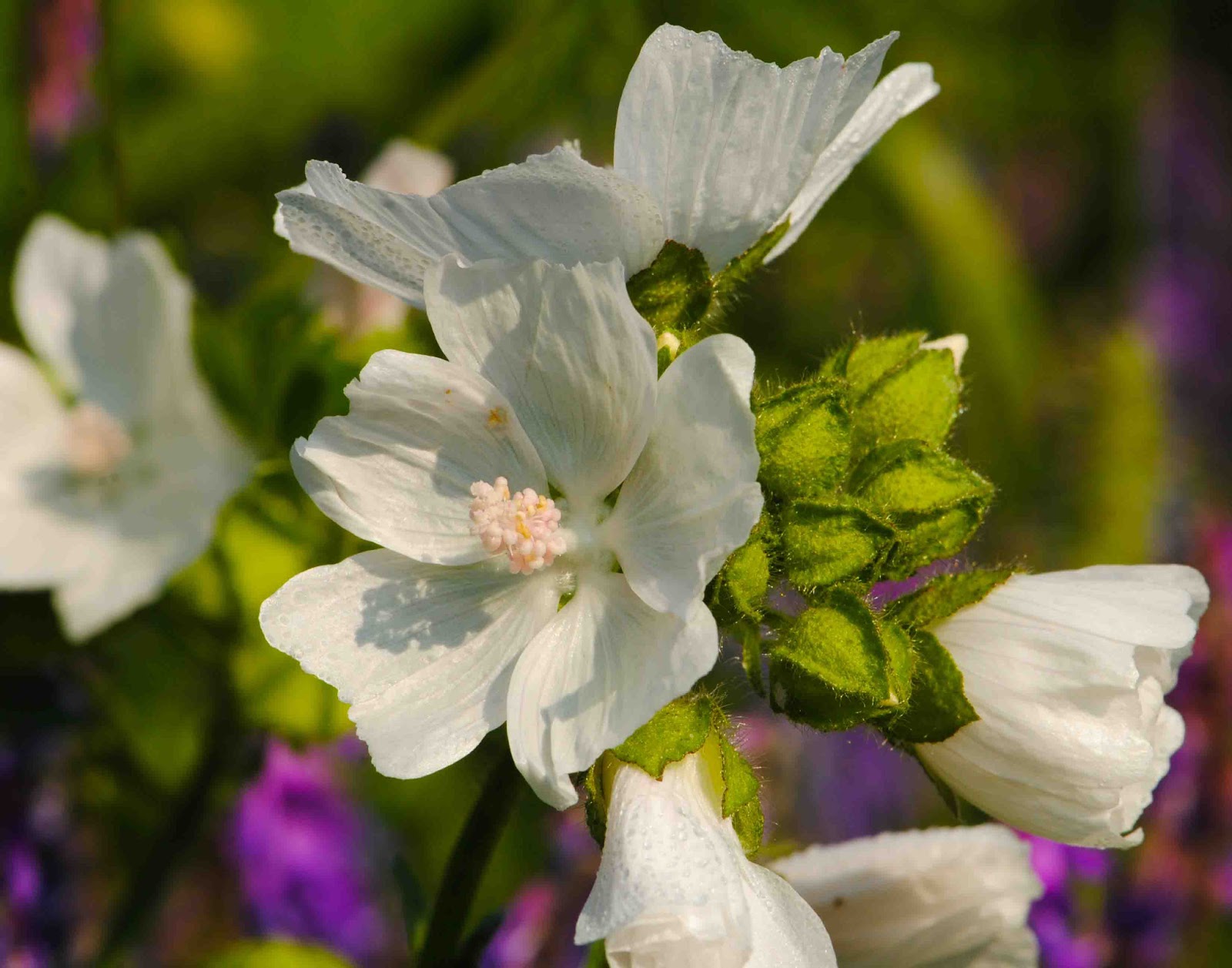
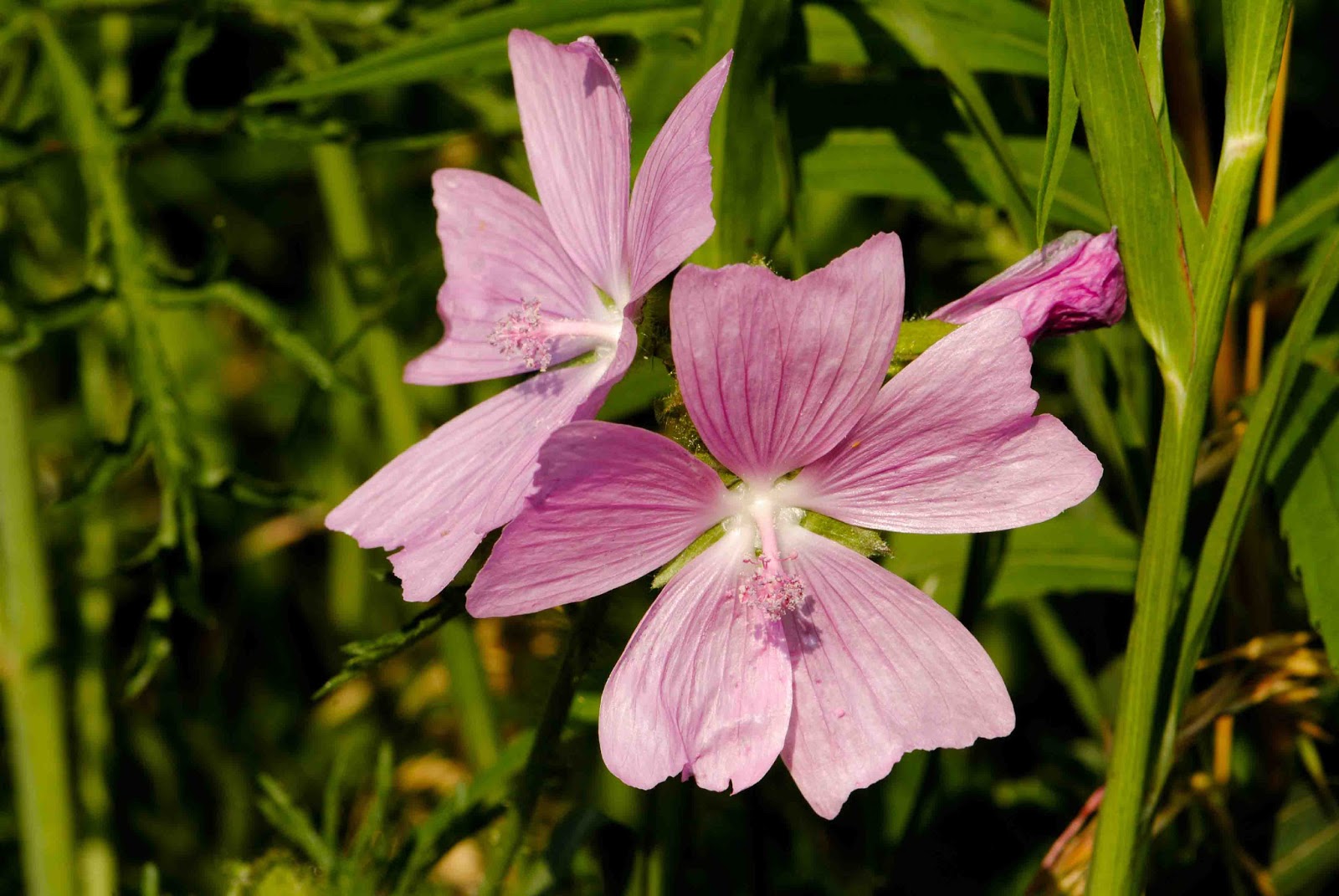
The musk mallow comes in both white and pink in our area; scattered blooms colour the meadow, the roadside and the ditches.

I'm linking this post to 'Today's Flowers'.

Saturday, July 6, 2013

Butterflies Galore!

The past few days the meadow has just been overflowing with tiny butterflies, especially little orange-brown skippers.  They rise in clouds when I walk, especially around the patches of trefoil, vetch and (in the garden) valerian.  I can't get over how many there are, probably thousands on our 2 acres alone.

This is the usual view of the skipper, its wings folded, light reddish brown, only about a cm in size, fluttering from flower to flower, often with 3 or 4 on one plant.

Occasionally you catch a closer look, and realize that sometimes they hold their two wings at separate angles.  I honestly don't know which skipper it is.  Checking the online guides I could make it a delaware skipper or a least skipper, but I suspect it's just a European skipper, which to quote one site 'has become unbelievably abundant' throughout eastern Canada and the U.S., especially in grassy habitats.  That describes our meadow.

There are almost as many Northern Crescents, a slightly bigger butterfly that also loves the valerian in the garden.  I often see three or four at once hovering around a single patch of flowers.  The wing pattern on these is quite distinctive.

I also spotted one Painted Lady, though this one looked like a rather tired, faded and tattered specimen.  In all of these trying to get a clear photo has been almost impossible.  I have taken dozens of each, only to get one or two that are passingly clear.

This heavily cropped image is of a moth I've never seen before, an Eight-spotted Forester, with a very distinctive black and white pattern, with some yellow on the forelegs.

And finally this is a Virginia Ctenuchid Moth, with a very distinctive yellow-orange head, and a blue patch behind this.  both of these moth species fly during the day.  The latter was fluttering around the valerian with the Skippers and Northern Crescents.

I just realized that by coincidence all five of these photos were taken on the valerian flowers in our garden.  Valerian in your garden turns out to be great for attracting butterflies and moths, as well as being very fragrant.

Friday, July 5, 2013

Rural Fences

A big part of the landscape here, originally a farming landscape but now much more varied with regrowing forest and rural non-farm homes, is the fences.  There are new fences, old fences, rebuilt fences and falling down fences, functional fences and ornamental fences.  We take them for granted, but driving around they're actually a big part of what you see out there.


You can't drive to see the first one, above.  This is an old genuine snake cedar rail fence, probably one of the originals, built without fence posts, by criss-crossing the rails in a zig-zag pattern.  As you can see, it's probably pretty old, because it implies the land on both sides was a field - today it's fairly mature sugar maple forest.  Although there are thousands and thousands of old cedar rails lying on the ground out there where fences used to be, it's actually quite hard to find a fence like this still in place - though now serving no purpose other than being a bit of history.


Much more common are old cedar rail fences that have been rebuilt, often with pairs of vertical rails used as fence posts, and the rails wired in place in between them.  And often starting to fall down where they're not maintained, like this, but still an attractive part of the rural landscape.
 

Next come the nicely rebuilt and maintained cedar rail fences, usually used for landscaping around rural homes.  We have a short stretch of fence ourselves, just because it looks nice.  Rails themselves are getting valuable; gathered up from old field edges where they're lying on the ground, they'll bring $3.00 each now.  I even saw one fence recently that was made of NEW cedar rails - that means they cut the trees and split the rails, a skill almost universally long lost.


Most more recent fences are the standard fencepost and page wire or barbed wire.  This one is a combination, and seems to be kept up by just adding fenceposts every 2-3 feet.  I expect some of the posts aren't even sunk in the ground, but just replace the verticals of normal page wire fencing.


And finally there are the fences on horse farms.  These are almost always the nicest and best maintained fences, designed with boards, or at least one wide band at the top, to make sure that running horses see the fence and don't injure themselves on the wires.

Next time perhaps I'll dig out some of the old stone fence pictures.

 Linking to Friday Fences here:

Tuesday, July 2, 2013

Canada Day Fireworks!

We went to the big Canada Day fireworks celebration in Priceville last night, the event of the day for this region, and it was great as usual.  Loud and crowded!  Here's a selection of my successful shots; a lot weren't!


For anyone interested, these were taken on a tripod, shutter on manual, aperture about f8, manual focus adjusted before it got dark, and exposed for 4-8 seconds on the bulb setting, just by holding the shutter down.

Happy Canada Day everyone!                       Linking to the Great Canadian Blog Bash.

Monday, July 1, 2013

Macro Shots in the Garden

In honour of Canada Day, here are a few of my favourite close-ups in the garden from the past two months.  I've only had a macro lens for 6 weeks, but it's opened up a whole new world of looking around me and appreciating what we have here.  From the garden to the valley to the country, we're glad we live here!


A beautiful white and purple Cornflower or Bachelor's Buttons, an early spring flower.


One of several tiny Primula that also bloom in early spring in our garden.


My favourite bright red Dianthus or pink in the scree garden.


A bright pink Transcanthia or spiderwort.


A bright pink Monarda, also known as bee balm or bergamot.

Full credit goes to the Chief Horticulturalist here, who I turned to to find out what each of these was officially called.  I'm linking them to Macro Monday and Today's Flowers.  In any case, when you look more closely at these, thanks to my camera, you just see the beauty even more.

And tonight we're heading for the huge Priceville fireworks display nearby.  I'm going to try some fireworks photos for Canada Day.