Wednesday, February 19, 2014

Birds in the Campground

I am continually amazed at the great bird pictures I see on a number of other blogs.  I'm NOT a bird photographer, but a few birds seemed to be all around us when we were camped in Kentucky, so I did get some pictures that are pretty good for me.  So with apologies to those of you who are good bird photographers, here they are.

The Tufted Titmouse is quite rare in southern Ontario.  I have only seen one before in my life, at our own feeder.  They just don't come this far north often.

We have lots of Mourning Doves, but this one sat still quite close for me.

We also don't get Red-headed Woodpeckers often, though I've seen one a couple of times before.

This Killdeer was exploring a puddle outside a quilting outlet on a farm.  I explored outside while my wife was checking out the fabric! In our area their loud 'killdeeeer' song is one of the early signs of spring.

I also saw this Barn Swallow, which I've only seen of a few occasions here in Ontario, on that farm.

And this pair of Cardinals was sitting in the tree above our campsite near Kentucky Lake.  I didn't even notice the female when I was taking the picture.  We get lots of cardinals in Ontario, but not at our feeder, which seems to be too open for them.  They like some evergreens nearby.


Monday, February 17, 2014

The Fighting Bluebird

We left the Smokies and moved on west across Tennessee and Kentucky all the way to Paducah, nearly on the Mississippi.  There we camped on the west shore of Kentucky Lake, and for 3 days we watched a bluebird fighting its reflection in the neighbouring camper's window!

The trailers were close together, and the neighbours, who apparently only came on weekends, had left chairs outside.  The bluebird sat there - until it saw its reflection!

 Once it saw the other bluebird, it obviously started defending its territory.

 
Repeatedly it jumped up against the window, but had no luck driving away the reflection.  It just stayed there, and we watched it for some time repeat this performance.

 Once or twice it stopped on our car too, finding another bluebird in that window!

But I did manage one natural shot of the bluebird.  This was the best bluebird watching we've ever enjoyed, and right outside our camper.  When they visit here in the summer they tend to be fairly secretive, because they're busy nesting and raising young.

Sunday, February 16, 2014

Flowering Dogwood

The many Flowering Dogwoods in bloom were a big highlight of our trip to the Great Smokies. Flowering Dogwood (Cornus florida) barely makes it into Ontario, where it's considered an Endangered Species, and doesn't survive at all where we live.

Here in Canada you can only see it in a few locations along the north side of Lake Erie, in the so-called 'Carolinian Zone'.  So to see it in bloom here there and everywhere through the Smokies was a real treat, and we were there just at the right time.

I'll always associate it with our drive through Cades Cove, where there seemed to be another dogwood at every corner.  And on a bright sunny day it stood out against the early green leaves of the forest beautifully.

The dogwood grows as a small tree, often it seemed to me on the edge of the woods or a clearing.  It's shape suggests branches reaching out almost like a series of flat shelves and it's often as wide as it is tall.

The blooms are striking against the blue sky, and have such a different look when viewed from underneath.

But the blooms are deceiving - the flowers are only the tiny yellow clusters in the centre of these blooms.  The white 'petals' are actually bracts that surround the flower cluster, but they're what makes the dogwood so attractive in the spring. 

And right near downtown Gatlinburg we saw several pink dogwoods, a strikingly coloured horticultural variety.

The dogwoods in bloom will always be part of our memories of the Great Smokies.  Those of you who live in Tenessee and nearby don't know how lucky you are!

Linking to:
http://mylittlehomeandgarden.blogspot.ca/

Saturday, February 15, 2014

Combat Photography!

On our last evening in the Great Smokies, my wife suggested that we drive back up to a lookout which had been described as good for sunset pictures.  We headed back up the road over the mountains, and near the top found the lookout.

We were lucky.  The sun was shining, but there were also clouds, so as the evening wore on we did get a spectacular sunset.  I was using my zoom lens, so some pictures were telephoto while others showed the whole valley.  This one was a closer look at the peak of the colour.

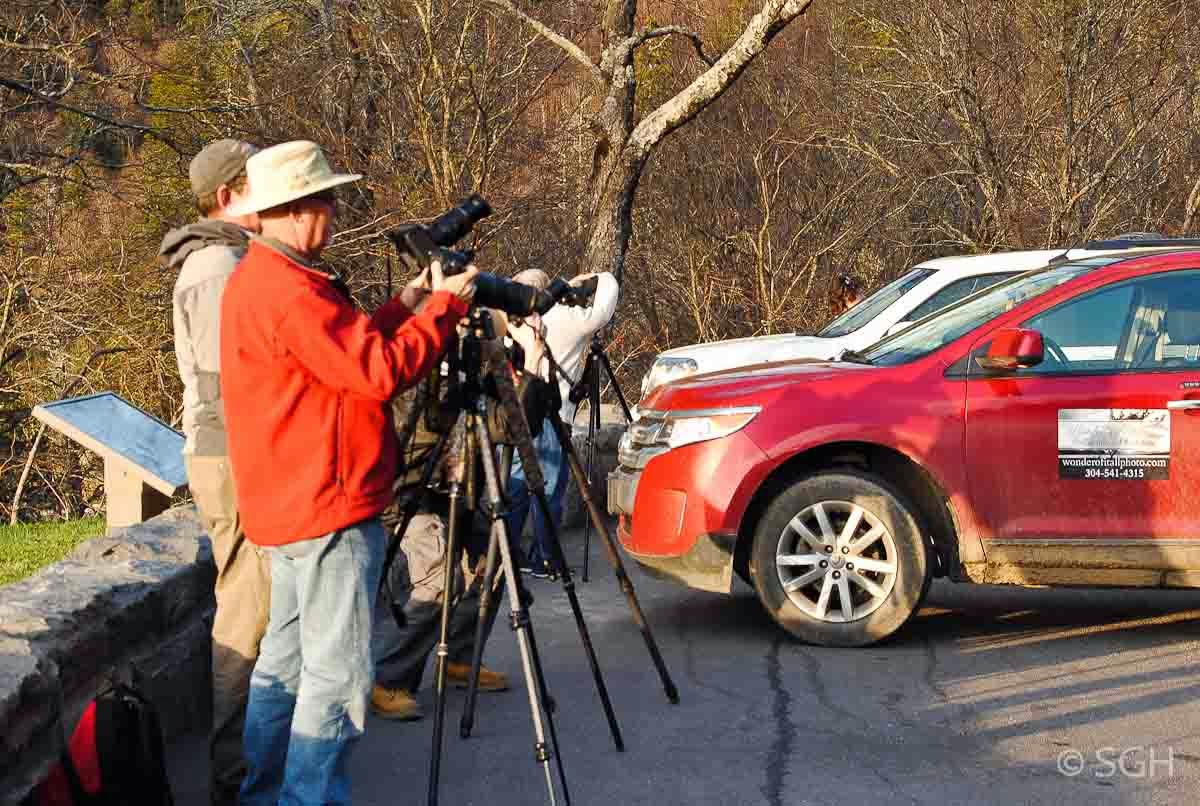
The colour in the sky hadn't even begun when we got there, and already five other photographers were lined up with their tripods and cameras, some with suitcases of lenses in their car!  This shot shows the whole valley, with the overlapping ridges down the valley that give that characteristic distant look to the mountains.

On the other hand, this photo is zooming in on the trees silhouetted on a mountain slope in the foreground.

As time passed, some other little wispy clouds drifted in, making the scene a little more varied, and as the sun headed down behind that mountain slope, the smaller clouds showed up in pink.  Over the evening, the colours changed from a light orangey-pink to a deep orange-red.

I shot the first half of these in aperture mode, just watching what the camera was telling me, and allowing for longer and longer shots, with the camera on my simple little tripod.  But at some point as the aperture setting reached its maximum, the pictures became too dark.  I just naively turned the camera to manual mode and kept on shooting, judging the exposure by trial and error - something easy to do with digital cameras! My first use of manual setting with a digital camera, and quite successful; it's not as hard as I thought.

I really like this shot, a sunset with no sun in the picture, shot fairly late in the hour and a half we were there.  I was exposing these for 2-3 seconds by this time.

Eventually the sun set and the sky started to darken.  Twenty-five photographers started packing up their cameras and heading home.  It had been a totally unexpected but fun evening for us, my wife waiting patiently while I took 100+ sunset pictures.

These are some of the photographers who were there when we arrived, getting set up.  By the time the real sunset arrived we were lined up shoulder to shoulder, and had to move aside to let passing tourists who just stopped for a quick picture get their turn!  My first experience of combat photography, but I survived.

A little late, but still linking to:
http://skyley.blogspot.ca/

Friday, February 14, 2014

Cades Cove

The most interesting drive we did in the Great Smokies was the one-way loop road through Cades Cove.  This is a beautiful flat-bottomed valley that was settled in the early 1800's, and today provides a number of interesting old buildings and homesteads you can visit.  It really was a tranquil and scenic valley in the mountains.

This short drive illustrated to me how the park was developed from land that had already been settled or logged for the most part.  Land was finally acquired in the 1930's, mostly from forestry companies to enable the park to go ahead.  But this valley features the early farming settlement.

Each homestead had been restored to some extent, and provided information on who the actual settlers were.  It was fascinating for me to see the variety of log construction used in most of the homes and barns - part of our house is a modern log cabin, which we built ourselves 'with some help from my friends'.

There were more homesteads than we could take time to stop at; you would really have to allow a full day to see all the sights.

This is a second cabin, here framed by two large tulip trees.  We hardly ever get tulip trees in southern Ontario; they're considered southern 'Carolinian' species here. I could have spent a lot more time exploring the forest itself.

There were 3 churches, which provided more insight to life here than anything else.  All were well worth stopping to see.  As you can see we were there on a beautiful sunny day, about the 3rd week of April.

And some of the graves illustrated just how tough life was in those years.  This stone marked the burial of 3 Hill family children - two presumably died at birth; one lived 6 and a bit months.  Not an easy life!  We found several such graves in just this one cemetery.


Wednesday, February 12, 2014

Clingman's Dome

The high point of our days in the Great Smokies (literally) was our walk up to the highest point in the park, Clingman's Dome.  We headed up the road that rose steadily south, starting to switchback once we got to the steeper valleys.

This was an early viewpoint where I started to learn about the wide range of forest types in the park, and in the Appalachians more generally, with different forest types occupying different elevations on the mountain slopes.  You may be able to pick out a tiny spot of white hoarfrost on the distant highest peak.

By the time we got near the top the forest was very different to that in the valleys, a complete switch from deciduous trees like tulip to evergreens and some stunted oaks, along with 'bald' patches.  This viewpoint looks south from the top, down the highway in North Carolina that had been closed due to a landslide.

The final walk to the peak is an easy climb up a wide paved trail that must get very busy at times.  We were astonished to find this lookout tower at the top, to give you a view out over the trees.  Quite a structure!

And the view was indeed spectacular, out over those mountains that give the 'Smokies', and the 'Blue Ridge' further east, their names.

And there was plenty of very heavy hoarfrost at this elevation, over 6000 feet.  We had a perfect bright sunny day too, if cold, so this was certainly a memorable day from our travels for us.

And this is one of our favourite pictures, looking over the increasingly blue ridges of the Great Smoky Mountains in the distance.


Tuesday, February 11, 2014

Great Smokies

After our drive down the Blue Ridge Parkway, we arrived at the Great Smoky Mountains National Park, and had a wonderful 3 days exploring it.  The park itself was fascinating; Gatlinburg at the entry point was a shock!  But we just ignored it and enjoyed the park.

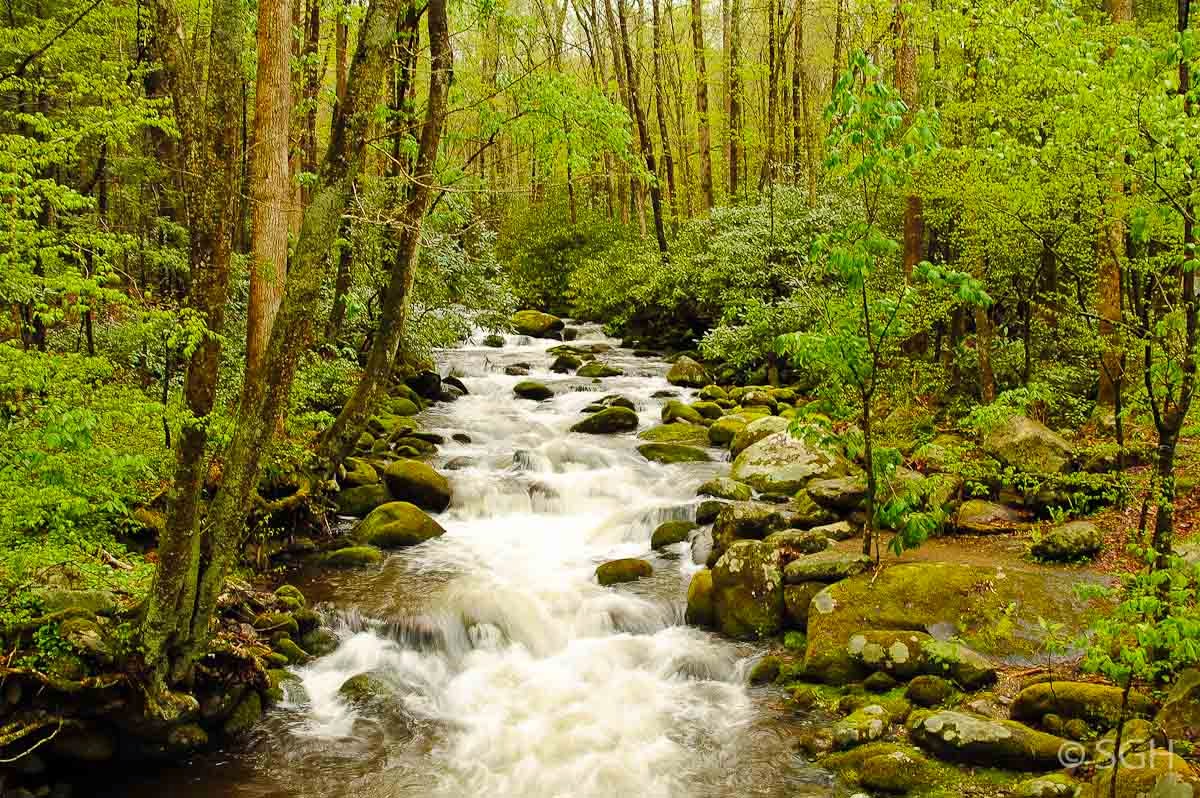
The first afternoon it was raining gently, half-way between heavy mist and drizzle, so we chose to drive the scenic road through the forest at Roaring Fork.  The one-way road just follows along this creek as it tumbles down the valley out of the hills.

With the rain, everything was richly green and moist.  I think it made for much better colours than if it had been sunny.  I kept stopping to take pictures of yet another nice view of the stream.


I wasn't very surprised to see the evidence of former settlement here, restored cabins that you can stop and visit.  This is second growth tulip tree forest, bought for the park in the 1930's.  There's an interesting story with each of these old farms.


Roaring Fork got larger and larger as we went downstream, and soon we found a tiny mill, also restored for visitors.  The wooden millrace captures enough of the stream's water to turn a wheel in the small mill.  Very interesting technology, as we have old mills here too, but nothing similar to this.


We ended up really enjoying our drive in the misty rain, and I think got some terrific pictures.

I'm linking to 'Our World Tuesday', but check out 
the past several posts so that you realize this isn't my world at all, 
but a holiday we took in the U.S.A. last April.
http://ourworldtuesdaymeme.blogspot.ca/