Wednesday, August 13, 2014

Summer Crops

By mid-summer, crops are maturing and dominating much of the landscape around the valley, except for all the woodlots and slopes too steep for farming.  Corn, wheat, soybeans and barley are our main crops here by acreage, along with hay, and all of them are looking good this year.  A huge part of what you see in mid-summer is fields of these crops.

This is the wheat field I posted a picture of yesterday; it's now been harvested, and the bales of straw left ready for gathering while the grain has probably been shipped off to a feed mill for export.

Barley is very similar to wheat; both are grasses which get combined, providing grain and straw.  What I like about barley is the 'feathery' look of the fields, especially when there's a breeze and the crop is waving in the wind.

Another field of barley, still somewhat green, but mostly turning golden yellow.

A friend asked me what was the difference between wheat and barley the other day as we drove home from canoeing, and I was reminded that some people may not know.  So this is a close look at wheat; you can see the individual grains, and the short spikes or 'awns' which are typical of all grasses.

On the other hand, this is barley, not quite so golden brown, and with awns or spikes that are much longer.  These are what give a field of barley its wavy appearance.  Barley is a northern crop, and Canada is the world's 2nd largest producer.

And here come the soybeans, growing well and looking a rich green at this stage.

Soybeans are not a grain, but are related to mustard, brussels sprouts and other plants.  They look very much like the beans in your garden at first glance.  Later in the fall they'll turn yellow, and then the oil seeds get harvested - like tiny beans.

 
More and more acres have been planted to corn around here the past 2-3 years, as the price has risen, so we see lots of fields like this.

And as the corn, another grain like wheat and barley (but a much bigger plant) matures, it tassles, those brownish spikes at the top that are the 'flowers' of the corn, turning the surface of the corn fields brown.

Someone also asked me recently what is the difference between hay and straw.  Hay is usually a mixture of grasses (and sometimes plants like clover or alfalfa), that is harvested whole, by being baled - usually into large round bales here.  It's used for animal feed, and still contains all the seeds of the plants, which are actually what provides the protein for the animals that eat it.

Straw is the leftover stalks of the wheat and barley plants when the grain has been removed by the combine, so it's baled (often in large rectangular bales, but in large round bales in the first picture above) separately, and has no seeds in it.  It's usually used for bedding for livestock, and only as a last resort for feed, if not being just left on the field.  A lot is shipped to horse farms which usually don't grow crops like wheat, but do need the straw for bedding.

And if you're buying some for mulch, you definitely want straw, not hay! 

A 'combine' by the way, in a large bit of farm machinery that 'combines' the operation of cutting these crops and separating the grain from the leftover straw.

Tuesday, August 12, 2014

The Seasons Roll On

The change of seasons in mid-summer is a subtle one, much more subtle than the rapid spring melt in April, or the first snow in late fall.  But change it does, and as this blog claims to document the seasons, I try to notice when patterns of change come together.  Over the past two weeks several changes have occurred that force me to admit that late summer has arrived.

One of the first signs summer is passing the mid-point is the hay harvest, mostly for feeding beef cattle; dairy farms cut their hay nearly two months ago, and are now into a second cut.

And here at home our own harvest occurs in early August, the garlic.  The Head Gardener grows something like 22 varieties of excellent garlic, and for two weeks both the garage and shed are filled with garlic laid out to dry.

Elsewhere in the garden, there is still lots of colour, but the Brown-Eyed Susans always seem to mark the beginning of late summer to me.  All the other bright flowers have been in bloom, now the daylilies are winding down, but the bright Brown-Eyed Susans will now last for weeks.

Away from the garden it's the goldenrod that starts turning the meadow yellow.  We have a lot of it out back.

On farms around the valley, the wheat is ready for harvest.  As you drive around, the golden fields of wheat are perhaps the most obvious sign of mid-summer in the landscape.  Haying is pretty well finished, while corn and soybeans are still green, but wheat is ready for the combine - today this field has already been harvested.

We also have a lot of cooler nights and mornings, often with heavy dew.  These tamarack needles were showing off the dew in the morning sun just a few days ago.

And of course, though I hate to mention it, the early leaves start turning.  This is Virginia Creeper, most of which will end up bright red.  It's only a few shrubs turning colour yet, but it's a taste of things to come.

So 'summer' is over, and 'late summer' has arrived in my mind.  Tomorrow I'll share some info about all the crops you see driving around the valley.

Linking to:
http://asoutherndaydreamer.blogspot.ca/search/label/Outdoor%20Wednesday


Sunday, August 10, 2014

Black History Memorial, Owen Sound

After finding the potholes and having our picnic lunch at Inglis Falls, we headed downstream into Owen Sound to Harrison Park, in my mind one of the nicest municipal parks in Ontario.  And one of our most interesting and memorable historic monuments is found along the banks of the Sydenham River in the park.

This is the Black History Cairn in Harrison Park, every element of it symbolic of the Underground Railroad and the route to freedom it offered to black slaves, and specifically the black community in Owen Sound, which is considered the northern terminus of the 'Underground Railroad'.

Quilts are said to have been an important means of communication along the route followed by slaves.  Hung over fences, or on clotheslines, the different patterns held different messages, directing slaves to safe houses or safe routes.  They're a key feature of the cairn.

The 'church' windows are symbolic of the local community and the importance of the church in their lives.  As well this monument includes a number of boulders in the walls that were sent from U.S. States or Ontario places along the route.  Note the tiny black labels on some of the rocks above.

The upper of these boulders came from the City of St. Catherines, Ontario, on the route around the east end of Lake Erie, while the lower boulder came from the State of Delaware.

 This rock came from the State of Maryland.

 
The cairn sits along the banks of the Sydenham River in Owen Sound, where the black community holds its annual Emancipation Festival, this year on Aug. 2nd.  Believe it or not, this was the 152nd annual picnic!

Looking upstream in the direction of Inglis Falls.  There are several other sites associated with early black settlers in the 'Queen's Bush', including some near the Beaver Valley.  I think I need to explore them a little and tell you about them too.
Linking to:
http://ourworldtuesdaymeme.blogspot.ca/

Friday, August 8, 2014

Inglis Falls Potholes

Our special destination for this visit to Inglis Falls was the potholes, which no-one but myself had ever seen.  Our son-in-law was particularly astounded by these round holes in the solid limestone bedrock.  And the walk was just a short one.

This is right on top of the Niagara Escarpment, so the limestone bedrock is right at the surface, with lots of roots crawling around until they can find a crevice to burrow down into.

We quickly found the potholes, with the interpretive sign. 

This pothole was about 4 feet across, and 18" deep in the bedrock.  Remarkably round, isn't it!  There were close to a dozen other potholes, either complete circles or partial circles, as large as nearly 10 feet across.
 
Maidenhair Fern growing on the vertical rock wall of a pothole.  They survive with roots in the tiniest crevices you can imagine.

The sign had a good explanation of how these were formed in the post-glacial period, by smaller rocks wearing deep holes in softer parts of the bedrock.  This means of course that there was a major river flowing here, much larger than today's Sydenham River which forms the falls.

As well as potholes, there were narrow crevices in the limestone here, so you had to be careful walking.  Of course for a four-year old these provided a perfect obstacle for jumping over.

There were patches of Liverwort in the crevices as well, growing in the cooler and damper than normal habitat.

And a few of the rare Hart's Tongue Fern.  You can find quite a bit of this rare fern in the woods here, as well as in the gorge below the falls.

As we left, we spotted an old root cellar with an intact roof which I had never seen before.  Our daughter looked inside, up through a round ventilation hole, and spotted this neat spiderweb.  Not quite in focus, but neat never-the-less.

Hope you all have a great weekend.

Thursday, August 7, 2014

Visiting Inglis Falls

Last weekend was a holiday weekend in Canada, and our daughter, her husband and our grandson came to visit.  He's four, and a never-ending bundle of energy and mischief!  One day we headed up to Owen Sound to visit Inglis Falls.  Our destination was the 'potholes', but first of course we had to look around the falls itself.

I've posted pictures of Inglis Falls more than once before - last winter when it was completely frozen over, and last November, when the river was flowing high after a lot of rain.  In comparison, this is normal mid-summer flow.

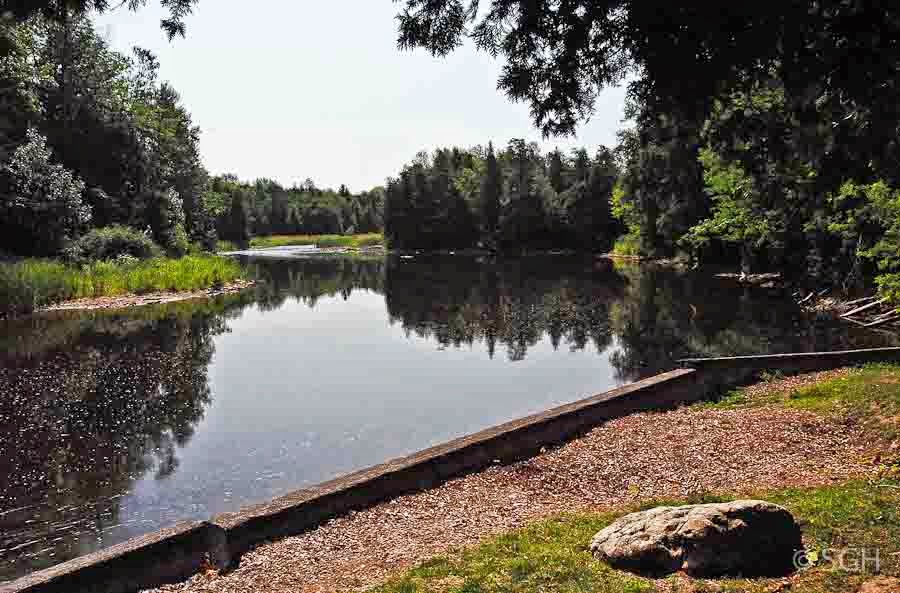
We parked beside the old mill pond, which offered some beautiful reflections.  And the parking lot was full, with lots of visitors including other besides ourselves having a picnic lunch.

The pothole trail was the other direction, but first we headed over to look at the falls, Nana quite concerned that the four-year old didn't fall over the cliff!

As always, it's simply a beautiful waterfall.

I like looking closely at various parts of the falls.  They vary a lot depending on water flow, and in my more adventurous years, I would have climbed up these steps.

Along the short trail to the best viewpoints I'm always impressed by the roots of the cedar trees, which somehow manage to grow directly out of the bedrock, finding nutrients and moisture in the tiny crevices of the limestone.


Back beside the mill pond, I always note these old millstones.  I've been told that my great-grandfather carried his grain to this mill from his farm 2-3 miles west, to be ground into flour.

Past the millstones is a bridge directly above the falls, and you get a good view of the small dam holding back the mill pond.  The large pipe that provided water to the mill is buried underground mostly, to the right of the picture.

This time I took a careful look at the display, which I think has been renewed and improved.  This is a wonderful old illustration of the mill in its heyday, with the falls on the left, the entry where today's parking lot is on the upper right, and the foundation of the mill extending down about 4 stories below the cliff.  It was quite a major operation, but the entire mill burned to the ground in 1945.

This large picture posted on the outside of the small interpretive building shows the mill from above the falls, where it seems like a much smaller building.  There's still a bridge where this one is shown, with the water vanishing over the cliff just behind it.  In the upper right circle is the opposite view, showing how the mill extended down over the cliff to the foundation below.  A small remnant of the stone foundation is still there, though hard to get to.

Tomorrow, the potholes.
Linking to:
http://weekendreflection.blogspot.ca/


Wednesday, August 6, 2014

Crocosmia and Clematis

The last of the bright flowers in the garden I'll share for now, and a real marker of mid-summer, is the bright red Crocosmia.  Our plant is getting bigger and bigger, with twice as many blooms as last year, where it's the bright red at the back of the garden (see pictures two days ago).  But in fact, I always think the view from behind is nicer, where the Crocosmia flowers are highlighted by themselves, poking our decorative fence.


Right beside the Crocosmia, a new clematis that was only a tiny vine getting started last year has exploded in deep purple blossoms all over the fence post.  We've never had a clematis that bloomed like this, and it's been in full bloom for nearly a month now!

Further down, there's a group of sunflowers now standing up with orange and brown blooms quite a bit higher than the fence.

Tomorrow, back to other topics.

On Monday night I did remember to come out at ten o'clock and see the International Space Station pass over.  It was dark, and a brilliantly clear night.  At first I couldn't see anything beyond the usual stars, so I waited a moment or two for my eyes to get used to the dark.  I turned around and there it was, the brightest thing in the sky other than the moon, sailing over the roof of the house and heading straight east.  It moves surprisingly fast, and was gone in a few minutes.

And I thought to myself, if we can produce that sort of modern technology today, why can't we figure out how to solve some of the more basic problems in society, like poverty and peace!

Linking to:
http://run-a-roundranch.blogspot.ca/