Wednesday, March 15, 2023

The Ides of March

We're in the middle of four important dates in the spring calendar.  Today is the Ides of March, yesterday was Pi Day, tomorrow is St. Urho's Day, and Friday is green beer day!  It's a worth a moment to remember what these days are all about.

Ides of March

The Ideas of March (a beautiful peaceful sunny day here) is best known from the ancient Roman calendar, when the first day of March marked the new year.  The middle of the month in that calendar marked the full moon, so March 15th was the first full moon.  In four months of the year the full moon was on the 15th day; in the other months it was on the 13th day.  Nothing foreboding about all that.

But in 44 BC Julius Caesar had just been elected Emperor for life, and the upper classes were a little peeved.  When Caesar showed up for the Roman Senate meeting he was stabbed repeatedly.  According to myth a soothsayer had warned him with the words 'Beware the Idea of March'.  Thus the 'Ides of March' has held a certain ominous meaning.

But it's really due to Shakespeare that we remember the phrase.  After all few of us know much ancient Roman history, but almost all of us studied Shakespeare's plays (for better or worse).  In his play 'Julius Caesar' Shakespeare has the soothsayer utter those words, and the rest is history.  Shakespeare wasn't too much hung up on facts, twisting the details to suit his fancy here (just as he did in the play 'MacBeth'), but we all remember the phrase 'Beware the Ides of March'.

Then of course the weather folks got into the game, citing major storms that have occurred on March 15th (often simply during the month of March seems enough).  Thus March in general and the Ides of March in particular hold the reputation of marking bad weather.  Certainly not here today, though winter is dragging on.

Pi Day

Yesterday was Pi Day.  If you remember your math, 'Pi' (3.14 or the ratio of the diameter of a circle to the circumference) is a mathematical constant.  And it's not surprising that the 14th day of the 3rd month is Pi Day.  Besides, it can be celebrated with a slice of pie!  I found reference to Pi Day in no fewer than 3 blogs yesterday, DJan-ity has the best discussion and points out that it's also Einstein's Birthday.

St. Urho's Day

St.  Urho is a fictional Finnish Saint, invented by Finnish Americans in Northern Minnesota in 1956, when Urho Kekkonen was elected President of Finland.  The conspirators who invented it wanted to have a day to celebrate their culture as the Irish did on St. Paddy's Day.  Then they picked March 16th as St. Urho's Day so they could start drinking their green beer before the Irish.  Of course Far Side of Fifty is the blog that celebrates St. Urho's Day - check it out.

Green Beer Day or St. Patrick's Day

St. Patrick is the patron Saint of Ireland, known for bringing Christianity to much of northern Ireland in the 5th century.  Though there is debate over both when and where he was born, I think the dates 385-461 mark his life well enough.  I think the legend of his birth in southwest Scotland is reasonable, but we do know that he was captured by Irish pirates as a teenager and enslaved as a shepherd in Ireland for 6 years.  He escaped and made his way back to home where he trained to become a cleric.  It was then that he moved to Ireland and began his great life preaching Christianity.

St. Patrick's Day was recognized as a Christian feast day in the early 1600s, and has grown ever since.  Some would say that it's celebrated more among the Irish of North America than in Ireland itself.  It's not just green beer that's associated with the day, it's almost anything green, especially any clothing and shamrocks.  The day falls within Lent of course, but historically the church has lifted the restrictions on eating and drinking alcohol for the day, enabling the consumption of gallons of green beer!

So enjoy whatever day you want to celebrate, but beware the Ides of March!


Sunday, March 12, 2023

Thanks!

In the meantime it has reminded me of many happy memories of great times together, though I have many other trips to still work on.  Now that we're almost completely tied to life here in Meaford I realize how important those travels have been.

So I'll just end with one of my favourite picture of the entire two trips, and leave it that.  Now I just have to come up with some new topics to post about!


Friday, March 10, 2023

Salisbury Palisades and Good-bye to Scotland

Our second day in Edinburgh we planned to visit some geological features.  You may have heard of  Arthur's Seat, a major landmark in Edinburgh, but you probably haven't heard of the Salisbury Crags just a little lower down the ancient  volcano.  Here we headed for a walk up the hill, practically out the back door of our B$B.

Arthur's Seat is one of the most noticeable landmarks in Edinburgh, and easy to walk up.  Not for us though, we contented ourselves with hiking up to the top of Salisbury Crags, the line of cliffs in the foreground.

In fact this was the view just a block behind our B&B, so it wasn't far to go.  but it was certainly uphill!

Before we got there, we stopped to see this geological feature at the base of the hill.  Looking quite simple, this is one of the most famous sites in the world in the early history of the science of geology.  Known as Hutton's Section, it features an observation made by the famous geologist James Hutton,  (1726-1797) father of modern geology. 

You can see that the lower part of the rock here is sedimentary, composed of thin layers of ancient sediments.  The upper rock is a uniform slightly pinkish volcanic flow.  Hutton used this and other evidence to support the theory of uniformitarianism, the idea that land was created slowly over a long time through erosion, deposition and volcanism, rather than in one ancient event.  This underlies Darwin's theory of evolution among other scientific ideas. and contradicted the Christian belief that the world was created in 4004 B.C.


Part of this other geological evidence comes from sites like this, just nearby, vertical hexagonal columns known as Samson's Ribs, formed by a lava flow.

In any case we had a great time hiking up the cliffs where you get a magnificent view over Edinburgh.

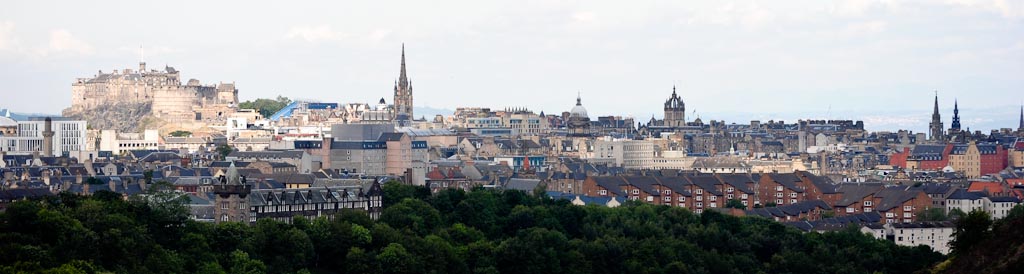
Here you're looking along Edinburgh's High Street, from the castle on the left downslope past the rounded steeple of St' Giles' Cathedral almost to the end of the street.

And right below you you're looking down over Holyrood Palace, the grey building on the right at the bottom of the street.  The new Scottish Parliament buildings (in white) are right below us.

We did take time to walk up the high street later, passing St. Giles' Cathedral.  This is where the Queen lay in state before being taken to London for her recent funeral.
The entrance to Edinburgh Castle itself, and the view back to Arthurs Seat.

Of course we had to walk down Candlemaker Row to see Greyfriars Bobby, the memorial to a loyal dog in the mid-1800s  who guarded his master's grave for 14 years.  And with that we said good-bye to Scotland and headed home.  Thanks for coming along!


Wednesday, March 8, 2023

Edinburgh's Royal Botanical Gardens

We tacked on 2-3 days for exploring Edinburgh after our trip, and our first stop was the Royal Botanical Gardens.  This time we were staying at a B&B right in Edinburgh, just south of the new Scottish Parliament buildings.  Thus we could take a quick taxi north to the gardens, entering by this shiny rock garden gate rather than the main entrance.

We'd been here before at the end of our very first trip to look at gardens in England, so we knew what we wanted to see.  We were after the rock garden and the alpine garden especially.

The rock garden is something else to see, rolling knolls and small valleys now covered in a collection of mature shrubs and flowers.  It was drizzling the day we visited, that constant Scottish smirr that left this garden looking a thousand shades of green rather than colourful.

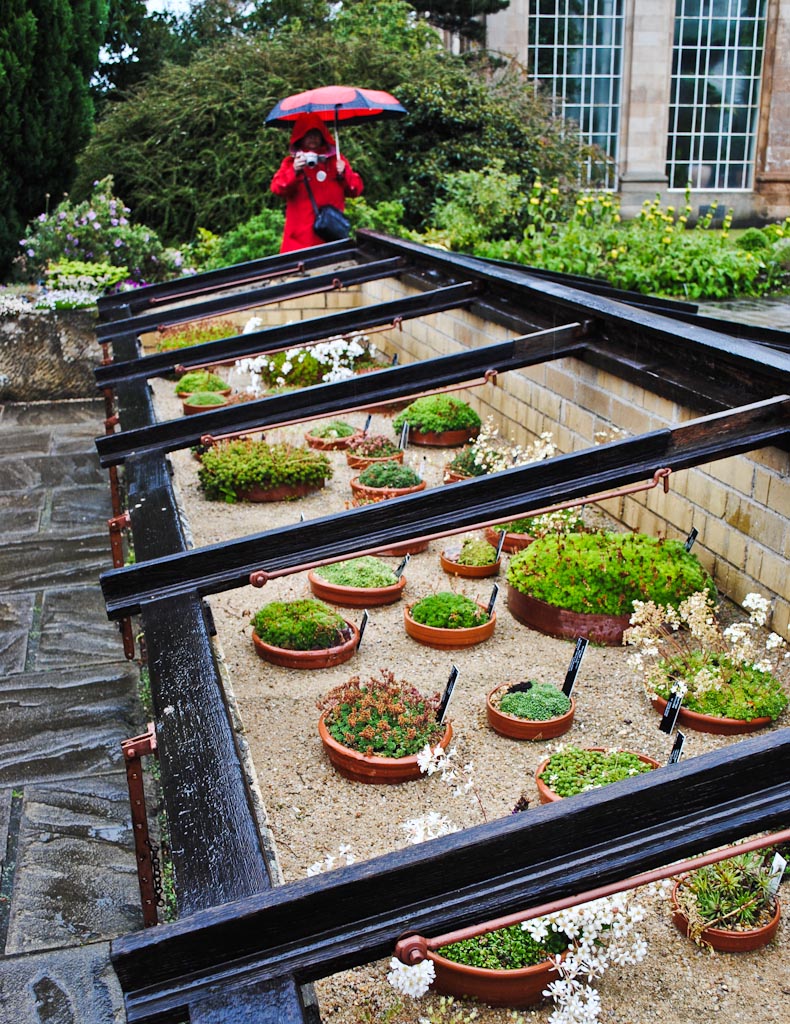
Mrs. F.G. herself was very colourful that day!

Walking through the beautiful grove of specimen trees toward the main greenhouses we passed a Tulip tree with a bloom so low I could get a photo.  It really does look like a Tulip bloom in shape.

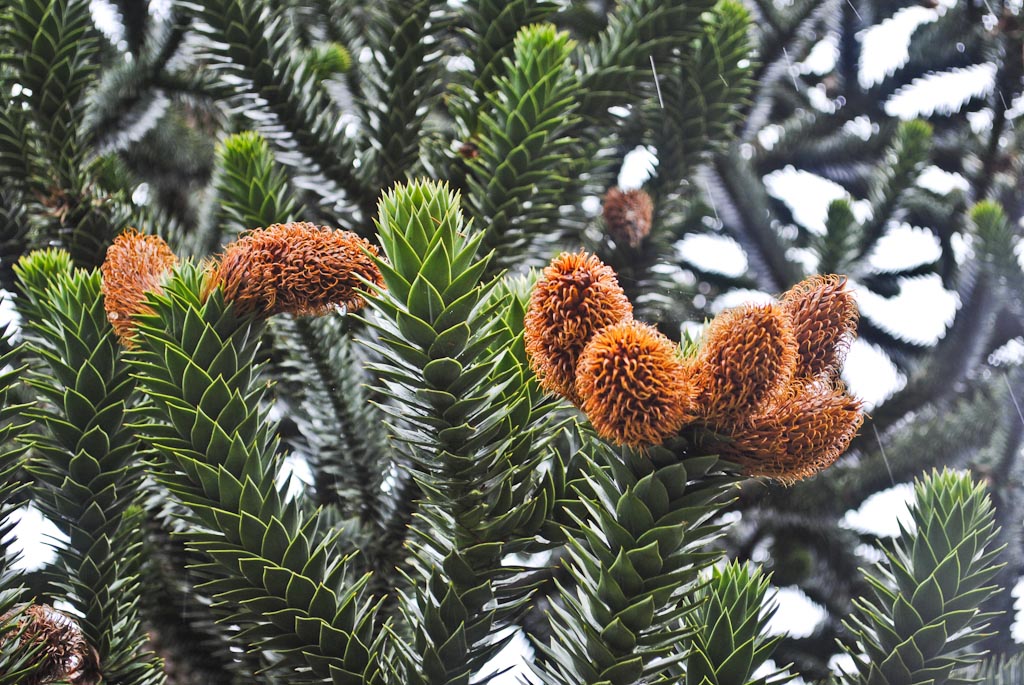
Of course there were a few Monkey Puzzle trees, one of those unusual trees brought back by the early plant collectors as they roamed the globe.  Monkey Puzzle trees are native to Chile and also known as Chilean Pine.

Shortly we found ourselves in front of the original greenhouse, the Palm House.  Outside, lying on the ground, was this truly ancient fossilized tree older than the dinosaurs that I wanted to see.  It's another earthcache.

Inside were all manner of tropical plants including this one, but we didn't stay long; we were headed for the alpine garden.

The alpine garden is hemmed in by this beautiful flat rock wall, teeming with plants hanging down over the edge or out of crevices.

Ironically, for they are certainly hardy plants, native to high elevations of mountains around the world, alpine plants need protection from the wet Scottish winters and from summer heat. so some of them must be grown in greenhouses.

The alpine garden in Edinburgh is a world renowned collection of mostly tiny alpine plants, some protected in the greenhouse, other growing in the open, many of them in small troughs.

Of all the gardens we've visited in Europe, this one provided the most specific ideas we brought home.  Mrs. F.G. was the plant collector, and had already been building troughs, but I did the grunt work as the undergardener at our previous house.  From this Edinburgh garden I brought home the idea of developing a scree garden, with mostly alpine plants that would survive in southern Ontario.  And it became one of my favourite little patches of unusual plants in our garden.


Sunday, March 5, 2023

St. Andrews

We headed back southwest of Fair Isle to mainland Scotland, landing near Aberdeen.  I think they were making things up as we went here, for we actually had to wade from the dinghies into shore.  We were taken by bus to Aberdeen where we got to look around a little, then on down the coast to Dunnotter Castle.

Dunnottar is a spectacular ruin, situated on a high rocky outcrop almost but not quite separated from the mainland, surrounded by the North Sea on three sides.  It has a long and violent history as the home of the Keiths, Earls Marischal for Scotland.

From there we rode on by bus to St. Andrews, ancient home of St. Andrews University, the third oldest university in the English-speaking world, and one of the best in the UK.  We had a short historical tour led by one of the students, wearing his bright red robe.

Among other things, he pointed out the town's most popular tourist site at the time, the dorm where William and Katherine met.

I was equally interested in the pattern of thick branches of the old apple trees.

The town grew up around St. Andrews Cathedral, where relics of St. Andrews were kept, brought to Scotland by St. Regulus.  Of course during the Reformation the cathedral was destroyed and it is now a sad ruin, most of the stone taken elsewhere for building purposes.  This cathedral suffered more than most with its fairly complete destruction.

You may remember the square St. Rules tower from my earlier post on our first trip to Scotland.  It is part of an earlier church, intended as a beacon for travelling pilgrims.

And we paused to remember George Wishart, his place of execution marked by bricks in the pavement.  Wishart was one of the very earliest preachers who laid the foundation for the Scottish Reformation.  We have just missed the 477th Anniversary of his death on March 1st.

As the plaque says, he was apprehended for his heretical preaching, condemned to death by the nefarious Cardinal Beaton and burned at the stake at this spot in St. Andrews, in 1546 while the Cardinal watched from a castle window.  Within three months a Protestant mob attacked the castle, murdering the Cardinal and hanging his own body from the window.  Thus was born the Protestant Church in Scotland.


Friday, March 3, 2023

Fair Isle

Leaving Shetland we sailed south, back toward Scotland, and stopped midway at Fair Isle, nearly 100 miles from Shetland.  Fair Isle is another isolated island, with a population of only about 50, though it does have a school, with 3 pupils at the moment.  Crofting and knitting provide the main income, the island being famous (among knitters) for the 'Fair Isle technique' of knitting multi-coloured jumpers.  The island also has a famous (among birders) bird observatory.


As usual we were ferried in to the tiny harbour in small groups to go exploring.  Some were headed for the small outlet to look at the knitting, while others were going bird watching.  Our ship is anchored just around the headland out of sight.

The Good ?shepherd IV was docked in the harbour, the local ferry that provides the cheapest ride back to Shetland.  It will carry one car but is mainly a passenger ferry.  The island also has a small airstrip.

Around any of the shoreline the scenery was spectacular, with cliffs dropping down into the North Sea.

Like I think all the other places we've visited outside of Glasgow and Edinburgh, sheep are ubiquitous, free to graze just about anywhere.  This one had some pretty fancy horns!

And bird watching was fun, with Puffins the main target for the serious photographers.  This one was serious enough to tell me off as I crept too close, trying to get a photo with my own rather ordinary camera lens.

Never-the-less, I did get my own photographs, a few of the Atlantic Puffins resting on the edge of the cliff.

The bird observatory was certainly a serious one, with overnight accommodation and a small cafeteria and bar.  This is a major migration point for north Atlantic birds, with a number of rarities seen every year.  The island is known as one of the best places in Europe to see rare birds.

Sadly, this building burned down in March 2019, though the birding observations were all digitized so were not lost.  A major campaign is now underway to rebuild it, led by Ann Cleeves, a well known British mystery writer, author of the books upon which  the TV series Shetland is based..  I just read one of her books actually,  Currently prefab modules are being brought over by barge, when weather permits, starting to recreate an actual building.  They hope to re-open in Fall 2023.

The island is known for its knitting, so well known in fact that there is a technique known as the 'Fair Isle technique'.  Mrs. F.G. picked up a touque; she couldn't afford a sweater!


Wednesday, March 1, 2023

The First Robin!

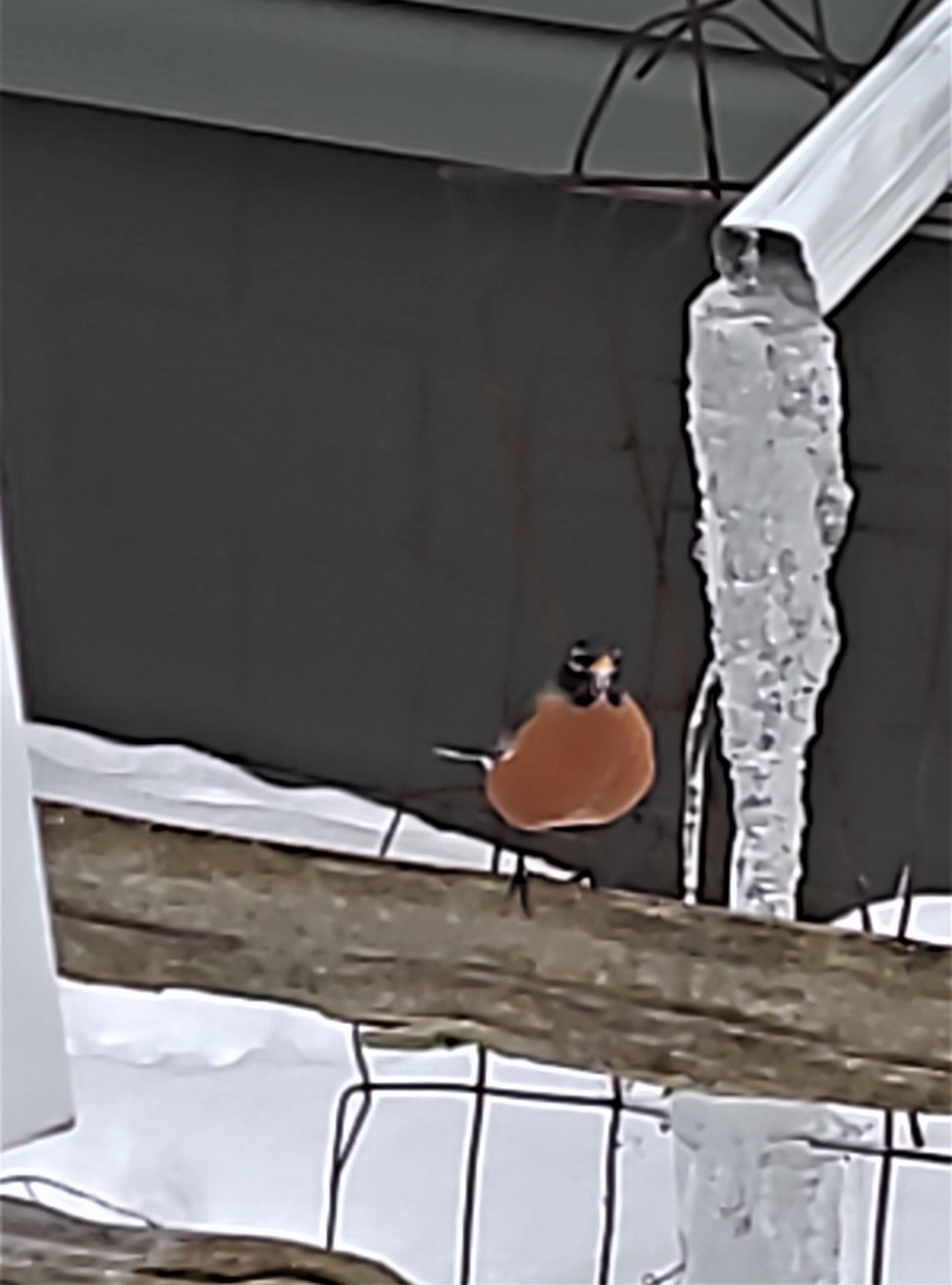
In our family the first robin has always been the first sign of spring.  My mother always said the first robins would arrive back about Mar. 10th, and she was usually right.  This year has been unusually warm for a winter here, so it doesn't surprise me that this one is a little early.

My caregiver took this picture this morning, right on her deck.  there were actually two robins, but she only got a picture of one.  I'm well aware that robins overwinter in some parts of southern Ontario, but I've never seen one in 50 years of birdwatching, so I'm happy to celebrate this one.

Of course there are other signs of spring around.  The days are much longer, and they're brighter during the middle of the day too.  Daylight Savings Time here arrives in less than two weeks.  It's above freezing the next few days, and the historical average takes us above freezing to stay in just two weeks.

Hope you're celebrating too!

[Picture used with permission]