Thursday, March 5, 2020

Sunny Breaks

We're getting a lot of nice sunny breaks, or sunny mornings with bright blue skies and that bright early spring sunshine.  It makes a big difference after a winter with a lot of dull grey days and it seems typical of early March.

It's certainly nice looking out the back window with its usual view and seeing the bright blue skies.  This was this morning, though it's clouded over now.

The sun slowly creeps in the bedroom window in the morning, so nice to wake up to!

I've even been sitting out on the front sidewalk for some sun and fresh air most days.


Wednesday, March 4, 2020

The Snow Isn't Melting, It's 'Sublimating'!

I've watched the snow would disappear at this time of year for years. The past two years I've had lots of time sitting in front of the window to just watch.   At the moment it's disappearing steadily as we have day after day that creeps up above the freezing line.

We all say the snow is 'melting', but in fact I hardly ever see it melting on the surface.  If there's a creek or ditch nearby you might see the snow melt along the edge and run away in a trickle, but I don't see this when I look out the window.  I still just see a sheet of white, although it's getting thinner and thinner.   So I've been trying to educate myself and I start from the fact that 'melting' is the change from a solid state (snow) to a liquid state (water).

In fact much of the snow doesn't disappear this way, it vanishes directly into the atmosphere, changing from a solid state (snow) to a gaseous state (water vapour) without ever becoming liquid.  You can't see this happening, but you can see that the snow is disappearing steadily, and sometimes fast depending on the sunshine and temperatures.  The snowpack gets thinner and thinner; green patches of grass appear, and the sidewalks are bare.  This, I've learned is actually the process of 'sublimation' a word that we don't use often, but we should use instead of saying that the snow is 'melting'.

The snow is certainly sublimating around here these days.  The resulting water vapour has even led to foggy mornings and cancelled school buses.

As I explore the process further though, I learn that the snow actually is melting at the same time.  It's melting at the level of individual snow crystals, and the water is trickling down through the snowpack to recharge the groundwater.  Maybe you could see this if you got out on your hands and knees with a magnifying glass, but I certainly don't see it.

As both these processes happen the entire structure of the snowpack changes.  Snow crystals may start out as light and fluffy, but as they melt or partially melt they recrystallize in the lower temperatures overnight and end up smaller, icier and more densely packed.  Squirrels walk across the surface of this snowpack instead of disappearing in the white fluff.  I've experienced a time or two when I could walk across the surface of the snow without breaking through, abandoned my snowshoes, and just walked on foot.

So when we talk of snow 'melting', it's actually disappearing in both directions, 'melting' downwards into the ground, and 'sublimating' upwards into the atmosphere.  You don't actually see much of either process happening, but my impression is that more disappears into the atmosphere than melts into the groundwater. 

What we need is a new word to express both of these processes happening at the same time.  Any suggestions?


Tuesday, March 3, 2020

Tulips

The Tulips friends brought over a week ago Saturday are still providing a beautiful splash of colour in the house.  They're fading, but just slowly.

Meanwhile, the snow is steadily vanishing, even though we had so much by Friday that it still looks like winter outside.

Mrs. F.G. finally had a repairman in today to fix the vibration in her big new (and expensive) quilting machine this morning.  I'm hoping she'll have a chance to get back into quilting more now.  We're off to Owen Sound for physio later, and probably buying her a new ipad, since her own, even though successfully restored last week, is still not working correctly.  And we have to have a way of staying up-to-date on the coronavirus and American politics.  Big day in the U.S.A. today!

And speaking of coronavirus, I think people are over-reacting; just wash your hands as you should be doing anyway!


Monday, March 2, 2020

Stuck!

Yesterday I got stuck in the snow trying to drive 50 feet from the car to the church door!

The parking lot had been cleared and the sidewalk had been shoveled, but there was a thin 2 inch layer of hard packed snow left behind.  You may not have experienced this if you haven't lived in this climate, but it can be hard to walk through or even drive through it.   My 300 pound wheelchair churned right through it, spinning on the icy sidewalk underneath.

My wheelchair veered to the right and immediately I was headed for a snowbank. I went back-and-forth but my wheels were just spinning in the 2 inches of hard packed snow.

Another churchgoer thankfully gave me a slight push  and I was able to turn myself forward and head for the door. That's the first time that we've experienced this sort of problem and it was one I didn't expect. You always have to watch out for the winter conditions that interfere with a powered wheelchair!

Saturday, February 29, 2020

Snow, Snow and More Snow!

The storm hit us full on, starting Wednesday morning.  It was late Friday by the time it stopped.  It's hard to say how much we got, but roads and schools were closed, and much of our downtown was shut down.  This storm was accompanied by high winds, so it drifted, piling deep in some places and only reaching about 18" in others.

The snowblowers and shovels have been busy.  This snowbank beside our driveway is over 3 feet deep.  The first foot of that pile was bare grass on Tuesday!  If I was 8 again, I'd be digging a snowfort!

It's hard to get a photo that shows how deep the snow is, but I thought I'd share a few photos of our Heron/Stork/Ostrich in the garden to try and capture the deepening white stuff.  This is our Ostrich today.

 Back on Jan. 16th, winter had been quite moderate and its head was still above ground.

Then in early February the snow started to accumulate and winter started to look almost normal as its head disappeared.

 After Wednesday's snow it looked like this, only a small tuft of the grass showing above the snow.  Our Ostrich is entirely buried; hope it's ok under there!  Compare this to the third picture above.

Then today I looked out and there was no trace even of that top shred of the grass stem.  I'll let you know how it survived once the snow disappears.  I seems that will happen soon; we have a week of above-freezing daytime temperatures coming up.


Friday, February 28, 2020

Old Durham Road Cemetery

The other and much more local site that honours early black settlers in Grey County is the tiny Old Durham Road Cemetery.  This is a very old pioneer cemetery near the hamlet of Priceville.  In our years coming up from Guelph to our former home, the cabin in the valley, we drove past this spot on every trip.  I actually have a geocache hidden there.

I have no pictures of my own though, so I've had to borrow these from the internet; apologies if they're a little blurry, but the story is worth remembering.

Black settlers were the first non-aboriginal people to move into this area, starting in 1849.  By the 1861 census there was a flourishing community of 100 settlers and their families.  But the community dispersed in later years as settlement grew, many moving to Owen Sound, where the memorial I featured yesterday is found.  

The cemetery was lost, grown over, and ultimately ploughed over to grow potatoes!  Starting in 1989 a local volunteer committee began work to restore the cemetery  This is the memorial I remember seeing first, 21 years ago, when I started my regular trips to the valley, coming up on weekends to build the cabin..  It was showing signs of age then, and consisted of only four broken tombstones under a plexiglass cover.
 
It had been dedicated by Lieut. Governor Lincoln Alexander in 1990, who I posted about a few weeks back, with a large boulder engraved to mark the occasion.

Later the volunteers added these crosses to remember the individual settlers buried here.

More recently the volunteers ran a campaign to build a better shelter for the remaining 4 gravestones.  This was dedicated in 2015.  It's a highlight of exhibits for the small local museum in Flesherton.  


Thursday, February 27, 2020

Black History Month

I can't let February go by without acknowledging Black History Month in Canada, a month in which we recognize the contributions that black members of our communities have made.  The situation is very different in Canada compared to the U.S., with a relatively small black population here.  But at an early stage in our history there were some black slaves here.

The symbol of black history locally is this memorial in Harrison Park in Owen Sound, site of the annual Emancipation Festival.  Thought to be the oldest in North America, it started in 1862 and is still going strong.

I think this is one of the nicest memorials for any reason that I've seen.  It's simple but symbolic and I think very meaningful.  It is of course meant to resemble a ruined pioneer church, and it was built with stones donated from several American states.

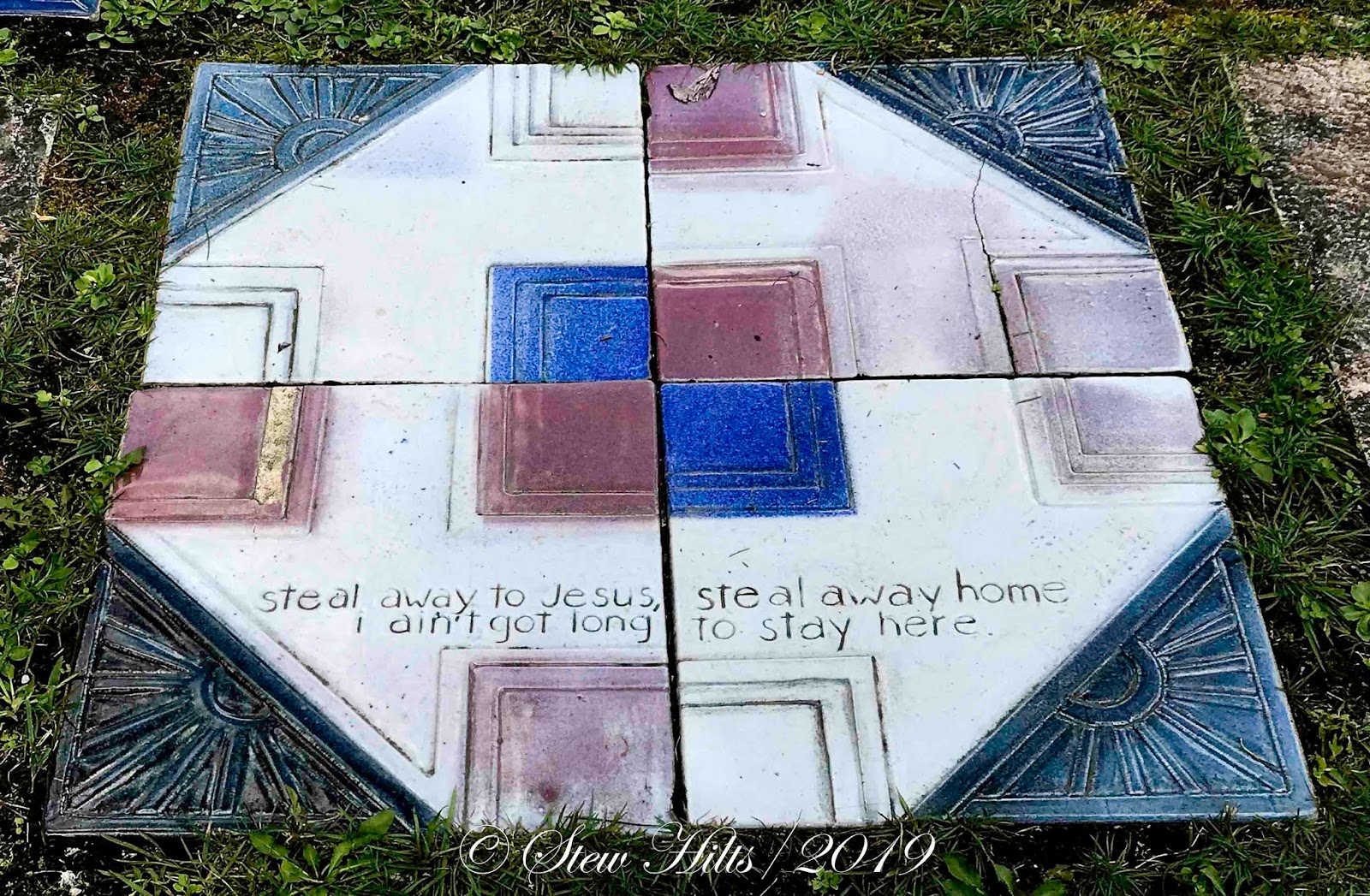
And the front is paved with flagstone, nine of which have embedded quilt patterns.

Just one of the big donated stones.

And a selection of the quilt patterns, with sayings from the times.  Owen Sound was said to be the terminus of the Underground Railway, and had a small but thriving black community in the late 1800s as a result.


There are several plaques that are very informative.  It's a nice place to stop when we visit the park.