Monday, September 11, 2017

Changing Seasons

The transition from late summer to early fall is a gradual one, and seems to vary every year depending on the weather.  The cool evenings and cold nights, and the early reports of frost around here certainly suggest summer is over.  And down in the swamps you can now find lots of colour in the trees.

You should know me by now - I'm just a magpie, the brightest colours (like red) appeal the most to me.

Most of the trees in the swamps are just starting to look more yellow than green, along with some that are dark purple.

These leaves are the classic shape of Red Maple, one of the two most common maples in the swamps.

These leaves reveal it to be a Silver Maple, the leaves more deeply dissected.  It loves the swamps too, and those two species hybridize, but they all turn colour in the fall.

Every now and then though, I'm finding a Sugar Maple along the roadside that has decided summer is over.  Few and far between yet, but soon they'll all be changing.

Sometimes it's just one branch on a tree.  This little patch of red leaves has been staring at me through the living room window for two weeks.

The evergreens don't change so obviously, but I do think there are some pretty heavy seed and cone crops on many of our Cedars and Spruce.

Linking to:

Sunday, September 10, 2017

Dewy Morning

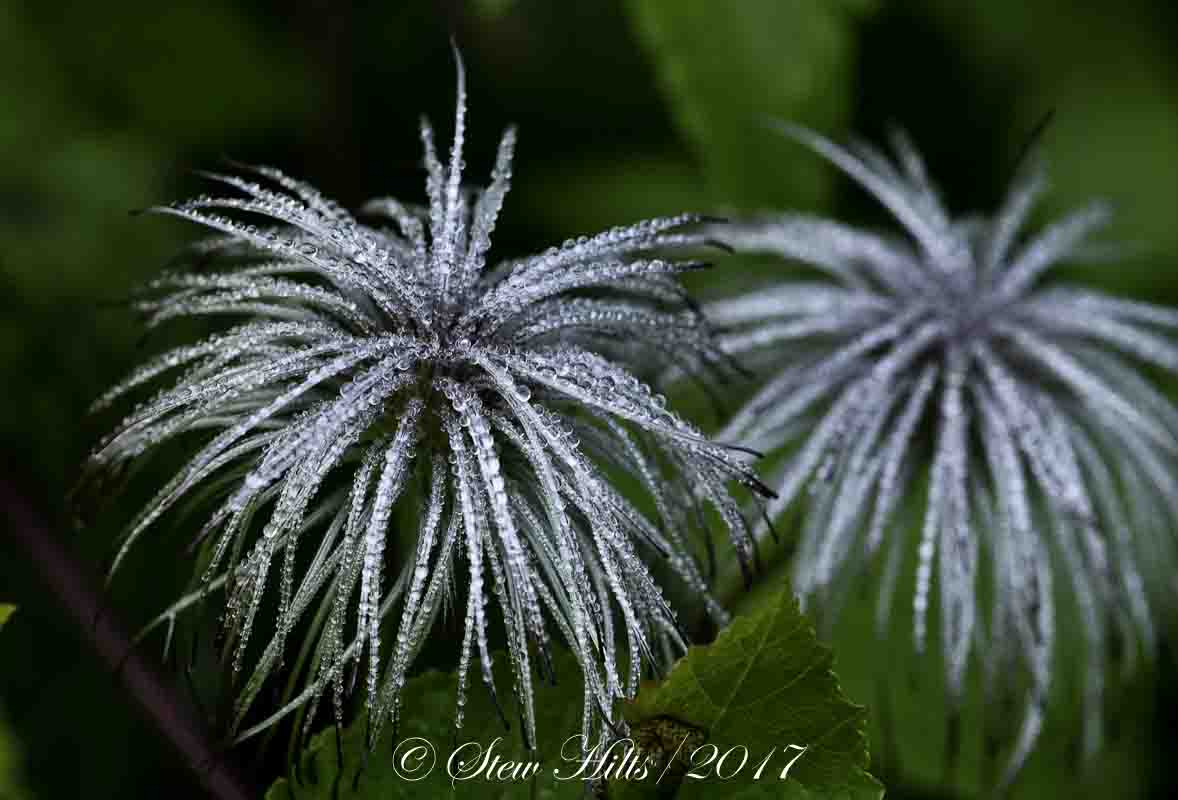
It's cold in the early morning now, only 3°C this morning, and every day there's a heavy dew.  Got a few shots in the garden to share with you.

The dew always seems to show up best on the plants with long narrow linear leaves, like Day lilies, Crocosmia, and Yucca.

Those seedheads of the invasive Yellow Clematis are striking if you can get the focus right.  Been a long day, that's all for now.

Linking to:

Saturday, September 9, 2017

Walters Falls Hike

My days have mostly been occupied by sorting a million little things in our garage, as we downsize prior to moving.  But I did get out for a hike around a loop of the Bruce Trail at Walters Falls last week.  Turned out to be a nice walk on a nice day.

We started right at Walters Falls, which I've shared pictures of before.  The Bruce Trail crosses the little bridge where I take pictures of the mill pond dam and old woollen mill.

After that we headed north-west.  Fairly quickly the trail descends from the top of the cliffs at the falls down into the ravine, running beside Walter's Creek.  

We followed the creek some distance downstream until we came to a concession road, still there with its bridges, but no longer open to traffic.

Crossing the bridge we headed east briefly before turning south-east again toward the falls.  It was a gradual uphill climb through the woods.  Parts of this trail looked like the remnants of old cart tracks, perhaps headed up the hill to the mills in the village.

This picture won't mean much to you without the explanation.  This is the contact between two different geological layers, the thin Cabot Head limestone layers above, and the Queenston Shale below.  The water can percolate down through the limestone, but once it hits the shale, it travels sideways until it emerges on the slope as a spring.  This geological contact accounts for thousands of springs all along the slopes of the escarpment, but the limestone layers are rarely visible like they are here, usually covered by glacial debris.

Just before we got back to the falls, we looked down on this big moss and fern filled crevice below the trail.  You can almost see the falls now in the background, and we could certainly hear it.

We finished at Walters Falls again, and headed for coffee at the local coffee shop.  Getting cold here, expecting frost tonight.


Friday, September 8, 2017

Young Wetlands

Last week I shared a few pix of the Young Wetlands, one of those places off the 7th Line that I visit.  I showed the flooded boardwalk from a time when the beaver were busy raising the level of their dam, and the Bruce Trail was flooded out.

Reading the comments I suddenly realized that I had not actually been in there yet to see the new boardwalk that was built the following year.  So that's where I headed earlier this week.  The trail has been re-routed a bit too, to provide this nice view of the wetland as you approach it.

I took a quick look and saw only this pair of Canada Geese.

Panning toward the dam (on the right), I saw no other waterfowl.

But then my lazy grey cells clicked and reminded me that I had my binoculars with me.  Suddenly I was seeing a lot more geese!

Looking toward the stump-filled upper end of the pond, I eventually counted nearly 40 geese.  Can you see the 8 in this picture?  All but one of them are standing on one leg - why do they do that?

I continued down the trail to check out the new boardwalk.  It's a serious, heavy duty boardwalk, about 2 feet above water level, and a full 30" wide.  I was in to watch it being built, so I know it's a solid trail.  And the trail crew that built it was able to save the old bridge and straighten it out a bit.

Here's the pond at the high level when the beaver were most active.

And here's part of the boardwalk then, on the surface, but just floating.  I couldn't take a step beyond this.  Quite a big improvement!

As I was heading out another small flock of geese flew in for the night.  I think at this time of year they spend daytime out in crop fields filling up on spilled grain, and then fly to the wetlands where they can perch overnight safe from predators.

Linking to:

Thursday, September 7, 2017

Gentle Sunset

We don't get many sunsets here, because there's a hill to our west.  But every now and then the sun lights up clouds across the whole sky in pink.  These colours are fairly subdued, but made a nice gentle sunset the other night.  Over 15 minutes the clouds moved from white to pink back to gray.  The sun itself has already set.

There really wasn't any pink in these beautiful cirrus clouds when I started our for my walk.

But before long I thought I detected a change.

By the time I saw these two planes, the clouds were definitely pink.  I wondered how the two planes would intersect.

They missed each other safely!

Already the lower clouds have lost their colour and turned to dark gray.  All in only about 10 minutes.

Linking to:

Wednesday, September 6, 2017

More Garden Trouble

The three plants I shared yesterday are a problem in a garden because they self-seed so readily.  The plants below don't spread by seeds as much as by their roots, they just relentlessly expand the patch they occupy, overwhelming other plants, and taking over more and more of the garden.

Ligularia is a beautiful plant, providing a bright splash of colour at the end of the summer, and in the shade no less...

But it's big heavy leaves and stems cover other plants, spread steadily, and are very hard to dig out.  We've lost several hosta plants underneath this!

The False Sunflowers are another bright splash of colour, though about a month or six weeks ago.  They have anchored the garden after the day lilies are finished, and usually last a long time.

But here you get an idea of how they spread.  All of those yellow flowers are False Sunflowers.  they used to be a nice patch on the left.

Here they've invaded a Crocosmia, providing a really bright colour combination, but eventually they would take over.  On the other hand, you can control these by pulling them out as they spread, so with this one control becomes a little easier.

Obedient Plant is another mild spreader, though a very pretty plant at this time of year.

Those bright green leaves in the foreground are a young Obedient Plant, also invading the linear leaves of a Crocosmia.  But they are also easy to pull out and thereby keep under control.

Sweet Peas are a wonderful mid-summer flower.  I see them growing in ditches along a few rural roads.  You can easily stop and gather seeds, and establish them in your own garden, or even in your own roadside ditch.

But they do spread in a garden.  Those winged, slightly bluish-green vines grow a long distance, and then root.  I've kept them under control by pulling, but I fear they could take over.

This last one, the dreaded Goutweed, is not my photo, nor is it in our garden, but Patsy mentioned in in yesterday's comments.  It is one of the worst garden pests, spreading among all the other plants and hard to get rid of.  Avoid it at all costs!

Don't get me wrong, I love our garden, but I feel guilty all the time, because these plants spread more than I can control them.  It's not a matter of totally avoiding them, but if you choose to include them, know that you will have to control them.  These few plants are a very small part of our garden, which has more hostas and day lilies than anything else.  And there are lots of varieties of clematis that are not invasive like the yellow clematis I mentioned yesterday.  We have 3 others ourselves, which cause no problems.

There, that's the end of my undergardener rant!