At this time of year the daisies, buttercups, and hawkweeds - the 'King Devil' and the 'Devil's Paintbrush' - turn the meadow colourful with their blooms among the grasses. Especially in the morning of a sunny day the flowers all come out and turn toward the sun, leaving the meadow sparkling with yellow stars. But what the human eye sees is very hard to capture with a camera. This is the best photo I've managed:
On the other hand, what the human eye does not immediately leap to, a close-up, the camera can capture beautifully. The yellow hawkweed or King Devil seems most prolific in our meadow.
But my favourite is the Devil's Paintbrush, or Orange Hawkweed (not to be confused with the Indian Paintbrush found up in the Bruce Peninsula of Ontario). It provides bright red-orange flashes among the dominant yellow 'weeds'. Do I really dare call these wildflowers rather than weeds?
Again, a close-up captures a much better view of the incredible colours of these wildflowers. How can something that looks so striking be considered a 'weed'?
At the same time, buttercups are dotting the meadow, and in some nearby pastures providing a carpet of yellow. The pistils and stamens in the centre of the flower are such an identical yellow to the petals that it's hard to get a picture showing the details; there just isn't enough contrast.
And in patches here and there, along the roadside ditches and beside the old fences, the daisies are in bloom - sometimes enough of them to make a field look white. Getting them to stand still long enough for a good picture was a challenge.
We notice the bright colours, and think of the pretty flowers, but when you look closely, the details of nature's design are really incredible, all in a field full of weeds.
Wednesday, June 26, 2013
Tuesday, June 25, 2013
Grey County Farming - The Hay Harvest
Farmland is a huge part of the landscape around here, and the changing pattern of crop seeding, growth, and harvest are one of the most obvious signs of the passing seasons every year. I never tire of driving the country roads and noting what crops are being grown where, watching them mature, and then watching the harvest.
At the moment it's the hay harvest well underway, with farmers taking advantage of any warm dry days-in-a-row when they can mow the hay and let it dry. Dairy farmers are usually first, as they want hay with a high protein content, while for beef cattle that's not quite so important - and Grey County here is the leading beef producer in Ontario. So there will be a lot of hay cut later on in the summer too.
The big round hay bales scattered over rolling fields always seem to make great pictures to me, but you tend to forget how much work it is. Admittedly, not nearly the physical labour of those old square bales, all tossed into the hay wagon and unloaded in the barn by hand, but still a lot of time mowing, raking, baling, then gathering the bales and taking them off to the barn, or wrapping them in white plastic - giant marshmallows lying along the fencerows.
I just threw this slightly different shot in just because I love the snaky motion of the fence along the edge of the field! I'm linking this to 'Our World Tuesday'.
Monday, June 24, 2013
Hart's Tongue Fern Fiddleheads
Hart's Tongue Fern Fiddleheads - these tiny fiddleheads are the last to emerge among the ferns, and the Hart's Tongue is extremely rare in North America, though we happen to live in the one region where it is found - along Ontario's Niagara Escarpment between about Latitude 44 and 45 degrees North.
It's found among the mossy boulders in shaded, sheltered corners below the limestone cliffs of the escarpment, where temperatures are probably a bit cooler than normal, on the talus slopes. The fern is evergreen, and last year's fronds are still lying on the ground - but it doesn't look like many ferns you've ever seen, just one solid leaf 8-10 inches long, like a hart's (deer's) tongue.
The rest of these are a few other first shots with my new macro lens - I'm linking this to Macro Monday2.
Sunday, June 23, 2013
Honey Locust Trees
Driving here and there recently I've noticed clusters of lighter coloured trees in the distance occasionally. Then one day I drove past such a group of trees fairly close - they were honey locusts.
Honey locusts are actually in bloom just now, and their blooms are so obvious that they turn the trees white. These trees were recommended for fencerows and windbreaks many years ago, and you find them planted in groups around old homesteads, and occasionally a row of them forming a fencerow down the edge of a field.
You can recognize them even in the winter by their twisted, crooked trunks and upper branches. There are no nice soaring symmetrical canopies; these trees seem to have to fight their way to reach the sky.
The blossoms are somewhat like pea flowers, hanging in heavy clusters. Although the leaves are already out, they will fill in after blooming so the tree does end up looking green.
Saturday, June 22, 2013
More Sunsets
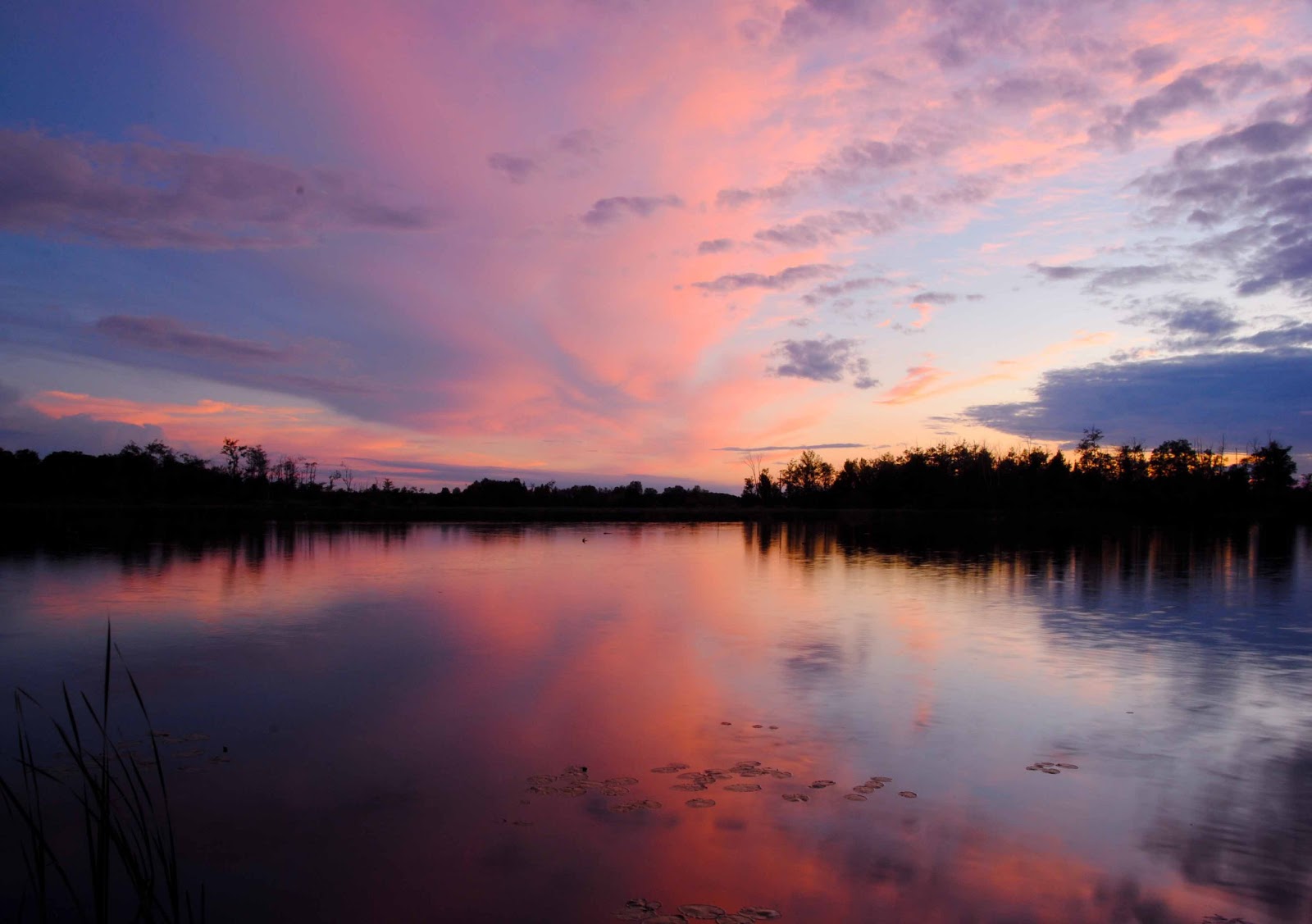
Yesterday I posted what was probably the highlight of our sunset photography evening (other than the picnic that went with it), but we spent nearly 2 hours watching the sun set over Lake Eugenia, and taking pictures as the clouds shifted and the sun slowly disappeared. Here's a selection of five photos spread out over the evening - trying different composition and shooting angles. At one point the half-moon came up and found its way into the corner of picture #4..
Friday, June 21, 2013
Skywatch Friday - Sunset Over Lake Eugenia
Our local photo group gathered to try for sunset pictures over Lake Eugenia, on the edge of the Beaver Valley, Ontario. It wasn't a spectacular affair as sunsets go, but for a few moments it was pretty nice.
For the first time I'm trying to link this to 'Skywatch Friday', a blogging site that features views of the sky from around the world. Never done this before; we'll see if it works. .... That was easy! I'll have to do it again sometime.
Wednesday, June 19, 2013
Poplar Fluff
Would you believe, one of the most searched for pages in my 3 years of blogging is a post I did on poplar fluff about this time 2 years ago. I think it's popularity must be due to there being little written on the topic, and in some places (like Edmonton) there is so much that it's a nuisance. People want to know what it is, so here's the true, detailed story:
Poplar trees produce their seeds in catkins, which hang unpollinated on the trees in early spring. Once they are pollinated, green seed capsules form (above), and when they break open the seeds are released, each carried by a tiny parachute of fluff. This is what you see stuck in the tree, floating through the air, or lying on the ground (below).
Sometimes the fluff accumulates on the ground so thickly that it looks like snow! Google 'poplar fluff' and choose 'Images', and you'll find pictures from cities like Calgary or Edmonton (where poplar are one of the most common shade trees), where the ground is white. Headlines reassure residents that it is not allergenic, and in Moscow, the mayor is 'going to save the city from the fluff'!
We don't get nearly that amount of fluff here, just a little floating through the air like big snow flakes, or a bit on the ground. Here's a full catkin covered in fluff that fell off on one of our young spruce.
If you dissect this story, you find that there is an intermediate stage of seed pods or capsules forming, shown in green above. These develop after pollination, but they are not seeds, rather they are the containers for the much smaller seeds with their parachute of fluff.
As these capsules dry out, as they do in late June, they turn brown and split open, releasing the tiny seeds and fluff. This is the event that brings the 'snow in June', and decorates your lawn with bits of white.
A close look shows the dry, split capsules along the catkin, and the fluff bursting out. In comparison, a single seed with it's attached fluff is miniscule - see below. And that's the story of the poplar fluff.
Subscribe to:
Posts (Atom)