Sunday, June 5, 2016

The World has Turned Green!

It's the greenest time of the year around here, as all the leaves are finally out.  When we headed north a week ago they were only about 1/2 out, but when we got home it was as if everything green had exploded in growth.

I'm intrigued with pictures down roads where the trees grow in to both sides.  It looks like a leafy green tunnel, and is so relaxing to drive through.

Maybe when you're totally surrounded by green like this it's a special kind of forest therapy that actually does make you feel better.   It sure feels like it!

These first three pictures are taken with my usual Nikon DSLR, which I'm very comfortable with.  The second one, with a bit of a glare, may have been taken through the car window, but I don't remember.

This one and the remaining pictures are taken our new pocket-size Lumix camera.  It's really handy, but I'm not sure it has quite the same quality.  And being so tiny, I just find it harder to use.  It's easier to hit the wrong button!

I find in particular that the auto-focus doesn't seem as fast as on my big camera, certainly is not when you're using an extended zoom.

But I find these late May pictures down rural roads around here really refreshing.  I guess the road, rather than just a wall of trees, gives a focal point that adds interest.  You never know what's going to come around that bend.

I've shared this view before, in the fall I think - about the only passable gravel road down through the valley and up the other side, with sharp dog's leg bends at the top on each side to get up the steepest part.  Heavy rain and lots of sun here, so the weeds are going to grow like crazy.


Saturday, June 4, 2016

Paddling Lake Eugenia

I told myself I could afford half a day away from gardening, so on the spur of the moment I headed out with a paddling buddy to paddle Lake Eugenia, not the open lake but the stump-filled and marshy southern reaches where the Beaver River enters the lake.

Lake Eugenia is an artificial lake, created by what is now Ontario Hydro, in 1914 when the Beaver River was dammed to generate electricity and the Eugenia Power Plant began its life.   Quite a few farms were purchased by the government, and flooded, but in parts of the lake, the trees were simply cut down, leaving stumps.  So in the upper shallow end of the lake the stumps all stick out of the water.  Makes for some tricky paddling.

We paddled through that, and headed up the channel of the Beaver River, though it`s flooded quite a bit deeper than it was originally.  I was in my little `single`canoe, which I love paddling to explore places like this.

We went as far as we could, but eventually the way is blocked by fallen trees.  This is where the flooded portion of the river ends, and you begin to have to paddle against a current, a fairly serious current.  And as we got in among the trees the bugs found us of course.

We were paddling across lots of logs in the water beneath us.  This one crossed the entire river, so if the water level dropped far it would be a barrier.

The logs look so clear under the water, sometimes it`s hard to believe that you can paddle right across them.

In several places there were Marsh Marigold tumbling over the banks, their bright yellow flowers reflected in the water.

Another big stump as we paddled down out into the lake again.  Those circles of roots are under all the stumps, under the water, but this big one had obviously fallen over (or been pushed by winter ice).

There`s a pair of swans nesting in the area, and we saw one adult Mute Swan (see its orange beak).  It never moved far so I suspect it was guarding its mate on a nest in the reeds.  We stayed well away.

We also saw a very large gull, just sitting on one of the stumps.  No appearances of a nest nearby, but it stayed still while I got remarkably close as I paddled by.  This view is uncropped.

I double-checked and it`s a Herring Gull.  In this cropped version, you can see the red spot on its bill.  It also has those the black-tipped grey wings, and  flesh-coloured legs.

Linking to:

Friday, June 3, 2016

Is it a Zonkey or a Zedonk?

Driving back and forth to our daughter's place recently, we've noticed a strange animal in a horse paddock we pass.

Can you spot something unusual?

This appears to be a cross between a Zebra and a Donkey!  There are various names given to such a critter, but I think I like Zonkey better than Zedonk.  In any case they are definitely Zebroids, which are any form of Zebra/Equine cross.  Of course if I'm wrong thinking it looks like a donkey, it might be a Zorse!

Not the only interesting critter we've seen recently.  Yesterday this Hummingbird Moth was hovering around our potted annuals on the deck.

Here it's mid-air, and in spite of the shot being taken at 1/640th of a second, it didn't freeze the vibrating wings!

This one shows the wings better; it's perched on a flower.  There are a number of different moth species that are commonly called 'Hummingbird Moths'.  They all hover on rapidly vibrating wings in front of flowers, behaving just like Hummingbirds.  I believe that this would correctly be called the Hummingbird Clearwing judging by the information I've been able to find.

Linking to:

Thursday, June 2, 2016

Two Lighthouses

Back ten days ago we drove over to Lake Huron for a day, checking out two lighthouses we had never seen on the Bruce Coast Lighthouse Tour.  It was a beautiful day in late May, and a long drive through prosperous farm country to get there.

The Point Clark Lighthouse is in the small cottage community of Point Clark, north of Goderich and south of Kincardine.  It's one of three on the Bruce Coast tour that is made in this 'imperial tower' style and is one of the oldest on the tour,  There are 13 lighthouses and a museum on the tour altogether.  

I like looking up at the huge cut stone blocks, highlighted by the shadow of the mid-day sun.  This is built of limestone from the Lake Huron shoreline nearby.

The 'lantern' (room with the light in it) at the top still has its glass, and the railing.  The lighthouse is open for tours in the summer, and you can climb the stairs all the way up.  Unfortunately we were too early in the season.

Eventually I found a spot across the road where I could get a picture of the whole lighthouse complex, the keeper's cottage on the left, and a little entry building on the right.  The keeper's cottage is a museum, so I think we may just have to go back in the summer!

About 20 km. to the north is Kincardine, with its unusual lighthouse.  It's located on the banks of the Penetangore River, in downtown Kincardine, and is only one of two lighthouses on the tour where the tower is built extending out of the roof of the lighthouse keeper's home.

 Unfortunely the lantern here has been closed in, by the looks of it with steel sheets.  There is a museum, but again it wasn't open when we were there.

This lighthouse is the only one of the nine that I've seen which is inside the harbour.  In fact it's sort of lost among all the boats in the marina, some distance from the lake.  We drove around to look at it from all sides before we discovered that the large road bridge in the upper right is the best place to view it, where the above two pictures were taken.

But you do get a nice view down the river, past the harbour (on the left), and out into Lake Huron.  Though it was built to serve the fishing and salt industries in the 19th century, no big freighters come in here today!

And at the end of the bridge is this fascinating plaque in honour of 'the Phantom Piper'.  Briefly, the story is that in 1856 a ship nearing town suddenly got in trouble in a storm.  Donald Sinclair, on the ship with his family, got out his bagpipes, and played a lament, hoping that someone onshore would hear them.  Another Scot onshore did hear them, got out his pipes, and played in return.  The captain heard the onshore piper and was able to steer safely into harbour.  For many years Donald went down to the harbour to play his pipes, in gratitude.  And since 1996, the local Kincardine Scottish pipe Band has provided a lone piper to play from the lighthouse balcony on summer evenings, in honour of Donald Sinclair.

Other lighthouses I've posted about include:


But I can see that I didn't focus on the lighthouses so much in those posts, and I need to read a little lighthouse history to be able to tell you more.  Since I shared pictures of two on one of these posts, this covers 7 of the 13; now I need to chase pictures of the remaining lighthouses, most of which are on islands!

Linking to:

Wednesday, June 1, 2016

Buttercups!

An entire field of Buttercups!  I don't know how the cattle feel about this in their pasture, but every year the field turns bright yellow, and it's not Dandelions!

Can you see the fence?  Just the very tops of the posts showing, down in the ditch.

This is a pair of fields we drive by frequently; this time it was driving home from picking up our dog at our daughter's place after we got back farom up north.

And these two close-ups I got right here in the garden (where they're 'weeds').  All shot with my new pocket Lumix, and I'm not entirely satisfied with the focus on close ones, but it's pretty good.  I let the background be pretty dark in these two, to try and emphasize the form within the flower.

Linking to:

Tuesday, May 31, 2016

Mine Tour

The Mining Museum in Cobalt also runs a mine tour, a short drive out of town, where you can walk through some of the old tunnels of one of the silver mines.  That was an unforgettable experience, and we also enjoyed the Mining Museum itself.

The mine tunnels are several feet wide, and about 6 feet high, as they had to be able to push those tiny railway cars through them with the ore that was mined.  But once we got away from the door, you REALLY got an idea of how dark and claustrophobic it would be in the mines.

Horizontal tunnels like this one are called 'adits', in comparison to the drilled shafts that descended vertically, so it's easy to just walk in.  Of course they wouldn't have a cement and steel entrance and lights like this one back when the mine was in use.  These were added for safety with the tourists.

Our tour guide was a retired former miner who could really talk about what it was like.  He locked the door open behind us, just in case!  He also told us that these mines were relatively safe.  Because the rock is so hard, they didn't suffer from collapses, and because there was no dust, there wasn't the same health hazard as in many other mines.  It was just dirty, dark, hard work!

They had a few old different types of drills set up in the mine, but all of them pretty rusted by now.  It's been 100 years since most of these were used.  The tunnels and shafts would simply follow the veins of silver.   I found it quite a challenge to get photographs, trying to avoid a flash by setting my camera to a high ISO.

Back in the museum, they had a lot of silver, small bits, big bits, and chunks of ore, like this one.  I believe this was on loan from the Royal Ontario Museum.

The silver is quite obvious in the ore, though only when it's cut flat where it can be seen.  There were a lot of other mining exhibits too, as well as history of the town.

I liked the old telephone switchboard - we've come a long way!!  I always remember that when I was young, living in Woodstock, Ontario, we just had to dial '4' to get my dad at work.  The office he worked in must have had one of the first phones in town!

Way back in the far room, they also had a display of fluorescent minerals, the best I've seen anywhere.  These are composed of several different minerals from different parts of North America.

After a long day of the mine tour, the museum, those shopping trips I mentioned, and a fabulous dinner in Ville Marie, Quebec, we headed home, to see this beautiful sunset over town.

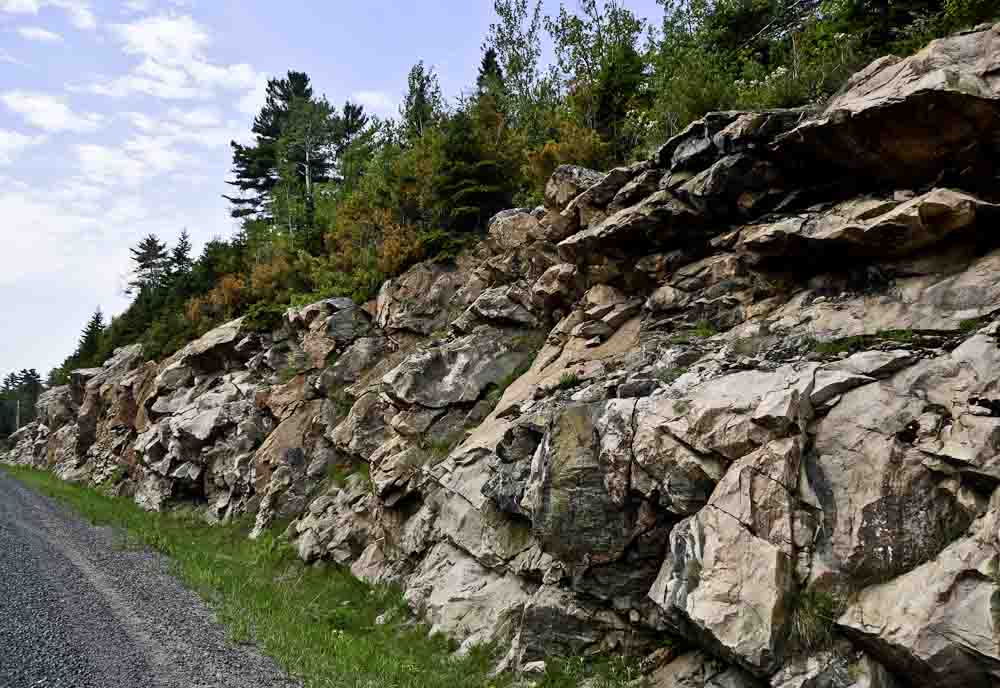
The next day we took our time getting ready, after another delicious breakfast of french toast and sausage (who knew my son was such a chef!).  We headed south on the long drive through North Bay, past Huntsville, down to Orillia, and west to Grey County.  We really enjoyed the rock cuts on the first half of this drive, all that pink granite.  These pictures (and a bunch of others) were taken on request, as a source of possible ideas for an upcoming quilting contest.

Now it's back to gardening madly trying to keep ahead of the weeds!