Before I take you back to our garden where the day lilies are now blooming in profusion, I wanted to celebrate a striking monument I found on my drive up to Georgian Bay the other day. This is the monument to the Kemble Women's Institute - now, believe it or not, the oldest operating Women's Institute in the world!
The monument takes the form of a huge slab of limestone set up as a table, with a chair at one end - I'm sure reminiscent of many Women's Institute meetings. The Kemble Women's Institute was formed in 1897, the third in the world, and is now one of some 500 in Ontario alone. There are 9 million members worldwide. Here the monument is located at a lookout on the upper edge of one of the bedrock escarpments that run up each side of the bay, providing a beautiful view.
While the plaque gives the information, the unique setting of the table is what struck me as memorable. As the last line of the plaque says, "The table is set. Come sit and ponder .... making a better community for all". I'm sure that my own mother and both my grandmothers, and probably numerous aunts were members of a nearby Women's Institute, working to make their contribution to their own local community.
The view itself is spectacular, although it was grey clouds early in the morning when I passed by. You're looking east across Owen Sound Bay, a narrow bay off the much larger Georgian Bay, across to 'Coffin Hill', one of the many outcrops of the Niagara Escarpment that is such a striking feature of the landscape in this part of the province.
Wednesday, July 17, 2013
Tuesday, July 16, 2013
Keppel Henge
To continue the story of Keppel Croft Garden, perhaps its most fascinating feature is the Keppel Henge that has been erected in the field behind the garden. A genuine stone circle on a mound surrounded by a ditch, this is a henge designed as a way to celebrate the millenium in 2000.
This is the view as you approach the henge. It was designed to throw shadows that would indicate celestial events such as the solstices and the equinox, usually tied to sunrise or sunset. Thus each individual stone has a name and is placed in such a way as to be astronomically in the correct location, while the taller thin 'Pointer Stone' is in the centre to cast a shadow.
You approach the field through another bit of whimsy, this interesting gate which certainly leaves you with the feeling that you're going someplace special. Then you follow a mowed trail through the tall grass until you emerge into the henge.
The stone closest to us in this picture is the Winter Solstice Stone, while the stone on the left is the Winter Sunset Stone. On the far right is the Winter Sunrise Stone, and second from the left is the Summer Sunset Stone. Note the allignment of smaller stones running south to north in the centre, all of which have a purpose.
The pointer stone is marble rather than limestone like all the rest (which came from a local quarry), and it is taller, and on a small mound in the centre of the circle. Construction of the henge was a major undertaking, especially in getting all stones in the astronomically correct locations, and was accompanied by appropriate ceremony. A fascinating garden feature!
Here I'm standing on the month of July, and my shadow falls between 11 and 12 a.m.; it was just past 11.30. I'm so intrigued by this I'm thinking of trying it in our own back yard.
There are a number of other small constructed 'zen' stone gardens along the path through the field, which look to me like fascinating pieces of art. The henge is just visible in the background right against the trees.
And of course there is more whimsy as you leave the field through the thyme garden.
Remember the cobble beach I said the garden was built on? This is the beach today; millions of perfect skipping stones. The ancient beaches Keppel Croft is built on are at a higher level, from a time when glacial lakes pushed the shoreline higher, but imagine building a garden on a bed of stones!
This is what lets Big Bay claim to be the 'Stone Skipping Capital of Canada'.
The Keppel Henge and the sundial are a project of both the Keppel Croft gardeners and a neighbour. You can find a lot more interesting details on the garden's website. All in all a very fascinating place!
This is the view as you approach the henge. It was designed to throw shadows that would indicate celestial events such as the solstices and the equinox, usually tied to sunrise or sunset. Thus each individual stone has a name and is placed in such a way as to be astronomically in the correct location, while the taller thin 'Pointer Stone' is in the centre to cast a shadow.
You approach the field through another bit of whimsy, this interesting gate which certainly leaves you with the feeling that you're going someplace special. Then you follow a mowed trail through the tall grass until you emerge into the henge.
The stone closest to us in this picture is the Winter Solstice Stone, while the stone on the left is the Winter Sunset Stone. On the far right is the Winter Sunrise Stone, and second from the left is the Summer Sunset Stone. Note the allignment of smaller stones running south to north in the centre, all of which have a purpose.
The pointer stone is marble rather than limestone like all the rest (which came from a local quarry), and it is taller, and on a small mound in the centre of the circle. Construction of the henge was a major undertaking, especially in getting all stones in the astronomically correct locations, and was accompanied by appropriate ceremony. A fascinating garden feature!
As if that wasn't enough, there are two analemmatic sundials nearby. In this one, your own body becomes the gnomon casting the shadow. The smaller vertical stones represent the hours of the day, and the flat concrete date scale is the base on which you stand - in slightly different positions depending on the month of the year. The plaque on the taller post provides the instructions..
There are a number of other small constructed 'zen' stone gardens along the path through the field, which look to me like fascinating pieces of art. The henge is just visible in the background right against the trees.
And of course there is more whimsy as you leave the field through the thyme garden.
Remember the cobble beach I said the garden was built on? This is the beach today; millions of perfect skipping stones. The ancient beaches Keppel Croft is built on are at a higher level, from a time when glacial lakes pushed the shoreline higher, but imagine building a garden on a bed of stones!
This is what lets Big Bay claim to be the 'Stone Skipping Capital of Canada'.
The Keppel Henge and the sundial are a project of both the Keppel Croft gardeners and a neighbour. You can find a lot more interesting details on the garden's website. All in all a very fascinating place!
I have linked this post to:
Monday, July 15, 2013
Places, #2 - Keppel Croft Garden
On that drive up to Georgian Bay, the real purpose was to visit Keppel Croft Garden. It's unique in my experience. It's full of interesting features and creations and fascinating landscapes, as well as (of course) plants. It's a private garden, but listed on the Grey-Bruce garden tour, and open to the public on certain days of the week. This one gets a lot of visitors - and it's so popular locally that it also gets a lot of volunteers! That must make garden maintenance easier!
From the moment you walk through the welcoming gate it's a fascinating place, with gardens, stone walls, paths, edges, sculptures and whimsy, as well as some really unique features like a stone circle and an analemmatic sundial (bet you don't know what that is!) - but that will be tomorrow's story.
Keppel Croft is best known for it's rock garden,which is beautiful, with numerous boulders, stepping stone paths, and an interesting array of plants, as well as the odd striking sculpture. Luckily for the visitor, the gardeners enjoy moving rocks around; rock walls, edging and paths feature throughout the garden.
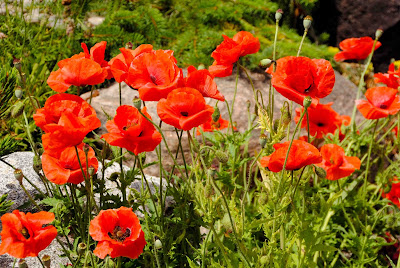
I always seem to be most attracted by the brightest flowers, like these poppies (my wife calls me a just a magpie), as well as the actual structure and layout of the garden - that's my half of the work at our own garden. The colour contrasts in this part of the garden are quite striking.
And here is a small part of one of many sculptures of various sorts. I could add 20 more photos of sculptures and whimsy easily.
One thing I was suspicious of are these giant thistles, about 6-8 feet high, with enormous stems and lower leaves. These are from the UK, where you commonly see them as ornamentals in gardens, and they really are very striking. But we had a few of these for 2 or 3 years in a previous garden, and they self-seeded all over the place. We quickly got rid of them so they didn't escape into neighbouring farm fields. I hate to think of the results if they naturalized here!
Tomorrow (that's later today now, 'cause I'm so delayed), the 'Keppel Henge', the 'Analemmatic Sundial' and the 'Skipping Stone Capital of Canada'.
From the moment you walk through the welcoming gate it's a fascinating place, with gardens, stone walls, paths, edges, sculptures and whimsy, as well as some really unique features like a stone circle and an analemmatic sundial (bet you don't know what that is!) - but that will be tomorrow's story.
Keppel Croft is best known for it's rock garden,which is beautiful, with numerous boulders, stepping stone paths, and an interesting array of plants, as well as the odd striking sculpture. Luckily for the visitor, the gardeners enjoy moving rocks around; rock walls, edging and paths feature throughout the garden.
I always seem to be most attracted by the brightest flowers, like these poppies (my wife calls me a just a magpie), as well as the actual structure and layout of the garden - that's my half of the work at our own garden. The colour contrasts in this part of the garden are quite striking.
The most interesting underlying story of this garden though is in its creation, for it's built on an area of ancient glacial lake beaches, composed entirely of flat worn, rounded rocks, several metres deep apparently. To hear the gardeners explain it, there was virtually no actual soil; they learned quickly to dig holes among the loose old beach rocks, add soil, and plant things in the holes. Today they are left with the small beach rocks as mulch throughout the garden - the most unique mulch I've ever seen. And there seems to be very little weeding problem. And of course there are lots of rocks at hand for those walls, paths, and edging. Look closely at the foreground of the photo above and you'll see the small stones that compose the 'soil'.
The whimsy they've added to the garden make it very interesting for me, and I come away with numerous ideas for our own garden - except it's already too much work without new projects! Here the flowerpot towers near the potting shed (and a few plants for sale) add a surprising bit of colour, and a collection of succulents sits on an old wooden step ladder.And here is a small part of one of many sculptures of various sorts. I could add 20 more photos of sculptures and whimsy easily.
One thing I was suspicious of are these giant thistles, about 6-8 feet high, with enormous stems and lower leaves. These are from the UK, where you commonly see them as ornamentals in gardens, and they really are very striking. But we had a few of these for 2 or 3 years in a previous garden, and they self-seeded all over the place. We quickly got rid of them so they didn't escape into neighbouring farm fields. I hate to think of the results if they naturalized here!
Tomorrow (that's later today now, 'cause I'm so delayed), the 'Keppel Henge', the 'Analemmatic Sundial' and the 'Skipping Stone Capital of Canada'.
Sunday, July 14, 2013
Places, #1 - Petrel Point
I started this blog to make note of things I observed over the passing seasons in the rural landscape here in the Beaver Valley in southern Ontario. But I have often thought of writing about other things. The most common is simply other places, so starting now, I'll occasionally be posting a few photos and observations about other places we visit. (The other story I'd like to share is about 'The Making of a Garden', our garden, but that will have to wait awhile).
When we visited Georgian Bay the other day, we carried on west to the Lake Huron shoreline, and the nature reserve owned by Ontario Nature at Petrel Point. This is one of the most fascinating little bits of habitat in southern Ontario. A shoreline 'fen', it's best known for its orchids, including this Grass Pink, or Calopogon, above. In my mind it's one of the most beautiful pink colours of any pink flower.
Another orchid species that grows here and a few other places along the sandy flat Lake Huron shore is the paler pink Rose Pogonia. Neither of these are fabulous pictures, but there is a boardwalk to protect the sensitive habitat from trampling, and we carefully stayed on it, getting what pictures we could from there.
This Tall White Bog Orchid is a distance away, but with some heavy cropping you get the idea - growing in the wet sand, surrounded mostly not by what looks like grass, but by wetland sedges and rushes.
The fen habitat is unique. Although Hudson's Bay is bordered by thousands of square kilometres of it, this far south in Ontario it is very rare. It occupies the wet band behind the shoreline edge, often marked by a low dune or ice ridge, and the first rise to higher sandy ground where the taller trees grow (on the left above). Especially in the spring, it is usually 3-4" deep in water, and it is a very harsh alkaline environment for plants. It's easily subject to trampling, so all access to this fen is by the boardwalk.
Orchids my be the plants that draw people to visit, but there are a number of unusual other plants too. Above is the very unusual flower of the Indian Plantain, composed of little five-ridged capsules, held vertically at the top of a 3 foot stalk.
And finally there are the insectivorous plants - here the Linear-Leaved Sundew, and the Pitcher Plant, both of which gain nourishment in part by capturing small insects and dissolving them. The 3 or 4 dozen vertical Sundew leaves in this picture all have tiny hairs which wrap around their victims; the reddish 'pitchers' of the Pitcher Plants have downward pointing hairs that trap their victims. Both very unusual plants to see - here growing in profusion.
Friday, July 12, 2013
Georgian Bay
Drove north yesterday, past Owen Sound, up over Kemble 'Mountain', and down to the Georgian Bay shore at Big Bay. It turned out to be a spectacular day, one of those beautiful high pressure days in July with deep blue sky and deeper blue water. Made me remember what the shoreline of Georgian Bay, viewed in the right weather, is really like!
By noon the initial clouds had disappeared, and the water was reflecting the blue of the sky. This is the view northwest, across Colpoy's Bay, to the cliffs of the Niagara Escarpment at Malcolm Bluff in the distance, White Cloud and Hay Islands on the right.
The pier at Big Bay, proudly flying the Canadian flag, the water on the right turned brownish by the waves churning the small stones on the beach, and grading out through turquoise to deep blue.
And the view to the northeast, along the incredible cobble beach, all composed of small smooth rounded stones, rolled around in the summer by the water, but pushed up in the winter by the ice.
Just for interest, this is the view that morning at 9 a.m., when I first arrived - before the high pressure system arriving had pushed away the gray clouds of the day before. I drove to Big Bay to visit the fascinating Keppel Croft Garden - more about that another day.
In the meantime, I'm linking this to Skywatch Friday. Got to figure out how to get those logos to appear here!
Thursday, July 11, 2013
Raindrops
Well, the rain is over, thank goodness. The hot humid weather has broken, and we're back to bright sunny cooler summer days. But I did try some raindrop close-ups over the past few days when it felt like the rain would never stop, so here they are:
Wednesday, July 10, 2013
Wooded Country Roads
One of the things I like best about the landscape around the valley is simply driving down various sideroads to see what you come upon, views that open up, crops being grown, or views that close in. There are several roads in our area that are open in the summer but not in the winter, where the road allowance has grown up in trees. They make a beautiful brief interlude in your driving.
Sideroad 7, Southgate Township
4th Line A Old Euphrasia Township
35th Sideroad, Old Artemesia Township
Subscribe to:
Posts (Atom)


