Wednesday, December 8, 2010

Snow Streamers in the Snowbelt!

For three days this week it snowed all around us, though we've only received 3-4" here. Snowfall in the snowbelt is obviously dependent on the vagaries of the streamers off Georgian Bay and Lake Huron. And this week, a major streamer has dumped huge amounts from Lake Huron toward London, while another streamer has snowed heavily from Collingwood southeast. Lucan, just north of London, has received nearly 5 feet of snow!! But we're in between, and it seems like just normal winter weather here.


This snow is 'lake-effect snow', caused by very cold arctic air masses moving over the relatively warmer waters of the Great Lakes. If the temperature difference between the higher, colder air mass and the air at the surface of the warmer water is big enough, atmospheric instability occurs. That is, the huge difference causes warm air (and water vapour) from the surface, to move up into the colder air, since nature doesn't like such imbalances, and always tries to even them out. (Warm air always rises, cooling as it does so, and cooler air always falls).

As the warmer air moves upward, it cools, starting the formation of snow crystals. When this air mass moves over land, it all cools, since there is no longer a source of relative warmth at the surface. The air also tends to 'pile up', as the friction of air moving over land compared to water slows down the air movement. Air has nowhere to go but up - cooling again, and adding more snow. The bigger the original temperature difference, and the longer the stretch of warm open water for the wind to blow over, the more snow that develops. Meteorologists look for a difference of at least 13 degrees celsius between the warmer and colder air, and a fetch of 100 or more km. over open water.

Such arctic air masses always tend to blow toward the south-east over southern Ontario, and then dump their heavy load of snow in a long band or streamer over land exactly as it did over Lake Huron toward London and Georgian Bay from Collingwood south-east this week. If you're in the path of a streamer, you may get excessively heavy snowfall, while areas just a few miles out of the path only get normal snowfall. Such snowfall is also more likely early in the winter, in November-December, because the temperature of the Great Lakes water hasn't cooled down much yet, so the atmospheric temperature difference is still high.

Southern Ontario, southeast of Lake Huron and Georgian Bay, (along with Buffalo and parts of New York State, east of Lake Erie) are the classic examples of 'snowbelts' in the world. Lake effect snow tends to be light and fluffy, so it easily blows around once it's on the ground, giving us white-outs and snowsqualls too.

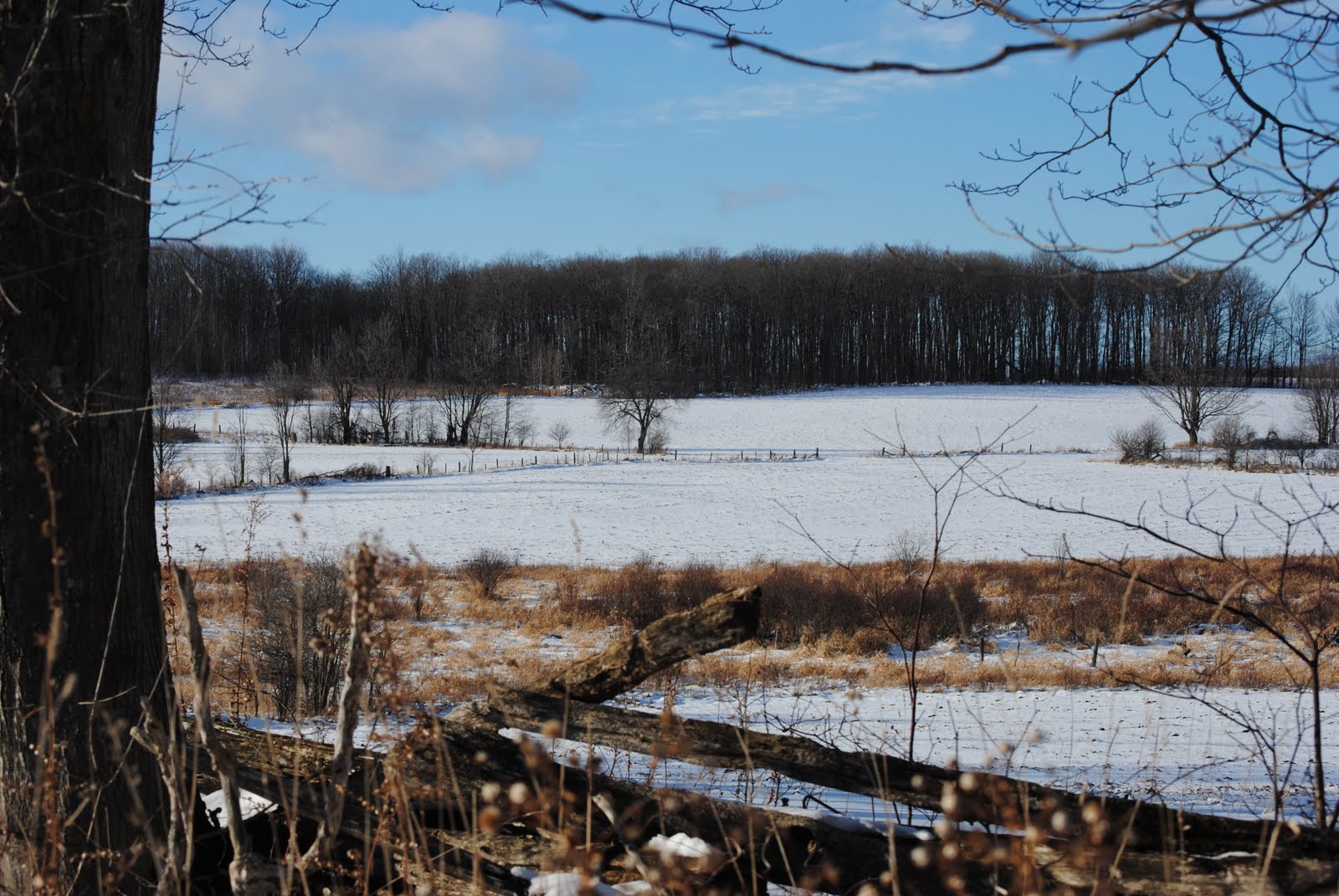
Certainly everything here is white now, covered in a foot or more of powder snow, and with the temperature staying near -10, the snow stays light and fluffy. And it's piling up on the leeward side of our house, waiting for me to shovel it. Next time we may be in the path of the streamer, but today is bright and sunny, with a dazzling blue sky, and for now I don't have to shovel!

Wednesday, December 1, 2010

Old Stone Fencerows

Among the most remarkable things in the rural landscape of the Beaver Valley are the old stone fencerows. Created by the pioneers when originally clearing the land for homesteads, these are permanent reminders of their enormous effort. They created a landscape of small fields bordered by trees, and they become startlingly visible in November - December.

I am absolutely amazed by the size of the rocks they moved, even the smaller ones. I've seen pictures of how this was done, using a team of horses, a huge tripod of poles, and a block and tackle for the large ones - a far cry from the easy stone picking we still do today. Three rocks in our own fencerow are half the size of a small car! And most of the rocks would be far larger than even two men working together could move.


Almost more amazing are the built-up stone walls, made of smaller rocks that could be packed into a solid structure. These form straight lines through the woods, or down the side of a lane, and some of them are still standing 150 years later.

I see these old fencerows almost everywhere I turn, though much moreso on top of the Niagara Escarpment where it is stonier, than in the actual valley, which has clay soil at the surface. They are most remarkable to me where they mark an old homestead now otherwise gone.

Saturday, November 27, 2010

Winter Has Come to the Valley

Winter has arrived in the valley. A 'Storm Warning' and 'Snowsquall Warning' the weather forecast said, and the snow arrived, about 6 inches of it, turning the ground white, while the strong wind howled around the cabin.

The Valley - Talisman Ski Resort lower left.

Some people retreat from winter, or head south, but we enjoy it. Winter walks, snowshoeing, and skiing all let you get outside. Others jump on their snowmobiles at the earliest opportunity, and organized, clearly marked snowmobile trails run for miles through the countryside.

The Valley - Cliffs of Old Baldy upper right

Skiing is important to the valley, with two downhill ski clubs bringing dozens of seasonal and full-time jobs. More than a few local farmers have supplemented their income with winter work on the ski hills while snow closes down work on the farm. The ski hills will soon turn on their snowmaking, once the temperature stays below freezing, and soon the skiers will be back.


The countryside is wrapped in its first blanket of white for the year, covering the fields, the fencerows and the woodlots. We have the snowshoes and snowblower ready, and in the meantime, just hunker down and prepare for indoor hobbies, quilting and writing, and over the next few weeks several Christmas dinners.

Sunday, November 21, 2010

Apple-Stashing Squirrels and Milkweed Seeds


Lots of little things happen as the seasons pass, and November is no exception. The red squirrels have been busy in the old apple trees along the fencerow, stashing apples in the crotches of the branches, presumably to keep them high and dry for later. Who knows if they actually return and eat them!

Elsewhere I've seen squirrels do the same thing with mushrooms - creating a mushroom tree, decorated with white mushrooms drying in the open air.


At the same time, November is a major time of seed dispersal. Returning from a walk you (and the dog) are decorated with burrs of several different kinds; even the tiny goldenrod seeds stick to your clothes briefly to get carried away from the parent plant.
But milkweed seeds are the most obvious, bursting out of the cocoons that have held them, and blowing away in the wind. Each small round brown seed is held aloft for awhile by a white parachute of silk. .


Mysteriously, I've noticed that different patches of milkweed seem to disperse their seeds at different times, even though all the plants in any one patch release their seeds at the same time. A patch near our garage was exploding in tiny white parachutes in September, but a patch 100 yards away just released its seeds now.

Sunday, November 14, 2010

Brilliant November Days!


A week of brilliant, blue-sky, warm days in November, a big bonus at this time of year, especially after last week's snow! Trees are standing stark against the sky, their leaves gone, trunks and branches black and grey against the blue, the ridges and patterns of the bark more obvious. The grass, weeds and shrubs are 40 shades of brown.

November is an in-between month for many, too cold to be comfortable outside, but no snow for winter sports yet. But for others it is a great time to be outside - the soybean harvest is just being finished, wild turkeys in big groups are picking up spilled beans in the fields (we saw probably 150 today). Hunting season is here, a great week outdoors for many - venison in the freezer for winter. And if you didn't get those October chores done, a week like this lets you catch up before snow flies.

I like November because you can see so well through the trees. Buildings hidden all summer show up on the slopes of the valley, among the forest. Rock formations, the rocks of the Niagara Escarpment, are more visible. Old stone fencerows emerge from the undergrowth reminding you of the folks who cleared this land 150 years ago. The landscape is laid bare so to speak, visible to all for awhile until snow flies.

Friday, November 5, 2010

The First Snow of Winter


The first real snow of winter, turning the world white. A wet snow, clinging to trees and twigs and grass, but melting on contact with the driveway or the boulders in the old fencerow.
It's notoriously hard to take a picture that captures the bright whiteness of a snowy day. By 4 p.m. at this time of year the sky is already starting to darken, and the bright whiteness is gone. But snow on the twigs give some sense of the beauty. Even the hawthorn meadow looks pretty in this weather.

Wednesday, November 3, 2010

Tamaracks are Gold


About 2 or 3 weeks after all the maples, ash and oaks have turned colour and then lost their leaves, the tamarack turn their needles to gold, a last sign of summer before winter snow arrives.

Tamarack are the only coniferous trees here that lose their needles every fall. Growing in a small bunch, the needles turn yellow-gold and fall off, leaving the tree as stark as deciduous trees over the winter. I've always seen this as a last burst of the glory of summer, and I've planted a small patch of tamarack at the back of our own property, just to look at at this time of year.