Showing posts with label Garden Flowers. Show all posts

Monday, July 22, 2013

Hosta Flowers


I have to admit that I've generally ignored the hosta flowers, beyond noticing the many white spikes along the fencerow at this time of year.  But hostas are actually the backbone of our garden, planted along 200 feet of an old stone fencerow.  We have easily 400 plants of 300 different varieties, so I thought it was high time I should take a closer look.  I was pleasantly surprised at the results.

Hostas are best known for the leaves, which do well in shade, and come in a variety of greens, sometimes with some white, and with varying textures.  The leaves range in size from 1 inch to more than a foot, forming plants from 6 inches wide to 6 or more feet wide!  And we have a lot of them!  The flowers are actually all very similar, but this was one of the most striking when I took the macro lens and tried to get some close-ups.

 
Viewed from the side, individual hosta blooms on the spike of flowers are quite beautiful, and they come in a range of colours from mostly white through to purple (above) or blue (below).  And looking closely you can see that the stamens also vary in colour, from yellowy above through reddish brown here, to blue below.

You almost have to look up inside the blooms to really see them, and have to get down on the ground with your camera to get a picture. Perhaps someday I'll post some pictures of the varied leaves too.

Only in some varieties do the stamens and pistil seem to unfold like this, while the petals bend backwards, giving this sort of an open view of the flower.  I have a whole new appreciation of hosta flowers now.

Apparently deer appreciate hosta flowers too, because we've lost a large number of the flower spikes (before they really bloomed) to the deer who come for a succulent snack in the dark!

This is the view you usually see walking by the fencerow, with about 15 different hosta plants in this picture.  This is just a tiny corner of our hosta collection, so I guess I should be paying more attention to them. At one point I knew a great many of them by name, because I transplanted all these from another garden when we moved here.  The profusion of blooms does catch your attention, but they have always seemed rather nondescript to me (in comparison with other flowers in our garden).  Looking closely gives an entirely different impression.

Check out other close-ups at Monday Macro2.

Saturday, July 20, 2013

Back to the Garden - It's Day Lily Season!

It's the brightest season of the year in the garden.  As long as the day lilies bloom we'll have bright colours to flash in the sun.  In fact, parts of the garden are a riot of colour right now.  As you can see by the pictures I love the bright colours.  Anything orange appeals to me!

This one is 'Saugeen Sunrise', perhaps our favourite day lily, a very prolific bloomer.  To show you how naive I was as a gardener, I didn't realize just 3 or 4 years ago, that each bud on a day lily blooms for one day - thus the term day lilies!

 
This one, a little plainer orange, but just as bright, is 'Start Me Up'.  To me they were all just nice flowers, but I'm gradually learning the names of the ones that particularly appeal to me.

The third orange one, with a deeper reddish 'throat', the area in the centre, is 'Orange Electric'.  I'd just go on buying the bright coloured ones, but there are lots of others.  I'm just biased in my preferences.  It's the very same with my wife's other hobby, quilting - the brighter the better.

These three blooms together are 'Across the Road'.  The number of buds on a day lily stalk, and the number of stalks on a plant together determine how often it will bloom.  Better plants produce more stalks with more buds and therefore bloom for a longer period.

'French Twist' has an unusual interesting texture to the red leaves.

And finally, 'Scotch Rock', one of the darkest flowers we have, a deep royal purple colour.  They're all simply beautiful.  If you get a chance to visit a day lily garden at this time of year, please do so!


Monday, July 15, 2013

Places, #2 - Keppel Croft Garden

On that drive up to Georgian Bay, the real purpose was to visit Keppel Croft Garden.  It's unique in my experience.  It's full of interesting features and creations and fascinating landscapes, as well as (of course) plants.  It's a private garden, but listed on the Grey-Bruce garden tour, and open to the public on certain days of the week.  This one gets a lot of visitors - and it's so popular locally that it also gets a lot of volunteers!  That must make garden maintenance easier!

From the moment you walk through the welcoming gate it's a fascinating place, with gardens, stone walls, paths, edges, sculptures and whimsy, as well as some really unique features like a stone circle and an analemmatic sundial (bet you don't know what that is!) - but that will be tomorrow's story.

Keppel Croft is best known for it's rock garden,which is beautiful, with numerous boulders, stepping stone paths, and an interesting array of plants, as well as the odd striking sculpture. Luckily for the visitor, the gardeners enjoy moving rocks around; rock walls, edging and paths feature throughout the garden.

I always seem to be most attracted by the brightest flowers, like these poppies (my wife calls me a just a magpie), as well as the actual structure and layout of the garden - that's my half of the work at our own garden. The colour contrasts in this part of the garden are quite striking.
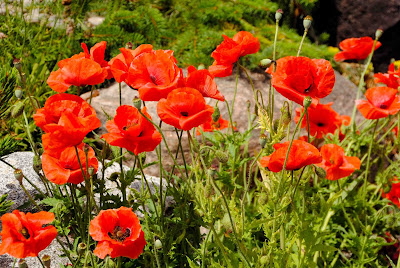


The most interesting underlying story of this garden though is in its creation, for it's built on an area of ancient glacial lake beaches, composed entirely of flat worn, rounded rocks, several metres deep apparently.  To hear the gardeners explain it, there was virtually no actual soil; they learned quickly to dig holes among the loose old beach rocks, add soil, and plant things in the holes.  Today they are left with the small beach rocks as mulch throughout the garden - the most unique mulch I've ever seen.  And there seems to be very little weeding problem.  And of course there are lots of rocks at hand for those walls, paths, and edging.  Look closely at the foreground of the photo above and you'll see the small stones that compose the 'soil'.
The whimsy they've added to the garden make it very interesting for me, and I come away with numerous ideas for our own garden - except it's already too much work without new projects!  Here the flowerpot towers near the potting shed (and a few plants for sale) add a surprising bit of colour, and a collection of succulents sits on an old wooden step ladder.

And here is a small part of one of many sculptures of various sorts.  I could add 20 more photos of sculptures and whimsy easily.

One thing I was suspicious of are these giant thistles, about 6-8 feet high, with enormous stems and lower leaves.  These are from the UK, where you commonly see them as ornamentals in gardens, and they really are very striking.  But we had a few of these for 2 or 3 years in a previous garden, and they self-seeded all over the place.  We quickly got rid of them so they didn't escape into neighbouring farm fields.  I hate to think of the results if they naturalized here!

Tomorrow (that's later today now, 'cause I'm so delayed), the 'Keppel Henge', the 'Analemmatic Sundial' and the 'Skipping Stone Capital of Canada'.


Monday, July 1, 2013

Macro Shots in the Garden

In honour of Canada Day, here are a few of my favourite close-ups in the garden from the past two months.  I've only had a macro lens for 6 weeks, but it's opened up a whole new world of looking around me and appreciating what we have here.  From the garden to the valley to the country, we're glad we live here!


A beautiful white and purple Cornflower or Bachelor's Buttons, an early spring flower.


One of several tiny Primula that also bloom in early spring in our garden.


My favourite bright red Dianthus or pink in the scree garden.


A bright pink Transcanthia or spiderwort.


A bright pink Monarda, also known as bee balm or bergamot.

Full credit goes to the Chief Horticulturalist here, who I turned to to find out what each of these was officially called.  I'm linking them to Macro Monday and Today's Flowers.  In any case, when you look more closely at these, thanks to my camera, you just see the beauty even more.

And tonight we're heading for the huge Priceville fireworks display nearby.  I'm going to try some fireworks photos for Canada Day.

Sunday, June 30, 2013

The Garden - Today

The overwhelming impression of the garden today is the fragrance.  As soon as you walk close the beautiful smell envelops you; in the evening the entire yard smells fragrant.  It's the valerian primarily, though in some corners of the garden there's also a strong scent of boxwood.


Visually, the tall orange spikes of foxtail lilies and the lesser spikes of the yellow baptisia or wild indigo punctuate the garden with strong vertical accents, while the remaining pink peonies are the biggest flowers of all.  The sweet-smelling valerian is the tall white flower in the left background above, much more conspicuous for it's fragrance than it's flower.


The foxtail lilies and the baptisia certainly accent the garden, but the close-up of the lily in bloom (below) struck me as the most fascinating picture.  The plant blooms slowly from the bottom of the flower spike upwards, and the rusty-brown stamens are strikingly obvious at this distance.


We've also got digitalis in bloom, a gentle pink one, but more will appear in the next few days.  You practically have to crawl on the ground to look up into the individual florets.


And this is the valerian, a tall open plant, the tallest well over 6 feet, with few leaves near the top, and umbellifera-like clusters of tiny white flowers.  It's taller than anything else, and it also self-seeds easily and widely, so it will soon decorate your garden if you don't control it - or spread and bring its fragrance with it if you choose to let it.


 The individual flowers are very tiny - obviously powerful for the fragrance they provide.  Individual blossoms might be 1/4 inch across.  But at this time of year it's my favourite, because it colours your whole experience every time you walk to the garden.


Saturday, June 29, 2013

The Garden - Peonies and Lilacs

Most of my pictures are of nature or the landscape, but in fact nowhere is the passing of the seasons more obvious than in the garden, and it's right under my nose every day.  Flowers come and go at astonishing speed, blooming and fading over just a few days.  You can mark the seasons by many of the flowers in the garden - and the past few weeks have been peonies and lilacs.


I think this is the best picture I've shot of the peonies this year, early in the morning in the sun with the dew still on the petals;  I found it hard to get any picture that would capture the richness of the huge flowers, but I think this comes close. 


The white peonies actually bloomed first, moving from the large swollen buds, here covered in raindrops, through lavish large flowers, until the started falling over and dropping petals.  They are just about over now. 


For all their rich blossoms, I wish the peonies had a stronger fragrance, and weren't so sloppy as they finished blooming.  They just look so bedraggled eventually.  But they certainly dominate the garden when they're in bloom.  The pink ones are still with us - looking bright and beautifuland adding a huge splash of colour to the garden.


Largely at the same time our group of lilacs blossomed - finally.  They spent their first winter, a decade ago, in a plastic bag in the basement.  For the next several years they competed with long grass, while we ignored them.  But 4 years ago I started mowing around them, and then mulched them heavily with leaves in the fall.  Presto, without the competition they have exploded.  This year they have grown a foot or two, and were covered in blooms.


And their favourite visitor is the swallowtail butterfly
.
 

Linda, at the 'Crafty Gardener' has added me to her 'Can'eh'dian Blog Hop', a great list of Canadian blogs, and a good site to visit:  www.craftygardener.ca/canada-blog-hop/.  This post on the garden and a couple more will pay homage to her useful list.  Sorry, but I still have to learn to post links so they work; in the meantime, google it!


Sunday, May 26, 2013

Irises

Another beautiful late spring day, cool but sunny and great for a little more work in the garden.  But the flowers are passing so quickly that you only see them with their best blooms for 3-4 days at a time, then they're gone.  I can hardly keep track of what I'm seeing the garden changes so fast at this time of year.


These irises were in their best condition nearly a week ago, before the storm that brought so much rain and then the colder temperatures.  They're already pretty well gone now.  But I love the flowers, especially the tiny 'beard' that runs down the middle of the lower petals.  And they come in an amazing variety of colours.


I think I like the dark purple ones best, though these deep brownish-red ones are nice too.  We also have some white and yellow ones - though nothing beats the royal blue of the tiny early spring iris (see April 13th).


Saturday, May 25, 2013

Shooting Stars


May and early June is the time for gardening.  You could be out in the garden all day every day and not keep up with everything we want to do.  We're still expanding the garden, bringing in triple mix, manure and compost to build up an otherwise largely useless clay soil.  And for the veggie garden at least, we're building raised beds.  And we use tons of mulch, either the free leaves from across the road in October, or I buy it by the trailer load.  It works!  We're left with a largely weed-free garden as long as we load it up with mulch.


This year we have several new plants, after expanding the garden last year.  In fact every year we just can't seem to resist buying more new plants.  But this is my favourite among them - shooting stars.  It's an ephemeral spring flower that blooms now; the one we have is brilliant pink.  About a foot tall, it has numerous blooms at the top of two or three stems, over a basal rosette of leaves.  A close-up of the individual flowers, below, shows how colourful they are.


Thursday, May 23, 2013

Fern Leaf Peony


The fern leaf peony is supposed to be hard to grow, but ours is flourishing.  It's one of the first plants up in the spring in the garden, spreading it's very frilly leaves above the dirt as soon as any even slightly warmish weather gets here.  It grows fast, ahead of all the other peonies, until it's a mound of light green foliage nearly 3 feet wide and high.


 Then the blooms come out, brilliant red with yellow stamens buried deep in the flower.  For a few days anyway, the plant is just covered with the bright blossoms, making it look like a huge lantern in the garden.  Unfortunately this year the heavy rain the last two days has done it in quickly, but it's been a sign of colour to come over the summer.