Tuesday, December 13, 2022

The Legend of 'Blue Eyes' and TCE

Two more stories about the land known as the Meaford Tank Range, or the 4CDTC. 

The story of 'Blue Eyes' features a pretty little girl who lived on a farm in the area now occupied by the army base early in the last century.  The story is that the girl went out to gather flowers before supper one day, and never returned.  Though they searched everywhere she was not found until too late.  It turned out that she had wandered into an area where she was not allowed and fell into a deep well, drowning before she was found.  She is buried in the small cemetery there.  

What makes this an interesting ghost story is the number of army personnel who have reported a 'hair-raising' experience when nearby.  Most reports seem to occur at night.

One man reported being on a reconnaissance patrol in the area at 3 am, checking out an old forest road to see if it could still be used.   Learning to operate as a team in the middle of the night is an important part of training.  Soon the team reported the air turning ice cold and the hair on their neck standing up as they felt they were being watched.  Then they saw a moving white apparition far through the woods.

A year later the same man reported, again in the middle of the night, through IR goggles, seeing a little girl in a flowing white night gown.  I should add that this training also included sleep deprivation.

Several other people have reported feeling they were being watched, or seeing shadowy human figures through night vision goggles when operating in the area of 'Blue Eyes' grave.  In the reports I have found there have been no harmful episodes apart from that of the original girl who drowned.  


The TCE Proposal 

Moving from one end of the time scale to the other, Trans-Canada Energy is currently proposing to construct a large pumped storage plant on the army base in Meaford, and the proposal has drawn a lot of opposition from Meaford residents.    

In this image you can see the present base buildings in white in the upper right, and Georgian Bay in blue in the lower left.  This is an unusual perspective, from the northeast.   A new lake (in blue) would be constructed on the base, with a pipe to Georgian Bay.  The simple concept is that water is pumped up to the lake at night when energy prices are lower and demand is less, and then power would be generated during the hours of high demand by allowing the water to run back down hill, when energy prices are high. 

At that point it stops being simple.

You can first consider the immediate local impacts.  Fears of fish being sucked into the intake valves are probably number one, the impact of a new hydro corridor is a close second.  Will it use land the base requires?  And what will be the impact on Meaford during the period of construction, from both trucks on local roads and the number of workers involved?

Portraying itself as listening to local concerns, TCE has proposed three important design changes, first moving the generating station underground, second screening the intake valves to avoid harm to fish, and third, running transmission lines through Georgian Bay and underground to the junction at Essa, southwest of Barrie, all at a cost of an extra $1 billion. 

These points are illustrated in the diagrams below. 

This shows, in a conceptual way, the generating station underground, fed by water from the new lake above, with outflow/intake pipes running underground out to Georgian Bay.  

And this shows the alternate transmission lines.  Obviously the under Georgian Bay option will be much more acceptable locally.

However, all of this just looks at local impacts.  Comparisons to other projects are also important to look at, since TCE has described the project as contributing to making Ontario's hydro production 'greener'.  

First TCE claims that it would be 'greener' than a gas-fired plant, but there is no proposal to build a gas-fired plant, so that comparison doesn't seem very legitimate.  Then the Ontario Clean Air Alliance came forward to point out that we could import power from Quebec (which has plenty of surplus hydro power), at a very small cost in comparison.  It leaves me wondering just how this decision will get made.

It has also been pointed out that the cheap overnight energy prices that TCE will be paying come because the nearby Bruce Nuclear Power Plant has the energy available, and TCE owns 49% of the Bruce plant.  

Personally I'm left confused, but there you have it, a new lake on the base and everything else underground and out of sight.

****

In case you're wondering, Ontario has one of the lowest rates of carbon-producing energy production in the world.  We are heavily dependent on nuclear energy and hydro (thanks to places like Niagara Falls).  Coal was phased out some years ago and only a limited amount of natural gas production is used.


Friday, December 9, 2022

More on the 'Tank Range'

Continuing my story of the tank range training facility, I should first acknowledge the hardship of the farm families who were pushed out during WWII.  Expropriation came with its own hardship and disruption as families were torn apart and had to find new places to live, but there was confusion too. . 

First, some misunderstood what expropriation actually meant, some thinking that if they did not sell voluntarily at a set price, the government could take it for nothing.  Others thought they could return after the war.  On the other side of the coin, patriotism was a big reason for selling - 'If others were giving their lives, the least we could do was give our farms'.

There was certainly resentment over how the move-out was handled.  Deadlines were rushed and no help was provided, either for finding a new farm or for the effort of moving itself. Harvest was often incomplete so the government was forced into making available dates when farmers could return, especially to complete apple picking.

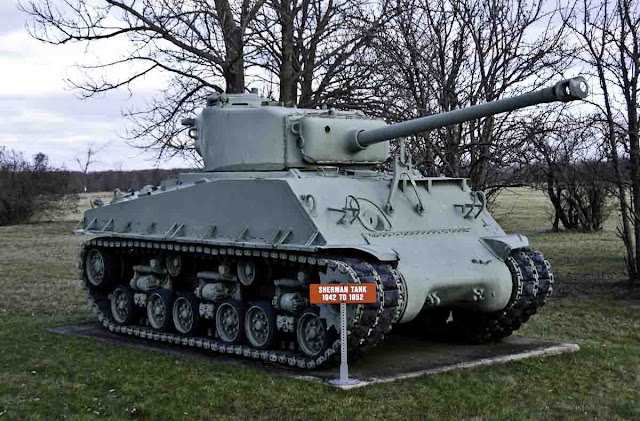
The Sherman Tank, in use from 1942-52. 

Never-the-less, people moved out, soldiers and tanks arrived, and training began.  The Meaford Military Camp began operations.  Initially training focused on tank warfare, and the base continued to be quite active into the 1960s.   

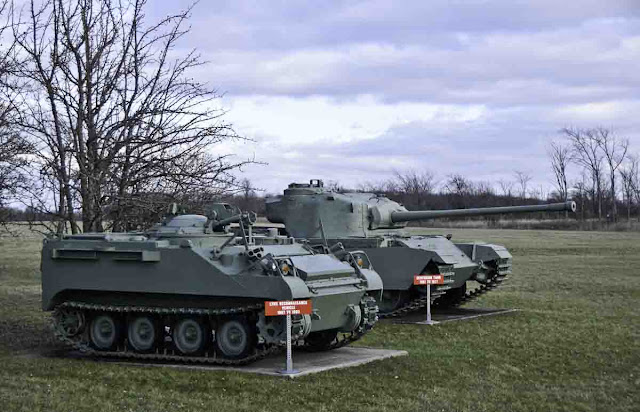
The Centurion Tank, 1951 - 1977, and  
a Lynx Reconnaisance Vehicle, 1967 - 1993 

Vehicles changed over the years, and the transfer of some training to Camp Gagetown in New Brunswick led to the Meaford base being mothballed in 1970.  Only five security guards remained.   

However, reserve forces (apart from regular full-time paid forces) from the Toronto area began using the base informally to save the time and cost of a drive to Petawawa, another base in Ontario east of Algonquin Park.  It only took a year or two before plans were made to re-activate the centre as a training ground for those reserve forces.   

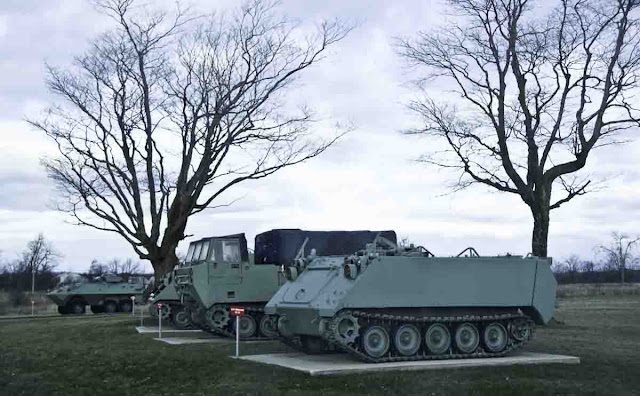
Several light armoured vehicles. 

Into the 1980s and the early 90s the area saw steadily increased use as the government expanded the number of reservists and new light armoured vehicles were introduced.  By the late 1980s major investment began to build a state-of-the-art facility, which it is today.  Over $80 million in construction provided new buildings and other infrastructure, so the base can support 600 trainees at any one time. 

By the mid-1990s it became the Land Forces Central Area Training Centre.  Today it provides some year round training for regular forces, and expands during summer with training for reservists.  Basic courses for infantry and artillery (the guns we hear) are held, covering rifle training as well as the use of bigger guns up to and including howitzers.  This includes full time summer employment for student reservists, as well as numerous weekend training workshops

A howitzer being fired during a training exercise two weeks ago, 
image from 4 CDTC Facebook page Nov, 28, 2022. . 

In 2013 it became the 4th Canadian Division Training Centre or 4 CDTC.   It offers both the military training as well as other workshops ranging from mental health to financial management.  Today police forces and other security units use the base for training,, and participants come from across the country as well as several other countries. 


Tuesday, December 6, 2022

The 'Tank Range'

I was hearing the muffled booms of the big guns last weekend, obviously from a training event up on the army base.  It just sounds like rolling thunder in the distance, but it can go on for several hours.  I thought you might be interested in a bit of the history of  our local 'tank range'.

It was 1941 and WWII was well underway.  German tanks had overrun much of France and the Allies realized they needed more tanks and more tank training.  They started looking for a site where they could establish a training base.  A quiet survey was done in the north half of St. Vincent Township and a decision was made.  One advantage of this site was the chance to have live firing exercises with the big guns aimed at the waters of Georgian Bay.  Residents received notice that their properties would be expropriated in early 1942.

On this Google image, you can easily make out the large area extending out to Cape Rich that is no longer used for settlement.  The army still uses a few roads, but most have grown over, and all buildings have been removed.  Only the small rural cemeteries remain.  However, the pattern of the former farm fields, the woodlots and the forested slope on the north and east, as well as long narrow Mountain Lake are all very apparent.  You can actually see the location of our house down in the lower right corner, inside the town of Meaford.

Before I pick up the story of the original expropriations and the operation of the base today, let me try and tell you a bit about the landscape, even though I can't get onto the base to take pictures.  I'll make do with pictures from nearby that help tell the story.  This is the view from Irish Mountain, just outside the entrance.  You can tell we're up on a hill, the entire base sits on top of this hill.

You can see in this closer view that varying geology obviously underlies this landscape, though the forest cover disguises it.  The farthest slope here is Blue Mountain, with a very flat top; the closer is the ancient glacial shoreline just east of Meaford.  The geological layers that underlie those slopes also underlie the base; in fact the base is almost identical geologically speaking, to Blue Mountain.  

You can also faintly see the claybanks just east of Meaford, steep slopes dipping down to water level, and all the light-coloured sediment that's been eroded from those clay deposits.  Very similar claybanks exist at the north side of the base, dipping down into Georgian Bay.
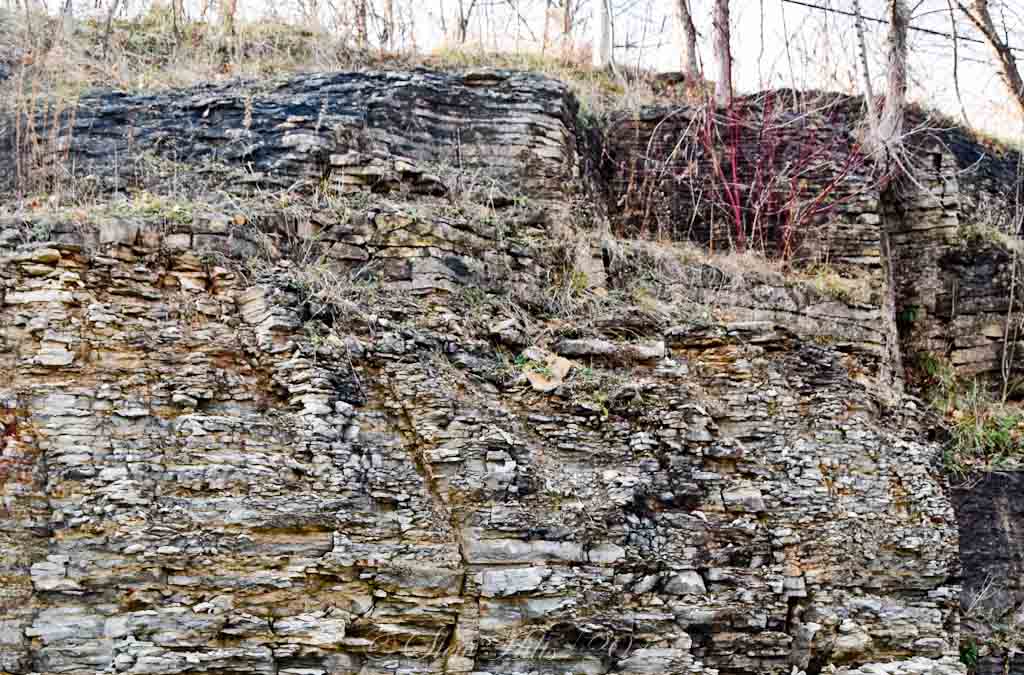
These are the thin beds of dolostone, the Manitoulin Formation, that underlie the main part of the base, as seen at Irish Mountain Lookout.  The base is an 'island' of higher bedrock, just like Blue Mountain. They are both plateaus of this bedrock, underlain in turn by Queenston Shale.  Both are part of the Niagara Escarpment. 

The claybanks east of Meaford look like this, taken on a paddle a few years back.  I presume the claybanks on the north side of the army base look like this too. 

Over 150 farms, 2 old one-room schools and 2 churches have vanished.  Replacing them is a cluster of dormitories, offices and other facilities that shows up as the white patch at the lower edge of this area on the air photo above, the the entry point for the base. 

Officially the base is known as the 4th Canadian Division Training Centre today, following the most recent re-organization of the Canadian military.  Until 2018 they provided occasional tours of the base, so I have been there, though my memory is faded.  They also have a gym facility which was open to public membership for a time.  Today the base is closed to any public visits though; we just hear the guns!


Monday, December 5, 2022

I got Interviewed!

A few weeks back while downtown I discovered I had lost the book bag that hangs on the back of my wheelchair when I go to the library.  And it had two library books in it!  I frantically retraced my route along the block back to the library with no luck.  As I was asking the librarians if they had seen it, a kind young woman standing nearby said she thought she had seen it and offered to go looking for it.

Soon she was back with it (our main downtown is only one block long), and I got to meet an interesting lady who works for the town.  While I thanked her profusely for rescuing me, we got to chatting and eventually she asked if I'd like to be interviewed about my use of the library.  Of course I said yes!

So Friday was the interview and Mrs. F.G. kindly drove me downtown.  I had to go to the bank first; they still haven't got our credit cards sorted out six weeks after our accounts got hacked.  Then I rode across to the library and headed for the reading room to wait.  My interviewer arrived soon after.

We sat and chatted for an hour and a half about the importance of the library in the community, while listening to the loud voices of young children in the background.  I'm well aware that not everyone goes to the library, but books have always been an important part of our family, as well as my career.  When we were travelling across country with young children, the reward for good behaviour in the car was a trip to the next bookstore we found.

Today I love coming to the library both to sign out books (I always have at least one book on the go), and to visit the reading room where I catch up on magazines I otherwise would not see.  I'm particularly fond of reading Macleans, Canada's national news magazine.   And the librarians are always helpful, putting books in and out of my book bag, which I can't actually reach myself.

This library is where I feel myself part of the community.  It's free, it's totally accessible, and a bright airy space where you can get help if you need it.  I think the renovations to the old grocery store transformed it into a great public library, and of all the public facilities in town, it makes me feel connected.

The small news item based on ,y interview will appear in the magazine-style program listing the municipality puts out in the spring, covering all recreation programs in town.  And yes, the library is part of that, as the loud voices of the young children reminded us.

And here's an 'official portrait' to accompany the article!


Thursday, December 1, 2022

Time is Flying By!

It's December already!  Yay!  Since I can't really get out and enjoy it, I no longer appreciate winter at all!  You can't ride a power wheelchair in the slush and the grit, so I stay indoors.  It's too cold for my shattered thermometer anyway.

Dec. 1st however always reminds me that in only three short weeks the days will start getting longer. How's that as a cause for celebration?  Within a few days of Christmas I expect you'll notice the days starting to feel longer (for my readers in the northern hemisphere anyway).

So I sit at the window and watch as the season unfolds, and for my money the faster the better!

In the meantime Christmas is unfolding all around us.  Music on the radio here abruptly changed to Christmas music this morning, 100%.  I think they have a box of Christmas music someplace in the basement that they drag out each year.  And the way pop singers can mangle a traditional Christmas song is appalling!

There is shopping to be done, traffic and crowds to cope with, presents to decide upon, and then they have to be wrapped and sent out by the Post Office deadline.  For me, getting out to shop is almost impossible, and I'm left with a distinctly inadequate feeling for not getting great gifts that are a surprise.  I have to come up with a surreptitious way to acquire a surprise gift or two this year. 

I find myself wondering though, how many shoppers remember where the tradition of gift-giving at Christmas originated.  Just what is the Christmas season all about?

Sending out Christmas cards does remain meaningful to me.  It's a chance to stay in touch with friends and relatives at least once a year, though I always know it should be more often.  And I know I should write a more meaningful, personalized message in each card.  My best effort will just have to do.

I hope you can cope with the rush of December, and I hope that spring arrives soon!


Monday, November 28, 2022

Driving Across Glacial Lake Algonquin

You've heard about our visit to Barrie, getting that button on the dashboard pushed and visiting the gigantic Bradford greenhouses, so you have heard the interesting part of this story.  But for this post you have to let me indulge my interest in the glacial landscape between Meaford and Barrie, which I have always found fascinating.

To understand the landscape, the physical geology that underlies this area, we start with Blue Mountain which you drive straight toward east of Thornbury, only 20 minutes from Meaford.

As you go round the curve you get the view that everyone thinks of as 'Blue Mountain' with the first of its ski runs.  You can probably make out a couple of the ski runs at the Peaks Ski Club, but let me tell you about the geology.  This and the land for some distance to the south is the highest part of the Niagara Escarpment largely because of the Algonquin Arch which runs to the northeast, deep underground, pushing the entire landscape higher.  This is why the slope is so high (and the ski runs so long).

Blue Mountain itself is composed of Queenston Shale, a very thick geological formation that erodes fairly easily into long gentle slopes, perfect for - you guessed it - downhill skiing.  That it remains this steep is due to the hard layer of Dolomite at the top, the Manitoulin Formation, that forms a cap rock, keeping the shale from eroding even further back.  If you were to hike the Bruce Trail, which circles the top of the mountain, you would find it almost completely a flat plateau.

The waves of the former post-glacial Lake Algonquin lapped at the bottom of Blue Mountain, and that former lakebed provides the flat land between the slopes and the bay where we are driving today.  We will meet Lake Algonquin again below, after we pass through Collingwood and Stayner.

We have driven through Collingwood and Stayner now, but as we head further east, I am struck by how flat and level the landscape is, for this is a huge former bay of Lake Algonquin, and we are actually driving on the old lakebed, which here extends many kilometers inland from the sand dunes of Wasaga beach today.

There are some interesting old barns, this one added to several times.

The Nottawsaga River drains through the huge Minesing Swamp in the middle of this area.  I once canoed this route, starting 25 miles south and pulling out just a short bit north of this bridge.

A few very modern farms too; this one was particularly impressive.

Farmers were active too on that sunny warm day, either harvesting the last of the corn, or as here, ploughing the fields after the harvest was complete.  We hardly ever see a mould-board plough any more, that actually turns the soil over, farmers use chisel ploughs like this one to loosen the surface but minimize erosion.

You do eventually come to the end of glacial Lake Algonquin, about the village of Minesing, but sorry, I did not get any pictures there.

Barrie is southeast of the ancient lakebed; on the way home though you are soon back down on the lakebed of post-glacial Lake Algonquin just west of Barrie, that same very flat landscape.

As you head north and west you can eventually see the shadow where the flat landscape will end, the Niagara Escarpment running south of Collingwood.
As you get closer coming west out of Collingwood, you are again driving straight into Blue Mountain where the post-glacial lakebed ends.  (I really just took this picture for the looping hydro wires).

After you pass Blue and drive through Thornbury, you get a very similar view, but this is not Blue Mountain at all, nor is it the Niagara Escarpment.  This is the bluff of the Blue Mountain Formation, carved into a steep slope by that same post-glacial Lake Algonquin.  I am sure it confuses many people driving  between Thornbury and Meaford (if they stop to think about it at all), but it is quite different geologically.  There is no dolomite layer on top of this huge slope.  Someday I will have to sort out the geology of the Meaford area and write about that.  Hope you enjoyed my geology tour!


Friday, November 25, 2022

Bradford Greenhouses Garden Gallery

CAUTION!  Far too many photographs, scroll through quickly!

After several posts describing our big snowstorm last weekend, I am taking you back to Barrie.  Remember when we learned about the button on the dashboard, a very easy fix and much appreciated!  

To pick up the story, after leaving the car dealer, and braving a couple of miles on Hwy. 400, we found Bradford Nursery which Mrs. F.G. wanted to visit and spent an enjoyable hour or two exploring the galleries.  It was huge!  Not actually our kind of place, but Mrs. F.G. hoped she might find the odd interesting plant, so that is what she was looking for.  

I did not realize that polar bears were a big part of the Christmas story, but they were what welcomed us here.

There was more greenery available than you could shake a stick at, but for people who are used to going out and cutting their own, this was an expensive way to get it!

And I am pleased to report that they had quite a good collection of Furry Gnomes.

But it was the plants that Mrs. F.G. was interested in, the house plants specifically.  I think that is going to be her new winter hobby this year.

So we found our way (past the furniture and clothing sections) to the house plant section.  It was a huge area!  Here is a selection of what I saw.


Of course they also had Poinsettas, and we bought three, two as gifts and one for ourselves. Ours is shading my laptop as I write this.

And then there were more Furry Gnomes.
And I look just about as shaggy as these gnomes at the moment!

So with our main reason for driving to Barrie dealt with (that button), we said good-bye to Bradford Greenhouse Galleries and headed home, a long but successful day.  And Mrs. F.G. took four new plants home with her.

Today it is drizzling and the snow continues to melt, a dull grey day.  Small bits of the garden and patio are now bare, all the driveways and the road are too.  It is supposed to hit 10°C tomorrow, so I think most of the snow will be gone.