Friday, February 11, 2022

Snowy Owls over the Years

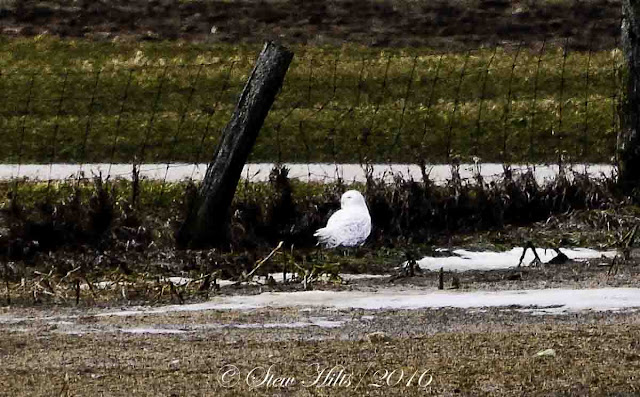
After our unsuccessful search for Snowy Owls I thought I would look back at my photos from the past and reassure myself that we did actually see Snow Owls on some of those excursions.  I can still hardly believe the first one, in February 2017, but here it is.

All the Snowy Owls we saw that year were sitting on the ground, beside fences where there's a bit of longer grass, like this one.  None of them were very close, but it was certainly a thrill to see them.

That year was so successful that we were definitely spoiled, expecting to have the same success every year, but now I think we witnessed an exceptional event among Snowy Owls, to see so many close together.

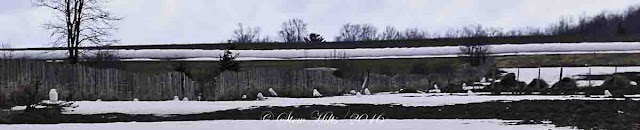
This is the unbelievable photo, 15 Snowy Owls along the fence in the back corner of a field,  Definitely a long distance away, but we did have serious binoculars with us, and verified that all of these little white dots were in fact owls.  I have never heard of such a group of Snowies together before or since.

There were a further 6 owls spread out along the other fence at the back of the same field.  Do you blame us for being spoiled in future years?  And we've gone back to the same general area each year since.

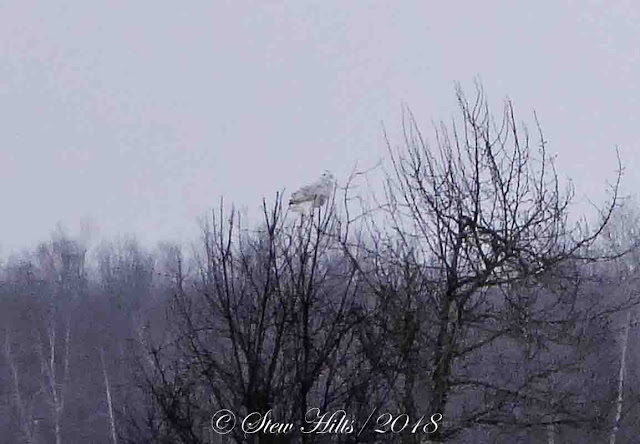
In 2018 we only saw one Snowy Owl, and that when we weren't expecting it, just driving home from a visit to Conn.  It was on a fencepost and when we stopped to look (we never got out of the car on any of these jaunts) it flew off to a small tree in a fencerow nearby.

After failing to spot one in 2019 or 2020, a year ago on that fateful day, January 6th, 2021,we went off for our annual drive again and were successful in seeing this Snowy Owl, while reading news reports of rioters storming the U.S. capitol.  We were appalled!  We do follow American new quite closely, even if we can never really comment on it.

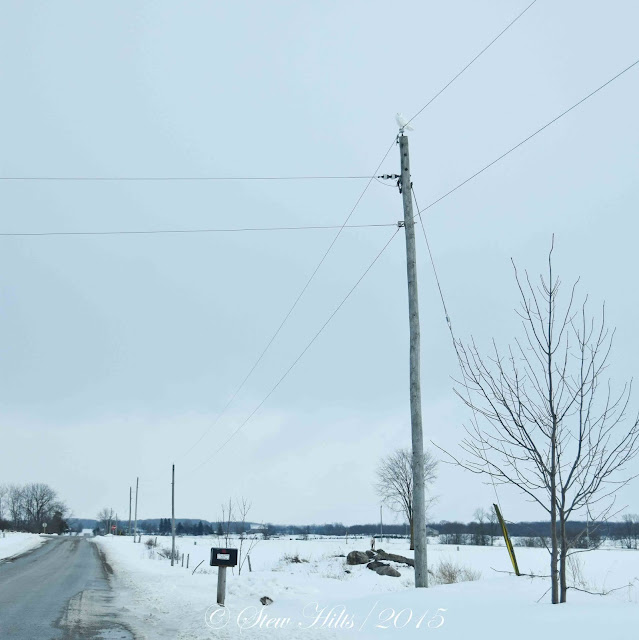
This photo shows what we're looking for as we drive around, and you can see how we might easily miss it - just a slight white spot on the top of a hydro pole.  Mrs. F.G. is the one with the sharpest eyes.

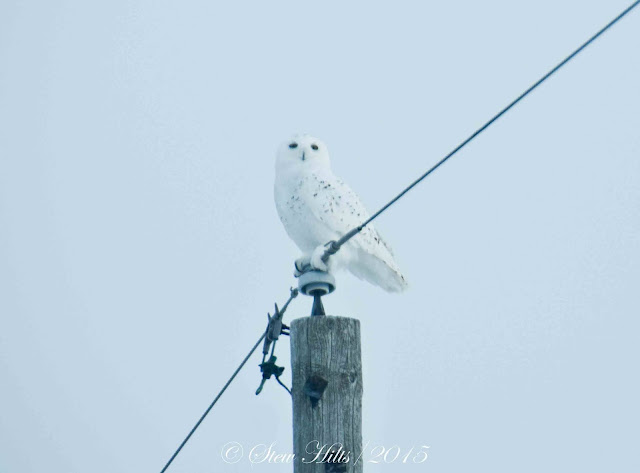
This is a closer look once I zoomed in and cropped the picture.  I always snap a quick shot to start with for the record, in case it flies away quickly.

So there you have it, three years in which we've seen the majestic Snowy Owls (and two in which we didn't).  But they've given us much more pleasure than simply counting our sightings, for they are what inspires us to go for those  long winter drives like my last post showed, even if we don't see any owls.   We've both got deeper connections to an entire part of the map thanks to our searching for Snowies.  I'm sure some would disagree, but I think much of the pleasure comes from the pursuit rather than the successful conclusion.


Monday, February 7, 2022

Our Annual (Unsuccessful) Owl Prowl

A week ago now, on a bright sunny Saturday, we headed out for a long drive to look for Snowy Owls as we have for several years now.  The snow was so bright it washed out my photos, but I came home with far too many shots of barns and rural countryside, so you can dash through these and move on, but for me it's good memories, even if we failed to see a single owl!

The shadows of the tall spruce at the end of our street were dark across the road as we headed out.

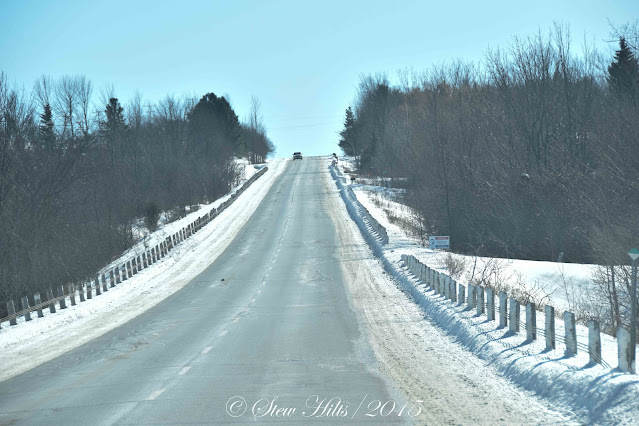
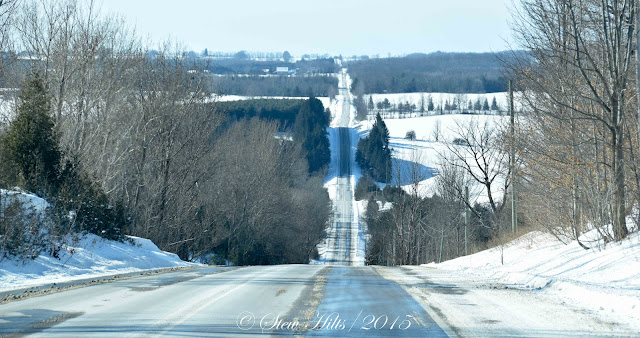
But the sun was glaring in our windshield as we drove up the big hill going south out of Meaford.  This is the ancient Algonquin glacial shoreline, not the Niagara Escarpment.

Soon we dipped down into Frog's Hollow Road, no idea how it got the name.

And then up again past the rocks of the escarpment.  This is the Niagara Escarpment (you can see the rocks at the top of the slope), and the Bruce Trail crosses up there where the road vanishes.

We passed a well designed windbreak, back far enough from the road to work properly.  I remember when this windbreak was being planted 20 years ago or more.

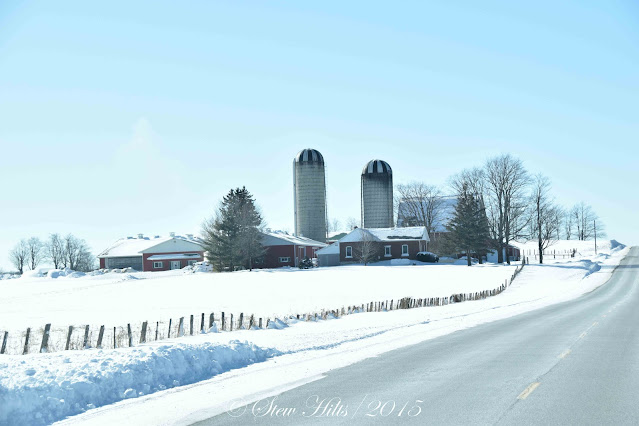
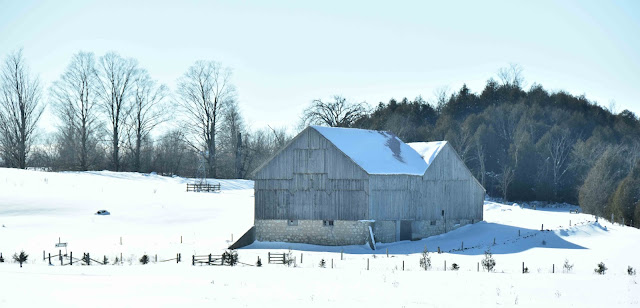
We passed a number of nice farms after that, and I had to stop myself just clicking away.  But the bottom of these two is interesting.  It stands on a large farm property acquired years ago as community pasture.  Farmers can apply to graze their cattle there in a dry year.  No house left, just the barn.

Further on, as we headed for Chatsworth, the road takes a large dip down into the valley of the Bighead River, at this point just a tiny stream.

A small former church, now made over into a residence.

And a fair bit of the landscape after that, as we headed all the way west toward Paisley, looked like this - individual trees, sometimes with a bit of fencing, a woodlot in the distance, all that's left of a former farmstead.

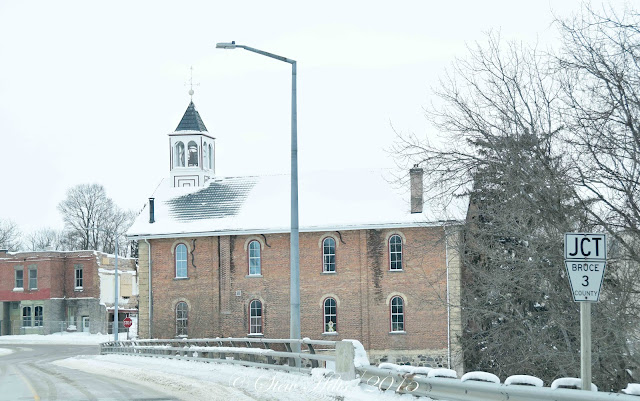
And arriving in downtown Paisley we came to the former church that sits on the corner between the road and the river, now I believe the local Canadian Legion.

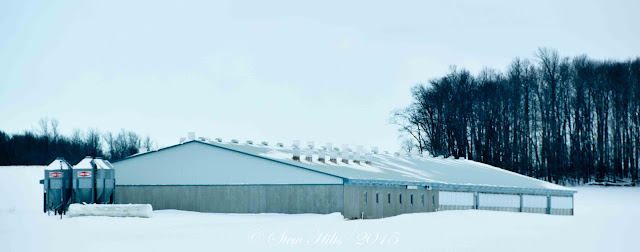
We headed north and then turned back east, passing a wide variety of barns, from the large modern operations to the sad falling down older ones.  There's so much farm consolidation going on here, it's almost more common to see a barn with no house than a conventional farmstead.

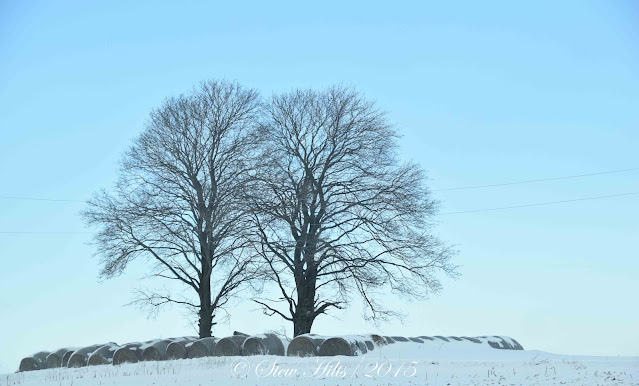
And frequently those trees or clusters of trees that mark an old farm home, here used as a spot to store hay bales.

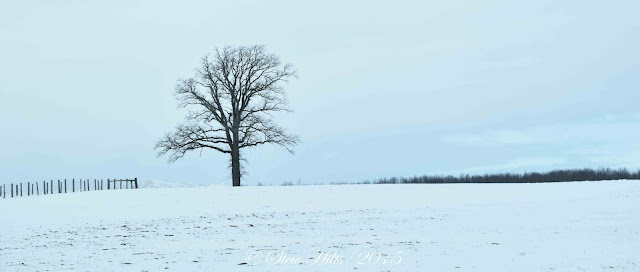
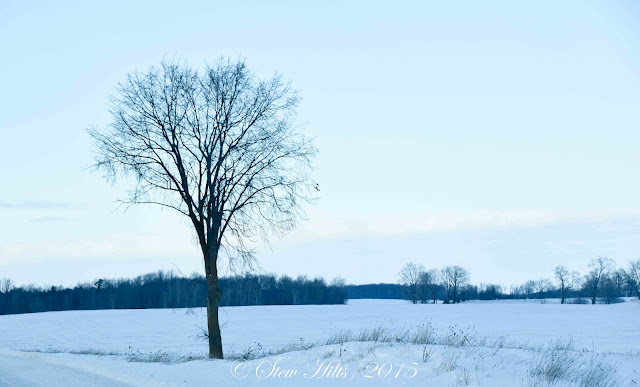
At one point we passed a single large American elm.  Elms that are isolated seem to have been able to withstand the Dutch elm disease.  You can tell in this picture and those above how badly the lighting is off, giving a blue tinge to the photos.

We passed several Wild turkey flocks, here with their feathers showing a lot of actual blue.

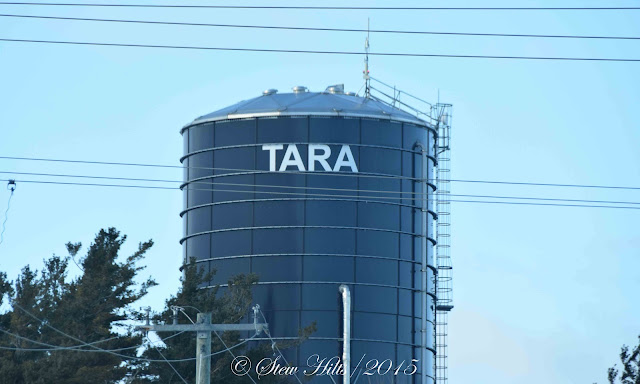
And ended up back over in Tara before heading home - no snowy Owls to our credit.  But it was a pleasant drive on a bright sunny day.

Looking back on these now, I can see that these pictures are terrible!.  It's the lighting, that bright white snow that just throws everything all off in your camera exposure.  Sorry about that, but this is what you get!  And sorry about so many of them too.  

But I was pleased that I managed to hold and use my big Nikon for the whole drive though, and didn't notice my hands getting tired.  It seems that you just keep on recovering little bits of your functions as the years roll on.  I think my daily exercise helps!


Saturday, February 5, 2022

Turning the Corner

There comes a day in winter every year when, even though it may be bitterly cold, the sun seems a little brighter, the shadows more distinct, and I just get the impression we've turned the corner toward spring.  Today is that day, or at least the first of those days this year, for there will be more.

It's -8°C here, and I don't see any snow melting, but I'm thinking there are plants buried in the soil that are starting to grow.  And I know the sap in the trees is starting to think of running up into the branches.  Soon it will be maple syrup time.  I expect some producers are already checking their lines and cleaning their equipment.  The atmosphere outside our window today makes me think of that!

Here's to spring!


Wednesday, February 2, 2022

We're Half-way to Spring!

Yes, it's true, we've reached the halfway point between the winter solstice and the spring equinox.  Societies have long celebrated this time when winter appears to turn the corner toward spring.  Variously known as Imbolc to the Celtic tribes, Candlemas to the church, and Groundhog Day to tourist hungry small towns today, it's one of the seasonal changes that I remember the most, perhaps because I'm looking forward to spring.

I know, you're thinking of Shubenacadie Sam or Wiarton Willie, or stateside Punxsutawney Phil, but spare me a moment while we delve deeper into the meaning of this day as February arrives.

Celtic society was deeply tied to the passage of the seasons.  Imbolc represents the beginning of spring, and the beginning of lambing season.  It was one of the four cross-quarter festivals the Celts celebrated in between the solstices and equinoxes, the others being Beltane (May Day), Lughnasadh (Lammas Day) and Samhain (Hallowe'en).  Each of these festivals represented the beginning of a season to the Celts, the beginning, in turn, of spring, summer, fall and winter,

If you remember that Celtic society was based in Scotland and Ireland primarily, this day as the beginning of lambing season makes sense, though here it southern Ontario, it's just a little cold yet!

In Celtic society Imbolc was tied to Brigid the Celtic goddess of the hearth, fire, and light.  And it's reflected in brighter, longer days, with the sun higher in the sky.  With that understanding it was natural for the church to adopt Brigid as St. Brigid (one of Ireland's three patron saints), and to replace fire with candles, and thus we have Candlemas.

Candlemas celebrates the presentation of Jesus at the temple, but it is also celebrated as St. Brigid's  Day.  It is widely symbolized by candles, families bringing their candles to the church to be blessed.  

According to ancient legends it is also the time when the 'Cailleach' or old woman, would have to go out and gather more wood for fuel if it was going to be a long winter,  She preferred a bright sunny day to do this, so sunshine on candlemas was seen as a prediction of more winter.  If it's a dull day, spring will come sooner. 

And as is our wont, we have trivialized and commercialized this into Groundhog Day, a tourist festival in Wiarton, Shubenacadie and Punxsutawney, among other places, for the benefit of tv, newspapers and the weather forecasters.  I'm very pleased to report that our nearest groundhog dragged unceremoniously from its burrow in Wiarton today would not have seen its shadow, so we're in for an early spring.  But I'm sorry to report to you that groundhogs are only right 50% of the time!


Saturday, January 29, 2022

Back Home Again

Well, the shadows are back here in Meaford.  There isn't much new to report other than the continuing snow and cold temperatures.  We get a little snow every few days, and tonight there's an extreme cold weather alert with wind chills forecast to take the mercury down to near -30C.  My caregiver this morning said her car thermometer read -31C!  Seems like a pretty typical January to me!

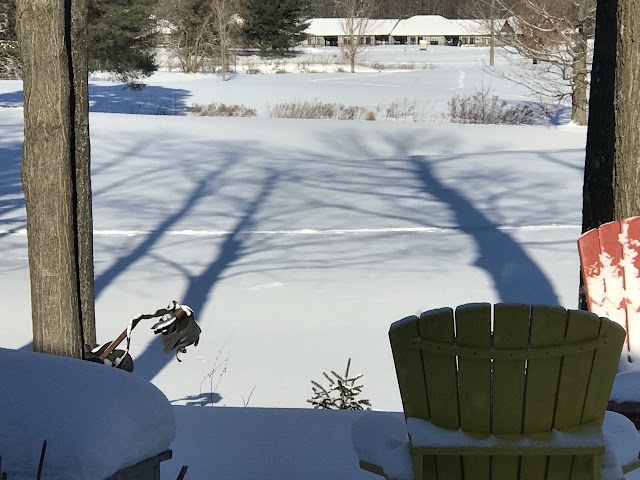
We did have a bright sunny day yesterday, and it was glorious, even though the sun wasn't enough to raise the temperature much.  It did bring the shadows of the trees back for awhile and the sun is back today.

And those trees were outlined against a totally blue sky.

The view out back was beautiful, making me think of the next season to come.

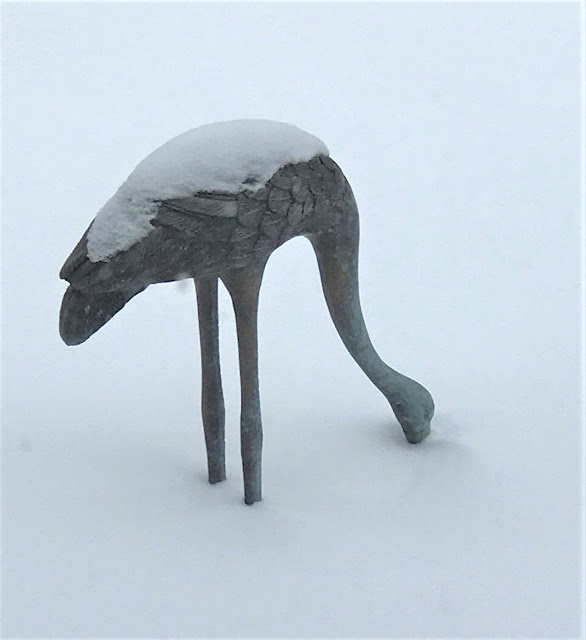
But there's enough snow that our heron is still behaving like an ostrich.

Just as a reminder, our heron still had his head (mostly) above the snow only 6 days ago.

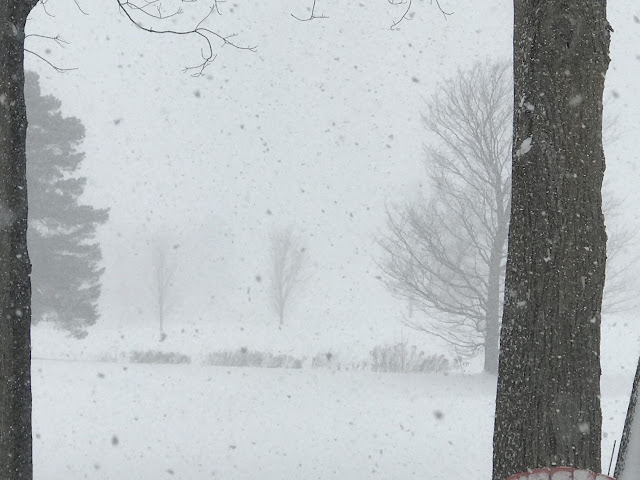
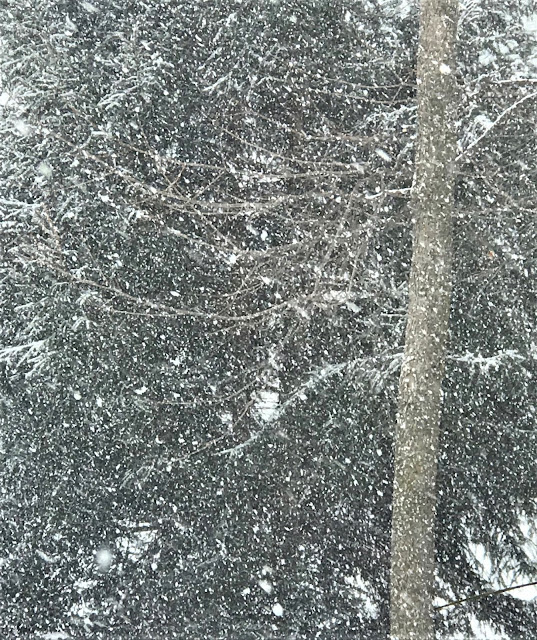
Just 24 hours before the bright sunny photos above, this was the view out back, with the snow coming down heavily.  We haven't had as much snow as some years, but it's plenty to make you feel that it's winter, and the continuous below freezing weather has been great for outdoor rinks and cross-country ski trails.

Not much else to report on here, but I'll see what I can come up with to keep you amused.  I've been stuck at home with a skin infection for longer than I'd like, missing both physio and church for several weeks now.  And our coffee group can't meet because of the current covid rules.  Hopefully that will end next week, and I am starting to feel better.  In fact I'm keeping happily busy with reading and writing as well as doing all my exercises.

I've just been looking back at posts from the past, and found we had a squirrel invasion 4 years ago on this date.  We had 6 squirrels clustered around the bird feeder at once!  In comparison I don't think I've seen a single squirrel for three weeks this year.  I have hardly seen a single bird in the yard either; it's a dull time of year for wildlife.

So I hope you're enjoying whatever weather the winter season is bringing you as we approach Groundhog Day and Candlemas next week.  Now only four days away, these festivals traditionally mark the middle of winter, 40 days after Christmas, on Feb. 2nd.  Hope that the groundhog does not see its shadow!


Wednesday, January 26, 2022

The Blue Lagoon

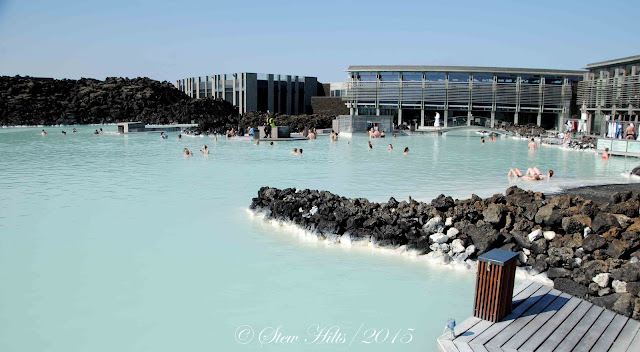
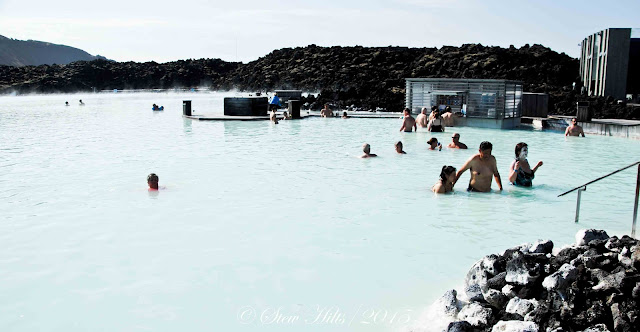
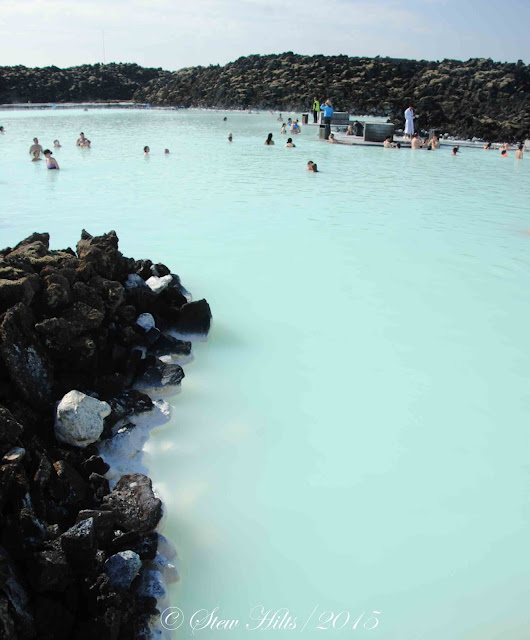
The last highlight of our trip to Iceland was visiting the famous Blue Lagoon.  It's conveniently located near the airport, so we left early on our last day and stopped there to enjoy the warm water for an hour or two.  It was very relaxing, and quite busy, popular with locals as well as tourists!

These photos show the busy corner of the Blue Lagoon; most people don't go far from the entrance from the changing rooms.  The required nude showers almost put Mrs. F.G. off, but it's quite routine here.

You can even slip into a sauna if you wish.  The facility operates as a spa, promoting itself as a retreat with healing benefits from the high silica content of the water (which gives it the blue colour).  There is a hotel and restaurants for those wanting a longer stay.

We quite enjoyed our hour-long swim, floating easily in the warm water, just as you'd expect from a hot spring.  There wasn't a lot of actual swimming done; most of the lagoon is only 4-5 feet deep.  And this isn't actually a hot spring, it's left over warm water from a geothermal power plant next door.

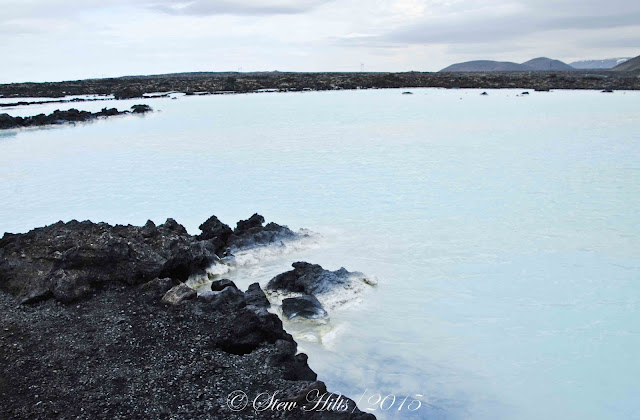
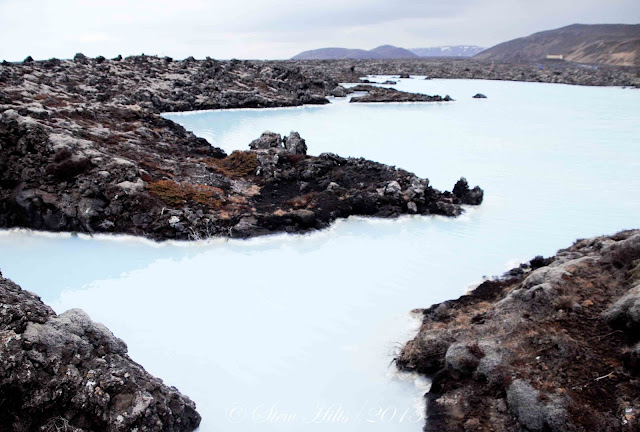
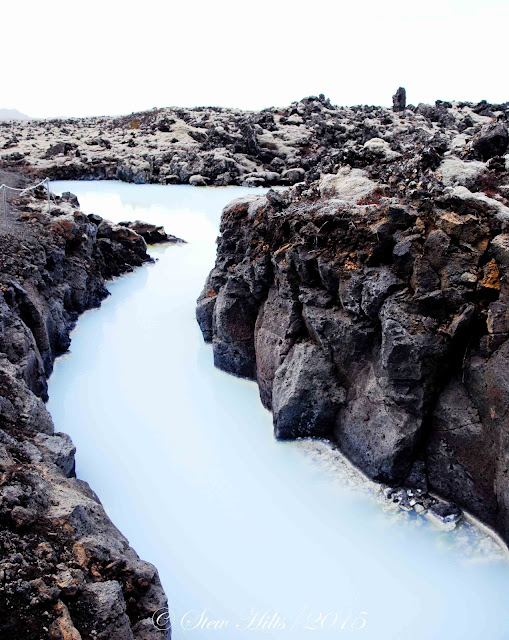
There is more to this geothermal lagoon than the area developed into the spa.  There are two major lagoons in the lava field here, beside the neighbouring geothermal power plant that provides the warm water.  The developed corner of the lagoon is only about 1/10th of the total lagoon.

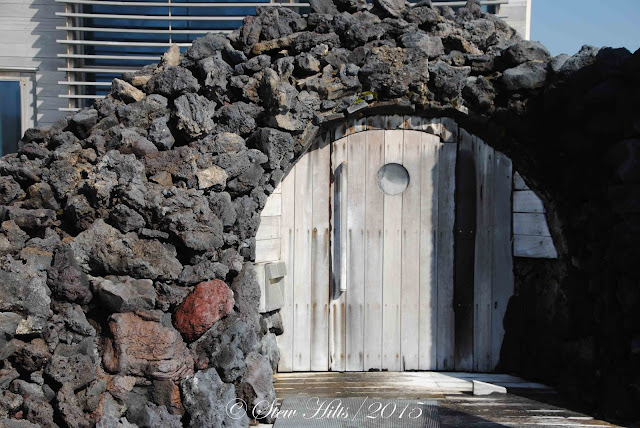
So outside the 'Blue Lagoon Spa', you can see other parts of the lagoon, surrounded by incredibly rough, convoluted black lava, stuff you would not want to walk on at all!  It's often covered by a thin layer of moss or lichen, the grey you see in the pictures.

The story of Iceland's transition to renewable energy is an important one.  Today nearly 90% of Iceland's homes (and almost all of Reykjavik's) are heated directly from geothermal sources, while hot water is provided directly to your tap and shower - you have to be careful because the water is HOT!  Between hydro and geothermal energy, virtually 100% of Iceland's electricity is renewable.  Oil and gas is only needed for vehicles, but even the roads, sidewalks and parking lots are cleared by the warm water piped underneath them.

So while you're floating in the blue lagoon you can celebrate Iceland's geothermal energy sources and the low-cost energy they provide, as well as the left-over warm water for the lagoon.  All of this is because of Iceland sitting atop the mid-Atlantic Ridge, and this corner, known as the Reykjanes Peninsula is the second place where the separating plates of the continents can be seen.  And the whole area is the Reykjanes UNESCO Geopark.

***************

If you've followed along you'll know that this trip crammed a lot into 4.5 days.  We were kept really busy.  Your have to be able to enjoy touring on a bus, but we had done that before when we went to Italy, so we were confident it would be ok.  And a very high proportion of Iceland tourism is based on tours, from the day-long tours we enjoyed to luxury tours that follow the circle route around the entire island, at a much higher cost!  You can rent a car and do the drive yourself, but you do then need to do your own research on what you want to stop and see.

As I said at the beginning, this adventure was very much a spur-of-the-moment decision when I saw the ad for a cheap Iceland holiday, and it turned out to be a wonderful adventure.  Not the time of year we would have chosen, but it fit our budget that year.

Out biggest impression was how rugged and interesting Iceland was, and how its settlement clung to the outer edge of the island.  And how organized they were - there wasn't s slip-up in our tours for the entire time.  And it all came in on budget, no hidden surprise costs.  Hope you've enjoyed joining us on our visit to Iceland..


Monday, January 24, 2022

Reynisdrangar and the (Sometimes Deadly) Reynisfjara

The destination of our fourth day in Iceland was actually beyond the waterfalls and the museum to the south coast, about 2 hours from Reykjavik.  It was both an interesting drive and a fascinating place.  We ended up at the famous black sand beach known as Reynisfjara.  And the sand was truly black, eroded from Iceland's volcanic rocks.

This is said to be the most beautiful black sand beach in the world.  It was formed when hot lava from the nearby Katla volcano ran into the cold seawater and broke down so quickly it formed sand almost instantly (in geological terms). I think the 'most beautiful in the world' description may have been added in mid-summer when the sun was out, the waves were gentle, and the water was blue!

That certainly wasn't the case on the day we were there!

But this felt like a real adventure and we enjoyed all of it - the beach that Mrs. F.G. is walking along, the crashing waves, the cold howling wind off the north Atlantic and the offshore sea stacks.  Almost as adventurous as being up on the glacier two days before!  And close to going outdoors at this time of year here in Meaford!

The waves off the Atlantic were crashing!  However, these waves can be deadly!  Because of the underlying steep slope of the beach here, a much larger swell can approach without warning, and suddenly push much further up on the beach.  Known by meteorologists as 'sneaker waves', these have caused several drownings here over the past 20 years, one just two months ago.

If you've ever been caught in an ocean swell, you'll understand.  It's the backwash that's deadly, possibly carrying you away from shore.  If you're wearing warm clothing and can't swim, you're in trouble immediately!  This is particularly treacherous for tourists who approach the narrow bits of beach at the far ends, where there's not much space between the peaceful waterline and the cliffs.  Just google Reynisfjara and you can find videos of large groups of tourists being knocked off their feet, and occasionally tourists being washed out some distance into the water.

Cliffs rise at either end of the beach, and the wild towering Reynisdrangar sea stacks (Reynir's Pillars of Rock) rise offshore, nesting place of thousands of birds like Puffins, Guillemots, Fulmars and Arctic Tern.   We could barely see the stacks through the haze when we were there and certainly couldn't make out the seabirds!

Did I mention that Iceland has trolls as well as elves?  There are two stories of how these rock pillars were formed, and both feature trolls.  One version is that two trolls were trying to pull a large schooner onshore, but the sun rose before they finished and froze them to stone (trolls in Iceland are creatures of the dark).  The other involves a man whose wife was murdered by two trolls.  He went to find them and again sunrise came before they could get away so they were frozen into rock.  Take your pick!

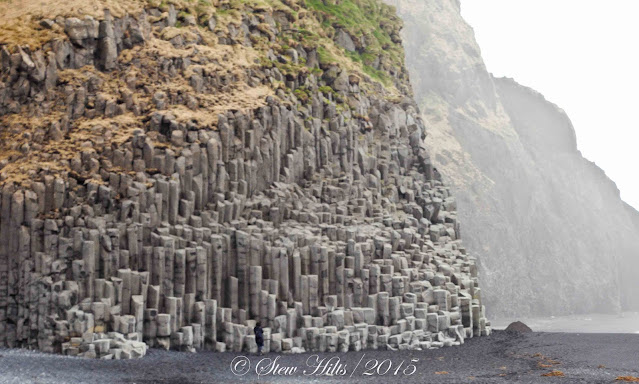
But in all of this it was the basaltic columns on the lower cliff at the end of the beach that intrigued me.  

These rocks are cooled lava, 90% of which is composed of basalt.  If it cools relatively rapidly (say over just a century), it undergoes columnar jointing forming these vertical columns.

 Typically the lava forms geometric columns, hexagons, pentagons or octagons in cross-section.  It's truly remarkable when you see them.  We've also seen these in Fingal's Cave on the island of Staffa off the west coast of Scotland, and in Edinburgh on the lower cliffs of Arthur's Seat, a site known as Samson's Ribs. but perhaps the best known sites are the Giant's Causeway in Ireland and the Devil's Postpile in eastern California.
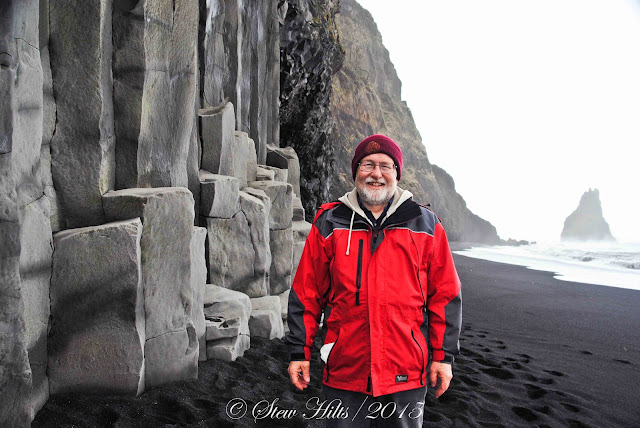
In places you could almost walk up the side of the cliff using the columns as stepping stones.

Can you see the little wheels in my brain turning under that hat?  I've been skimming Instagram and thinking of all the adventures we've had, including this one.  Once we've returned from Iceland I'll tell you about it.