Sunday, August 15, 2021

Expedition to Conn

On Wednesday we drove down to the Misty Meadows Market, a large Mennonite store in the village of Conn.  Mrs. F.G. has made plans to can jars of anti-paste, salsa, relish, red pepper jelly and pickled beets, so she needed a good supply of fresh veggies.  She usually cans a lot of jam, but we don't use it, so she's turning her attention to these, which we love!

We go for the fresh veggies, but the inside of the store is stunning too.  I'm always struck by the beautiful big quilts hanging at the second level under the huge raised ceiling.

There's an in-store bakery with lots of bread, cinnamon buns, Chelsea buns, and of course butter tarts.  And this is the place you buy your baking supplies in bulk, like 20 kg. bags of flour.

The men can shop for a hat that suits them.

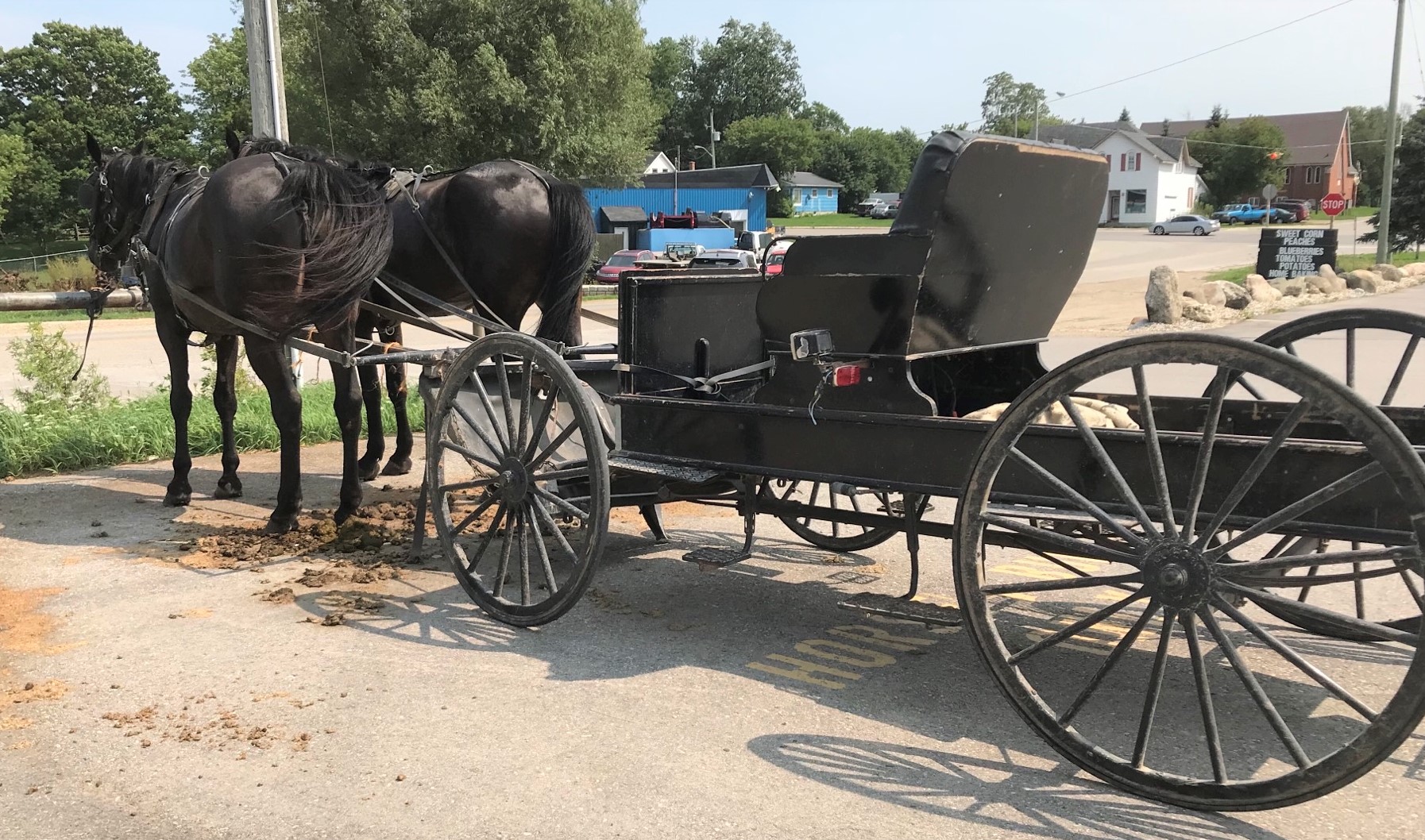
And outside I saw a horse and buggy drive up, with a farmer and his young family.

But we go for the veggies.  This is the sort of place where you can buy the right type of tomatoes, in the right size, and in bulk for canning.  You can buy the right size of cukes in bulk too, though Mrs. F.G. is not doing pickles this year.  She did buy her big bag of beets, all a nice medium size

Overhead the wind chimes were ringing softy through the air.  We've watched this place grow from a wagon on the side of the road to a small store to this large store, and we've met the owner many times in the past.  I think he's too busy now!

Oh, and they sell ice cream cones too.


Sunday, August 8, 2021

Potato Harvest and Other Updates

Once the Day Lilies die down the garden has passed its peak and is headed toward fall.  Harvest begins if you've planted some veggies and dedicated gardeners like Mrs. F.G. begin seed collecting from various flowers and planning for next year!  The flowers change too, but other plants like Echinacea pick up the lead role and provide colour right into fall.

But first the potato harvest.  This is the first bag of early new potatoes that Mrs. F.G. dumped out and she was thrilled, lots of potatoes and all unblemished.  You may remember that she planted six cloth bags of potatoes as an experiment.  This is about half the harvest from the first bag.

This is the rest of them.

And the second bag.  We've had a few for dinner now and they're all delicious!

The garlic is harvested or purchased too (far less than she used to grow), here lying out in the sun drying.  That will take a couple of weeks.  Some of this was purchased at Achy Back Farm.  Our crop used to fill our entire garage while it dried!

So the colour has switched to the Echinacea or Coneflowers, in shades of yellow, red and orange.

Some beautiful light mauve ones too.

Out front we have one lonely orange-coloured Crocosmia which particularly appeals to me.

These will probably be the last variety of Day Lilies to bloom, a two-tone colour combination I really like.

And astonishingly the Cast Iron Plant is blooming.  It's at least 50 years old, and may be considerably older for this came from Mrs. F.G.'s mother.  It's an indoor tropical plant, but comes out to get a bit more light for the summer.  It has flourished this summer, but we've never seen it bloom before.

And these are the blooms, two small purple-centred flowers that almost look like strange mushrooms, just emerging from the soil.

Oh, and the Monarch is still fluttering around every day.  That's it for now.


Friday, August 6, 2021

A Paved Trail Through the Woods!!

In Owen Sound the other day we headed for Harrison Park for lunch and a walk after physio.  We got take-out burgers which are absolutely delicious here, and sat in the shade.  I had heard that the old 'One Mile Road' had been paved as a trail so we were going to check it out.    It hasn't been a drivable road for as long as I can remember.

After our burgers we crossed the bridge and headed for the trail.  No big fish in the river now, but we'll go back in September to see them.

Apparently there was some controversy about paving this trail through the woods, but I didn't dwell on that 'cause it was just HEAVEN! to finally be able to ride through a bit of mature forest, something I used to do walking in ages past.

The trail curved one way and then the other as we went down the east side of the river, heading for the other bridge at the far end of the campground.

And here you get another selfie of yours truly!

And even a rare picture of Mrs. F.G. in the shade of the forest.

I recall driving through here as a very young child when we visited our grand-parents.  My Nana didn't get out much, but she loved coming here.  The road itself didn't last very long after that; it became just a walking trail.

Meanwhile there were lots of leaves bright green in the sun, and lots of big trees too.

The trail turned at the end and headed straight west for the river.

Over the bridge long-since closed to vehicles and we got another view of the Sydenham River, then we were done.  We were thrilled to have a trail through the woods to ride and walk together!


Monday, August 2, 2021

Monarchs!

Monarchs!  We have had several bright Monarch butterflies fluttering around the garden and feeding on a number of flowers.   The coneflowers closest to the Milkweeds seem popular.  We suspect that these are 'our' Monarchs, though we haven't seen any actually undergo the transformation from caterpillar to butterfly.  We certainly saw enough caterpillars after leaving a few Milkweed to grow in front of the window.

Mrs. F.G. is the photographer and I don't think we've ever had better close-ups of Monarchs.


The bright colours and lack of tattered edges convince us that this is a newly hatched Monarch.  The migration to their over-wintering sites in Mexico is simply amazing, one of the very longest of insect migrations.  And it takes four generations for them to return.  The Monarchs that migrate south are not the same ones that migrated north, so they have never done this trip before, and yet they know where to go, to a tiny area in Mexico where most Monarchs ovcrwinter.

This generation will survive the winter in Mexico and then begin north in the spring - but they won't get very far.  It will typically take four generations, each migrating a little further, before they are back in southern Ontario.  How amazing is that!?  How do they find their way?

The story of the Monarch eclipses our excellent potato harvest, so you'll have to wait another week before I tell you about that.


Friday, July 30, 2021

More on Trout Hollow Land Donation

Although John Moir's connection with Trout Hollow is what intrigues me the most, there was another important industrial development in the Hollow that is quite fascinating.  This is the Georgian Bay  Milling and Power Company which generated hydro for street lights in Meaford from 1902 to 1923 before Ontario Hydro's government support drove all the small power plants like this one into bankruptcy (and did spread the benefits of electricity to homeowners, a big step forward).

Here you can see the two remnants of the dam that crossed the Bighead River, big concrete abutments on each side.  The Trouts' sawmill was just out of sight behind the dam remnant on the right, on the far shore.

Here my friend Glen was pointing out the slots for timbers that were part of the control structure.

Beyond this was a high rock embankment that we walked along.  It controlled a holding pond on the left where water was pooled before it ran down to the turbines.

These are the gates that provided control before the water moved into a long flume.

The water emerged from this gap in the berm.

And headed toward the powerhouse in a flume on this ridge, now part of the Trout Hollow Trail.

There it abruptly disappears into this big dark pipe.

From the other side it's a huge S-bend, five feet in diameter.  This fed water into the powerhouse where it turned the turbines and generated the hydro.

There isn't much left of the powerhouse today, just a few leaning cement walls, looking strangely out-of-place in the middle of the forest.  


The Trout Hollow Trail continues downstream into the town of Meaford, and you get some great views of the river from the bluffs.  The donation of Trout Hollow by the Knight family is truly a big story for conservation in this part of Grey County.

I was perplexed though that the donation story on the Escarpment Biosphere Conservancy's website focuses on the power house story and only makes passing mention of Muir.  You would think that John Muir's connection with Trout Hollow was more significant for a 'Biosphere Conservancy'.


Monday, July 26, 2021

Trout Hollow Donated to Escarpment Biosphere Conservancy

Where John Muir worked in 1864-65.  The property along the Bighead River on the edge of Meaford on which Trout Hollow sits was recently donated to the Environmental Biosphere Conservancy, one of the largest conservation organizations in this part of Ontario, by the Knight family.  Trout Hollow was the sawmill owned by the Trout family where the famous American conservationist John Muir spent a year or two working in 1864-65.

The Trout Hollow Trail starts out on the unused (and sometimes very wet) Sideroad 13 road allowance south of Meaford, and passes through a bit of forest before reaching the Bighead River.

Then quite abruptly you step out of the cedars and you're on the gravel bars lining the river.  I've hiked in here three times in the past, and one of those hikes was led by a local John Muir expert, Robert Burcher.  He had done a lot of research to find the exact location where the cabin the millhands lived in was located.  It would have been in the centre of this picture on the far bank, up in that cedar forest.  Of course it was probably all open in 1864!

Burcher led us along the rocky shore where I spotted this beautiful Serviceberry in full bloom.

We continued along the riverbank until we could climb up the low bank on the left to the site of Muir's accommodations while he worked at the mill.

Here he told us of how he originally learned that the great John Muir had actually spent two years in this part of Ontario, and how he narrowed down the cabin location until they were able to have an archeological dig.

They found a number of artifacts, such as this pottery fragment (pottery is a favourite of archeologists) which enabled them to date the site approximately.

But there's other evidence too, including this old map which shows the road into the sawmill and the location of two Trout family cabins as well as the sawmill itself.

Not only that, but John Muir completed a sketch of the log cabin himself.  Pretty tangible evidence for a historian!  I was becoming amazed by this story of Muir in Canada myself by this time.

This would have been Muir's view in front of the cabin - approximately.  Undoubtedly the river itself has changed its course a bit in 160 years!

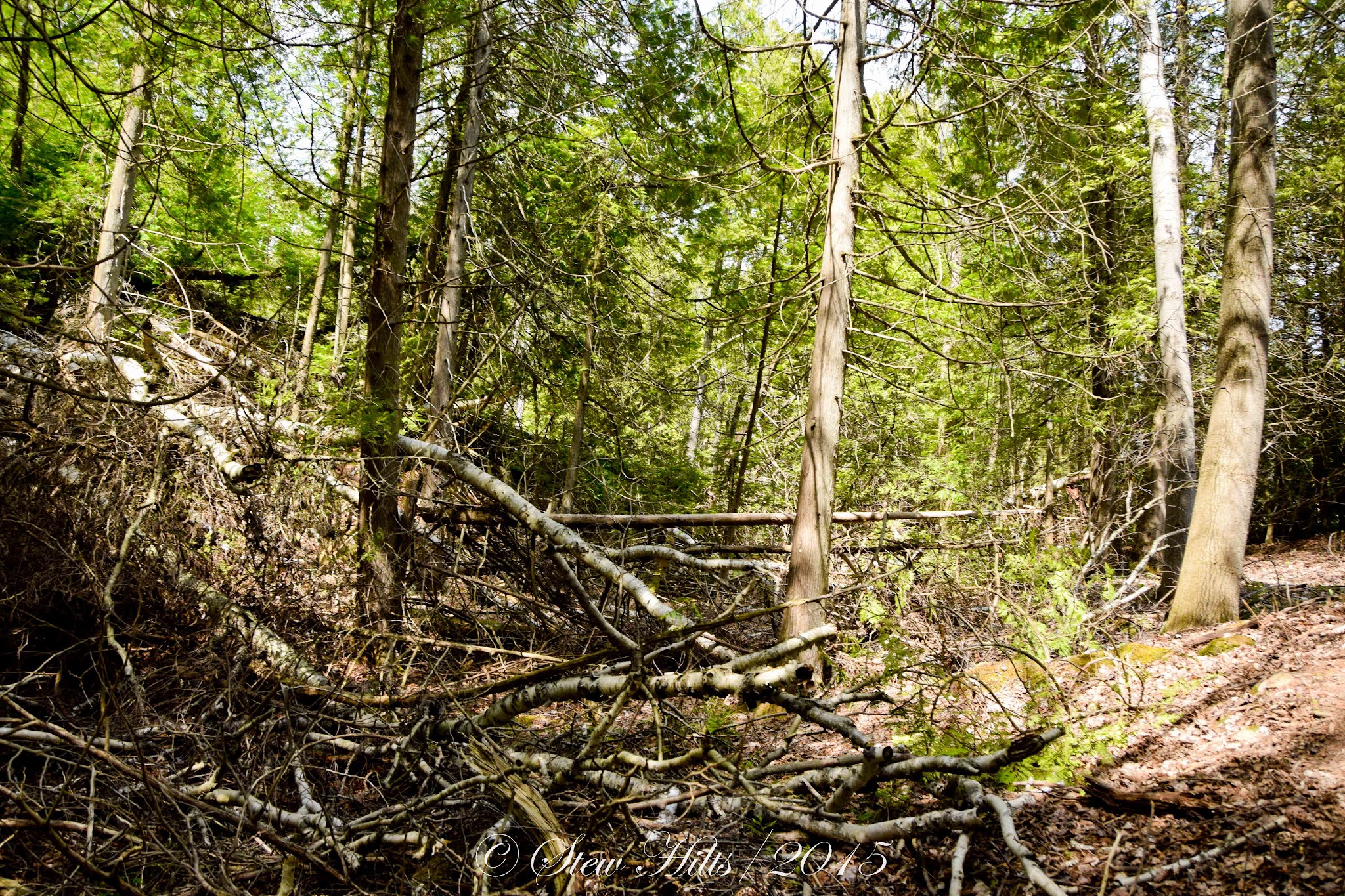
This tangled mess of fallen trees and branches is the site of the sawmill where Muir worked.  Muir was something of an inventor by this time, and he came up with a machine to make the tool handles that the mill specialized in, faster, thus increasing their output.  Tragically for the Trout family, the mill burned to the ground in 1865 destroying all their progress, leaving them bankrupt and leaving Muir with no job.

But in his spare time wanderings Muir had fallen in love with botany, and I expect with simply wandering in the woods.  From his letters back home and other sources it appears that this was the period in his life when John Muir became fascinated with the natural world.  He later developed that love of nature to encourage the protection of the sites in California that he grew to love - especially the Yosemite Valley - the first National Park in the world.  Burcher had plates of two of Muir's botanical specimens to show us. this one the intriguing Walking Fern.  It 'walks' by the tip rooting and forming a new plant.  I've seen Walking Fern several places in the valley.

A Walking Fern I found some years ago hiking the Bruce Trail south of Meaford.  Going exploring along the trail was my great love!

And this is the famous Calypso Orchid that Muir found in the middle of a dense Cedar swamp - the swamp that is now the Holland 'Marsh', a vegetable growing area.  John himself described his find, and his slog through the swamp, in a letter to his former professor, J.D. Butler.  Butler in turn forwarded the letter to a newspaper in Boston, and it became Muir's very first published writing, written while he was still on his botanical sojourn in southern Ontario.  Many years ago I found the Calypso Orchid growing under some Cedars ion Flowerpot Island.

I'll end with a picture of the great conservationist himself, but in the next post I will finish the story of the donation by the Knight family.  Trout Hollow is indeed a special place in conservation history and the Knight family deserve a great deal of credit for their donation.

Muir himself headed south through the United States, eventually walking all the way to Florida, working for a time in a wagon wheel factory.  After a brief stay in Cuba he arrived back in New York and took a train to San Francisco.  He spent the rest of his life there, dedicating himself to nature conservation.