Friday, June 25, 2021

Residential Schools in the News - Finally!

Residential Schools for Indigenous children are finally in the news in a serious way.  Of course we've heard about it before, but today it's all over CBC.  I've read at least 6 stories documenting the reaction and hopefully the public will pay attention!  Yesterday my sister posted this on Facebook, listing figures from 6 residential schools so far.  1323!

I've been amazed that there's been little public outcry over the 6000+ deaths recorded by the Truth and Reconciliation Commission, and reports of enormously high death rates at the schools, but that information contained in an official report doesn't phase us.  Unmarked graves not previously known, not recorded and where parents weren't informed are the tragedy that hits us.  Photographs from the actual school sites bring it home (the Kamloops school is one of few still standing).

And with the testimony of survivors we begin to see these children as real people.  When you hear reports of people rocked by the trauma all over again, most of these aren't just stories from the past, they're survivors whose friends may have 'disappeared' while they were at school, leaving them wondering every since.  The children in these graves are calling from the past.

The catholic church has come under particular fire not only for the deaths and refusal to release records, but from survivors for their blatant teaching that native spirituality was wrong, that they were all heathens and would be going to hell.  Survivors tell stories of beatings being routine for trivial offences, and the nuns 'being so mean'.  I can just picture these children cowering in fear.

In Saskatoon the doors of the cathedral were daubed in red paint.  It was quickly removed of course, but I'm surprised there hasn't been more vandalism.  I've heard stories of Indigenous people trying to reconnect with their land and culture and never quite understood the depth of their feelings.  But of course once you realize that they had it drummed out of them they were lost in a world they didn't understand, then it makes perfect sense for them to try to reconnect and to find that effort healing.

One of the tougher comments I read was this one.  We in Canada need to recognize that cultural genocide was real here too.  'Schools do not ,,, need graveyards' - can you believe it?

One of the many articles in CBC highlighted the work of Dr. Peter Bryce, a public health physician hired to study these institutions in 1904.  He reported on appalling health conditions and the rapid spread of tuberculosis leading to very high death rates in the schools.  He described it as 'genocidal practices in the government-sanctioned residential schools'.  

But when Duncan Campbell Scott (the famous poet) was hired as Deputy Director in 1913, Bryce was told his work was no longer required, 'as the department did not intend to act on it anyway'.  Bryce was hounded into an early retirement and his message fell upon deaf ears.

I have just seen a new article pop up on CBC indicating that the catholic order which ran the Kamloops and Marieval schools will release all records, though it may be a slow process because of privacy laws.  The Missionary of Oblates of Mary Immaculate order, ran 48 schools, mostly in B.C. and Saskatchewan and will release all records for those schools, another small step in the story.

So goes the news in this ongoing Canadian tragedy, a story that is far from over and will change our view of Indigenous people for years to come, hopefully permanently.

If you'd like a bright spark in this otherwise horrible news, the University of Guelph where I spent most of my career has announced the creation of a new Bachelor of Indigenous Environmental Science and Practice (BIESP) to start this fall.  Designed after a request from the Chippewas of Nawash Unceded First Nation (located on Cape Croker just north of here) it will be based in the School of Environmental Science where I was Chair for several years.  As the person who started the Environmental Science program many years ago at Guelph, I'm particularly pleased.

Thanks to Facebook for most of today's images.


Thursday, June 24, 2021

751 More Possible Graves at an Indigenous Residential School

The next First Nation to complete a radar search for unmarked graves held a news conference this morning at which they announced the discovery of 751 unmarked graves at the cemetery of the Marieval Residential School east of Saskatoon in Saskatchewan.  I can't possibly just carry on celebrating our garden with you when this is in the news.

It's another tragic moment in the history of First Nations in Canada, piled on top of the decades of discrimination and repressive policies.  And we have 128 residential schools to go.

Let's be clear, this is just step one, the finding of a ground-penetrating radar study that outlines disturbance in the soil.  It does not detect skeletons, and some of these may be adult graves which oral history has suggested exist.  Neither were the children 'murdered' in the conventional sense; deaths were primarily by disease spreading rapidly through crowded unsanitary buildings.  Archeological excavations will be necessary for the next step.

Added together the discovery of this many bodies (966 at Kamloops and Marieval) begins to reach the scale when it should be seen as a war crime.  Considering as well that the children were removed forcibly from their families and indoctrinated against the entire culture they had been born in, it is hard to imagine anything worse in our treatment of Indigenous peoples.

The Cowessess First Nation which conducted the study will consult with its members before proceeding with any next steps.  This is another Catholic-run school, closed in 1997, and torn down two years later.  But there is an identifiable cemetery, and there are graves which do have headstones.  The adjoining church is still standing.

I leave you with this single picture of another of my favourite flowers here, in memory of the children who are buried there.  Please take a moment to remember them.


Wednesday, June 23, 2021

Our Foxy Predator

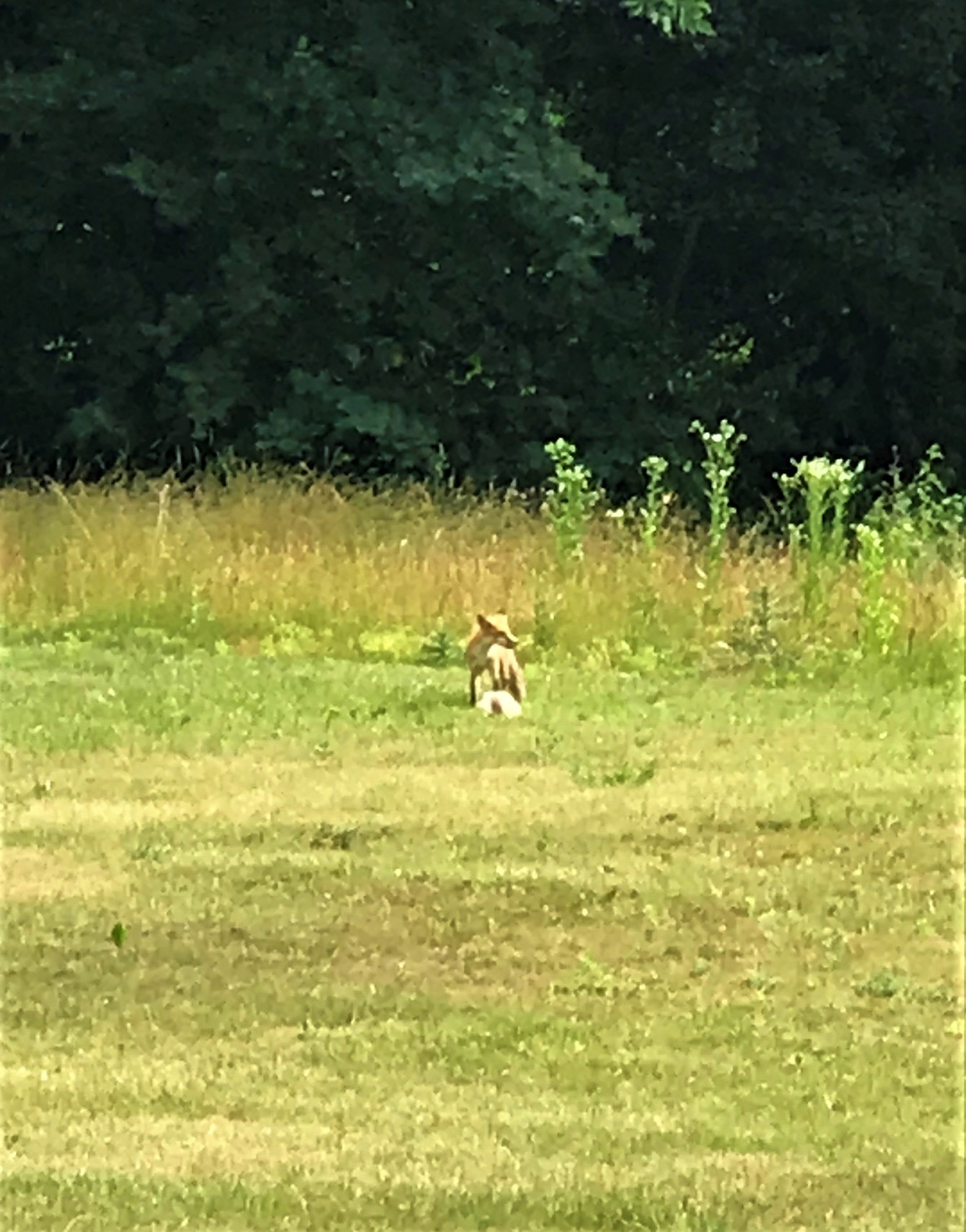
We've seen a fox or two out on the grass several times recently, but the other morning it was obviously demonstrating its ability to be a predator.  It had a fair-sized something it was eating.  It looked like a rabbit, but we have to admit it might have been a cat.  

I was able to shoot a couple of pictures through the window with my iphone, but you can't really crop these much without them going blurry.  But then Mrs. F.G. got out my big camera and took it out behind the tree to get some more pictures.  We were trying to see what it had to eat as well as just see the fox.  Mrs. F.G., the gardener, hoped it was a rabbit!

We could see it worrying away at whatever animal it had.  It looked furry, but beyond that we couldnt see.  Sorry, but there was really no blood and gore.

This was her best shot of the fox looking like a fox.

Its been cold and windy here, leaving me unable to get out for much of a comfortable ride either.  I am anxious to get out and will head out after I finish this.


Tuesday, June 22, 2021

A Poppy

I have blogging exhaustion from researching and writing the past seven posts on Indigenous people.  Though I very much enjoyed it, it was hard work! Thank you for all your thoughtful comments. So here's my offering today, a backlit single Poppy in our garden.


Monday, June 21, 2021

Reconciliation

Today is National Indigenous Peoples Day and it's time to reflect on 'Reconciliation'.  What will it take?  What can all of us do to advance reconciliation?

All the reading I have done suggests that the first important thing to do is to educate ourselves, that is those of us who do not have Indigenous heritage.  There is so much we need to learn.  If reconciliation is to lead to mutually respectful relationships we each need to at least understand each other!

I`m really tempted to leave it just there.  The 94 `Calls to Action` in the report of the Truth and Reconciliation Commission are central, but for me they are big, overwhelming and mostly directed at government.  We need simple first steps that the average person can start with, so start with just learning.

Learn about the Indigenous people who live (or lived) near you; that`s what I`ve been trying to do.  And learn about at least one aspect of the bigger picture - the story of residential schools in Canada would of course be the appropriate place to start today.  You can always learn about orange shirt day and ribbon skirts too if you want!

********************

Like I said, I`m tempted to leave it just at that, but obviously the entire education system has a similar huge responsibility to provide some focus on reconciliation.  I learned absolutely nothing about Indigenous history through all my years of education.  Future generations have a lot to catch up on.

There are also much more practical things that must be done.  Indigenous communities need access to clean drinking water, and they need modern quality housing.  They need health and education systems themselves that match those elsewhere in the country.  We need changes to both the judicial and the welfare systems to remove discrimination.

And in the immediate future we need financial support for survivors of residential schools to find any unmarked, unrecorded graves at the other 129 former schools in the country.  Finding the graves of course is just the first step, deciding what to do next is a major challenge for the communities.  Archeological excavation is a long, slow and costly process and appropriate commemoration will vary at different schools.

In all this it is obvious to me that first we must move beyond the polite words and apologies to action.  We`ve had enough of those nice words from politicians and some church leaders; we need to see real action.

*******************

Are there signs of hope in this dismal picture I`ve painted.  Of course there are!

Along with orange shirts we now have ribbon skirts, thanks to 10 year old Bella Kulak in Saskatchewan.  she wore her traditional ribbon skirt to her grade 5 class at school and was ridiculed by a teaching assistant.  Thousands of women have since posted pictures of themselves in ribbon skirts on Facebook  in support of Bella.

The amazing resilience of residential school survivors is an incredible sign of hope.  If they can accomplish that, then we can do a lot.  The diverse cultures of Indigenous peoples across Canada is a huge reason for celebrating.  Those western totem poles are the things that interest me the most, but all Indigenous cultures have a rich history.  With mutual respect these communities can share a great deal of their way of life that is rich and meaningful for us.

Sadly the discovery of those 215 unmarked unrecorded graves in Kamloops has been enough of a shock for the country that perhaps we will now see real change.


Sunday, June 20, 2021

The Residential School System

What can I possibly write about the residential school system that hasn't been written?  

After the recently announced discovery that as many as 215 unmarked graves exist on the grounds of the Kamloops Residential School, the Canadian public seems to have suddenly become aware of the full extent of this horror.  Article after article has recently appeared, often reporting the story of a residential school survivor.  

Informal memorial outside Kamloops Residential School.  After 215 pair of shoes were left on the steps of the B.C. Legislature, they have become a symbol for the 215 dead children.  Only a few days after the discovery the Canadian Parliament declared 'Orange Shirt Day' to be a national statutory holiday, officially to be known as the National Day for Truth and Reconciliation.  

I've told the story of Orange Shirt Day before.  It arises out of Phyllis Webstad's experience as a 6 year-old in Williams Lake B.C. where she was stripped of the special orange shirt her grandmother had bought her for the first day of school.  You will now see lots of orange shirts on Sept. 30th.

Background

Residential schools were set up in the 1880s to 'civilize' native children by taking them away from their families (by force if necessary) and educating them in the ways of Canadian society.  While at the school they were not allowed to use their native language, even among themselves; they could be physically beaten for disobeying.

Pine Creek Residential School, Saskatchewan

Two young staff who worked at a school in B.C. years ago recently described it as 'dehumanizing' (they were fired after 4 months for complaining).   Students arriving at a school were stripped, had their hair cut and were showered to remove lice.  They were given standard institutional clothing to wear and slept in open dormitories where they were not allowed to have personal possessions.

The misguided idea was to indoctrinate children into Canadian and Christian ways and assimilate them while destroying their links to the native ancestry.  It has been described as 'killing the Indian in the child'.  It was directed in part at teaching skills that would enable them to be more independent as adults.

Results

Hidden behind the horror stories you need to recognize that most children did survive the school system, but the trauma has reverberated through all the generations since.  Just being forcibly removed from their family started the trauma.  One survivor recently described being 'lassoed and roped ' to be taken away; I have posted before about child-sized handcuffs used when necessary. 

Abandoned School near Regina

Abuse was common as physical punishment was meeted out frequently.  Sexual abuse was widespread; presumably older girls suffered the most.  But virtually every student must have suffered emotional abuse.  Just being forcefully removed from families would be enough by itself to terrorize young children.

Several early reports highlighted the terrible living conditions - malnutrition was common; food was described as 'mush, mush, and mush' and students were more vulnerable to disease as a result.  Many deaths occurred from tuberculosis and during the Spanish flu epidemic of 1918-19.  Over 6000 deaths may have occurred at the schools, but records were not kept (or are still being hidden), parents were not notified and children were buried in unmarked graves, as in Kamloops.

Several experts pointed out what should be done, but it was considered too expensive and too much trouble to provide healthy living conditions, sufficient clothing, good food and enough rest to prevent students from getting sick in the first place.

An Unknown School in B.C.

Inter-generational Trauma

These schools have led to inter-generational trauma which is probably the worst impact.  Children removed from a loving family and community grow up not knowing how to be loving parents themselves.  Students subject to abuse abuse their own children, never having known anything else.  And this is compounded when several generations of children went to the schools.

Students end up in between two cultures as adults, but unable to be a member of either.  Alienated from their own world they also don't fit in the white world.  Their education consisted of little more than learning manual farm labour and prayer, not enough to succeed in a modern world.  By the 1940s it was apparent that this system was failing.  The federal government took over the schools in 1969 ending church involvement.  The last school closed in 1996.

Demanding Justice

By the 1990s parents and students alike were protesting the injustices of their experience loudly, leading to the largest class action settlement in Canadian history, a multi-billion fund for payments to survivors, with extra payments for survivors of abuse.  A formal government apology was issued in 2008.  Two of the 130+/- schools were named National Historic Sites.

One recommendation of this settlement was establishment of the Truth and Reconciliation Commission, launched in 2007.  It reported in 2015, giving a list of 94 'calls to action'.  These provide a framework for moving forward.

Orange Shirt Day provides a tiny glimmer of hope in this otherwise tragic picture, a hope that reconciliation can occur and Indigenous people can regain their rightful place in the land we share.  A fitting lead-in to National Indigenous Peoples Day tomorrow on the summer solstice.


Saturday, June 19, 2021

The Indian Act and the Politics of Destruction

Between the end of the War or 1812 and the passage of the Indian Act in 1876, attitudes to Indigenous people changed, slowly but dramatically.  Native allies were no longer needed as warriors, the fur trade died out and of course the exploration of Canada was finished.  

The Hudson Bay company sold Rupert's Land to Canada in 1870, and the federal government then began writing treaties with western first Nations.  In the government's eyes it had 'purchased' the land, and a flood of settlers followed.  Two years later the North-West Mounted Police (NWMP) were established, initially to make sure that natives moved off the traditional territories and onto reserves.  Starvation often followed and Indian Agents used food as a reward for moving to reserves.  Making room for the transcontinental railway was the first bug motivation.

Underlying the change of attitudes was also a wave of beliefs that we should convert and 'civilize' the natives in the British empire, changing their pagan ways to Christianity.  The English speaking world was seen as the most advanced civilization on the planet; why wouldn't they want to join it!

Out of these attitudes emerged the Indian Act in 1876, setting the terms of Canada's relations with Indigenous peoples for all the years since and completely reversing the relatively cordial relations of the previous 200 years.  Native peoples were restricted to their reserves, relatively tiny 'postage-stamp' plots of land away from any good farmland.  They still have enormous challenges of poor housing and water supply.

The Indian Act is complex and confusing.  To quote the Canadian Encyclopedia, with no consultation: ... "the Indian Act gave the government sweeping powers with regards to First Nations identity, political structures, governance, cultural practices and education. These powers restricted Indigenous freedoms and allowed officials to determine Indigenous rights and benefits based on 'good moral character.'

The Indian Act did a number of specific things:

- it established 'status and non-status' Indians,

- it removed hereditary chiefs and established elected chiefs and band councils,

- it excluded women from band governance,

- it implemented discriminatory marriage policies related to Indian 'status', differing for men and women,

- it banned the potlatch ceremony in 1884, and any Indian festival including powwows and the sun dance in 1895,

- it made attendance at residential schools compulsory in 1894,

- it banned hiring of lawyers in 1925,

- it enabled a pass system which limited the movement of natives off reserve.

It was in short a powerful restriction of the Indian way of life and Indian communities, giving the federal government sweeping powers of control.  It has been described as cultural genocide.  The reverberations of this legislation are still felt today, although amendments have taken away some of the worst abuses.

Following the first ever consultation with Indigenous people in 1951, amendments:

- enabled women to vote in band elections, 

- enabled bands to hire lawyers and commence land claims,

- and removed restrictions on religious ceremonies.

But they did not change the marriage policies related to status; women marrying outside the band lost their status while women marrying a native man gained status.  The amendments gave provinces jurisdiction over child welfare which enabled the notorious 'Sixties Scoop'  whereby welfare agencies could simply remove children from their communities rather than provide provide family support on-reserve.

Further changes followed slowly.  Starting in 1960 natives could vote without losing their status.  And finally in 1985 most of the discriminatory provisions of marriage rules were removed.  And with the James Bay and Northern Quebec Agreement in 1984 those First Nations took the first steps toward self-government, removing themselves from jurisdiction of the Indian Act.

Today First Nations debate whether to seek abolition of the Act, but it controls such a big part of Indian life that simply removing it would now cause a hug disruption.

I have not discussed the residential school system and its abuses; that will be tomorrow's topic.  But taken together the Indian Act has transformed what was a relatively neutral or even positive relations to a negative one, effectively destroying the native way of life in the process.