Sunday, June 25, 2017

Those Seagulls

We stopped for lunch on our way home at the waterfront in Wiarton, home of Wiarton Willie.  The bay was blue, and the gulls were screaming.

This is Colpoys Bay, the southernmost bay on the east side of the Bruce Peninsula.  The marina is on the far side, but the centre of the waterfront is a public park.

We could look out a long distance past Malcolm Bluff on the left to Hay Island in the distant centre.

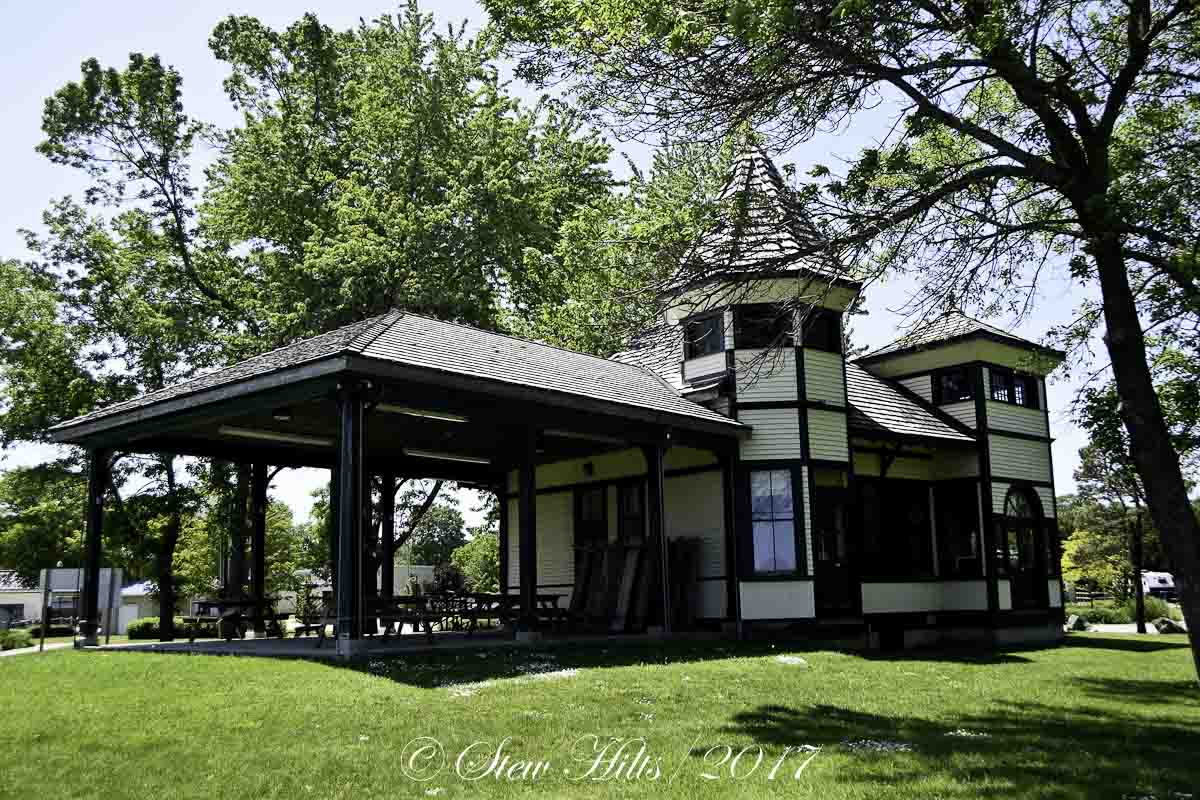
The old railway station in Wiarton was rescued and moved to this location some years after train service ended in 1958.  Now it's operated as the office for the adjoining campground, a tourist info centre, and a small museum.  I liked the sidewalk, which I presume was made to suggest railway tracks leading to the station.

The station itself was built in 1904, but the picnic shelter on the left was added only recently.

The museum did have a few momentoes of the railway age, including this picture of a locomotive.  I'm fascinated with that time in rural Ontario's history, because the age of rail was so significant and pervasive when it arrived, but it has died out almost completely.  They even had a stained glass window of Willie.

As for the seagulls, they were more than annoying!  These are properly called Ring-billed Gulls - there is actually no such species as 'seagull', but we tend to label all the gulls that way.

These gulls had obviously learned about picnics and available food scraps.  But they weren't content to pick up the scraps - they wanted right in on their share of the food!  I made the mistake of taking my plate out of the van to sit at a picnic table for lunch.  Six gulls were there in seconds, dropping out of the air to only a foot or two away.  When one attacked my head I had had enough, and headed back to the van!

I'm afraid picnics at this location have been destroyed by these overly aggressive gulls, but as long as you have no food, you can walk around and be totally ignored!

Thus ended our little expedition up the Bruce Peninsula to Tobermory and Flowerpot Island.  Hope you enjoyed it.

Saturday, June 24, 2017

St. Margaret's Chapel

Not much traffic heads down the Forty Hills Road on the east side of the northern Bruce Peninsula.  It's a twisty, turny, up and down narrow gravel road with some sudden sharp bends, through forests dotted with small parcels of open farmland.  And in the middle of this back road you find an exquisite small limestone church, St. Margaret's of Cape Chin.

I remember stopping here with my mother and aunt on one of our first trips up the 'Bruce'.  I must have been 14 or 15 at the time.  It's always struck me as a beautiful place in an out of the way spot.

I was surprised at how welcoming it was, so I walked in the gates and got a few pictures on a perfect sunny day.

The chapel was built starting in 1925, made of local stone and wood, with a lot of local volunteer labour.  Architecturally it is stunning, with the lancet windows, the bell tower entrance, and the gently sloping buttresses, all in light coloured dolostone.

Several Anglican churches in the peninsula have joined together to create a joint ministry, keeping several small churches open that otherwise might have closed.  This is one of the best cared for small rural church buildings I know of, even though services are only held in the summer.

Through the trees I saw what I think must have been the original Cape Chin one-room school.  It was a congregation meeting in the school that committed to building the chapel next door.

The door was open (in the middle of the week), with a welcoming note inviting visitors to come in - so I did.  It's a larger church than you'd expect in a location like this.

The stained glass design over the door was beautiful.  A lot of the stained glass windows feature wildflowers.

Although I have no particular connection here other than a memory of stopping here with my mother 55 years ago, I found it a very peaceful, spiritual place to visit.  Glad we stopped and I took a look inside.

Linking to:

Friday, June 23, 2017

Critters

We only saw a few critters on our trip up the Bruce, but one was a very friendly Garter Snake.  I'll get to the man-eating seagull in a day or two.

This gull was friendly, but didn't quite attack us.  As soon as we sat down on a bench and got out our lunch, there it was, with two or three of its friends, ready to scream a little for crumbs.

We sat there relaxing and enjoying lunch, and I happened to look down at my boots.  A nice little snake!  Rising up from beneath the boardwalk, also presumably to see if there were any crumbs.

It didn't stop coming toward me either, as I sat still watching.

But then it must have seen or sensed my presence and backed off a little.

It certainly wasn't afraid of us, and we showed several kids in a family eating lunch on the next bench over.  The kids were thrilled.

My third critter to share is the largest groundhog we've ever seen!  This is the sculpture of 'Wiarton Willie', by the beach in Wiarton where he lives.  Wiarton Willie emerges on Groundhog Day to offer his prognostications on the coming spring weather, the most famous weather prognosticator in Canada.  He's our 'Punxsutawney Phil'.  

A larger view puts it in context.  Quite a nice place to stop for lunch - except for those seagulls!

It's not known how many Wiarton Willies have passed on, but it's several!  The original prognosticators were a trio, Grundoon, Muldoon and Sand Dune.  The first Willie, an albino groundhog, appeared in the 1980's and lived an incredible 22 years.  At least two other 'Wee Willies' have served the town since the original died in 1999.  As you can imagine, Groundhog Day in Wiarton is a MAJOR celebration!

Linking to:

Thursday, June 22, 2017

Sunset over the Islands

After visiting Flowerpot Island during the day, we headed back into Tobermory that evening to check out the sunset over the islands.  It was spectacular!

We had an interesting conversation with the young woman at the ticket booth for Blue Heron Cruises, as we often do with local folks we meet.  She gave us the inside story on the best place to go and watch the sunset, and she was right!

On the deck where another company, Blue Anchor Cruises has its docks, we joined others to stand and watch.  It was the perfect viewpoint.  You're looking past the entry of Big Tub on the left, the Big Tub Lighthouse hidden on the dark shoreline, and over Doctor and Russell Islands to the northwest.

By the time the sun was actually setting, there were 30 or 40 people there, and a couple of boats that had gone out to try and get even closer!

The sun slowly disappears, the best sunset we have seen in a long time!

We must have been there at least 30 minutes, and took a lot more pictures than these.  As darkness fell, we headed down the highway to our campground.  But looking in the rear-view mirror, the sky was lit up - we had left too early!

We did see Big Tub Light blinking to us as we said good-bye.

Linking to:


Wednesday, June 21, 2017

Carnivorous Plants!

We also visited Dorcas Bay briefly one evening, another of our favourite spots up the Bruce Peninsula.  It's on the west shore, very different than the cliffs of the east.  Here the bedrock, covered with sand in the bay, dips into Lake Huron like a very slightly slanted table top, creating a series of unusual habitats.

Dorcas Bay dips so slowly into Lake Huron that you can walk out 100 yards and only have water half-way up to your knees.

There are three interesting habitats, that show up on this air photo on one of the Parks Canada sign.  There are the low sand dunes along the shore, the Jack Pine forests back of the shore, and the 'fen', the brown area to the east of 'You are here'.  This post is a little long with lots of pix, so just scan through quickly unless you're really interested.

This year the water has risen in the Great Lakes, so what was a narrow sandy stream flowing to the lake is now a deep flooded inlet, what was open wet sand is now shallow water.

We started taking a quick look in under the forest, where the Yellow Ladyslipper were in bloom, one of the more common orchids on the Bruce.  It was because of flowers like these that the property was saved from development for cottages in 1963, by the non-profit Ontario Naturalists in the 'Battle of the Bulldozer' which raised $30,000.00 to purchase the land from the bankrupt developer.  I first visited this spot the year after, and have been going back ever since.  For a few years I had a hand in its management, but it's now part of the Bruce Peninsula National Park

The beautiful little Fringed Polygala was blooming under the Jack Pines.

Behind the parking lot is the 'fen', a unique wetland habitat with shallow water and high alkalinity.  It's home to some really unusual plants which you can easily see from the boardwalk.

We spotted a few of the Blue Flag Iris.  The much rarer Dwarf lake Iris also blooms here, but earlier, in late May.  Botanists from across the continent visit to see it.

There is also some Cottongrass growing in the back corners of the fen.  Not a grass at all, but a sedge found in this unusual habitat.

But the interesting plants are the carnivorous ones.  This is the Linear-leaved Sundew, which captures insects among its tiny tentacles, and dissolves them for nutrients.

The best close-up I could manage shows you the tentacles and the drops the plant secretes to attract, hold, and then dissolve tiny insects.  Parts of the fen are almost carpeted with these plants.

The other carnivorous plant is the Pitcher Plant, perhaps the most common symbol of the fen wetland.

Insects crawl into the 'pitcher-like' leaves, where downward pointing hairs make it hard to crawl out.  Eventually they are dissolved as nutrients too.

The flower, in full bloom at this time of year, is both unusual and quite attractive, but it faces downward so it's tricky to photograph.

Out on the open shoreline we walked over the wet sand flats at the edge of the Jack Pine forest.  The only place Jack Pine are found this far south in Ontario is in sandy habitats on the Great Lakes shorelines.

Jack Pine is the pine species that needs fire to pop open the cones to release the seeds, but here on the hot sunny dunes, the temperature (which can rise to 50°C on the sand surface) is enough to accomplish that.

The native Tamarack with it's clusters of tiny needles and tiny cones is also common here.  Not many places you can see a Jack Pine/Tamarack forest in southern Ontario!

The Indian Paintbrush were glowing in the evening sun.  Usually red, but occasionally yellow.  With that we better quit; if you've lasted this long, thanks for your interest!