Sunday, July 24, 2016

Morning Dew

It's been a hot humid day, and the rain the weather forecast promised has not materialized.  We've taken to actually watering the garden, something we rarely do.  And of course I have outside projects to work on.  I took a lot of breaks today!  But one morning this week we had a lot of dew, and quite a few spider webs in the grass.

You'd never even spot these spider webs in the grass if it wasn't for the dew glistening on them in the morning sun.

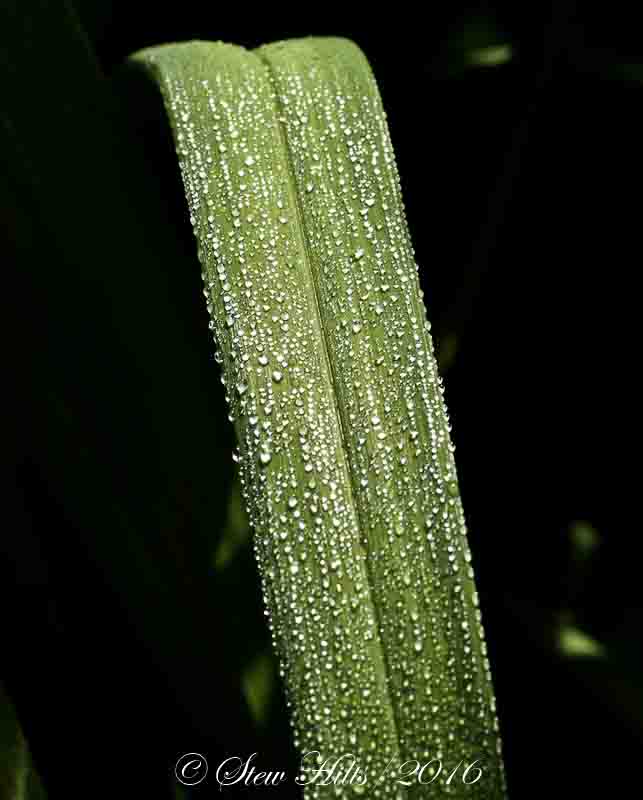
A lot of plants don't hold the dew, but the long linear leaves of the Day Lilies do.

And there were a few other plants like this Elephant Ears that hold the dew, at least along the edge of the leaf.

And yesterday's Day Lily blooms, already wilting and fading in the early morning sun.

Linking to:

Saturday, July 23, 2016

Swan Family

While we gathered and waited for the sunset shots I shared with you Friday, we had fun watching a family of Mute Swans emerge from the marsh and swim down the lake.  Apparently they do this every evening.

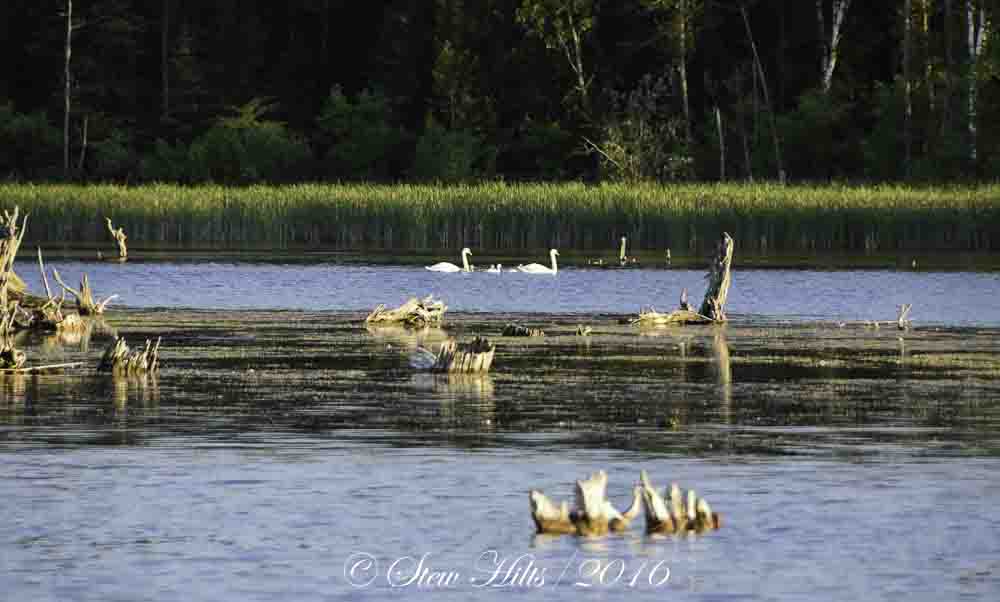
The swans were a long distance away; this is a much cropped shot.  We think there were four cygnets.  You can recognize the Mute Swans by their orange beaks.  They tend to be found in solitary pairs, and don't migrate, unlike the Arctic nesting Tundra Swans we see in larger flocks going through in the early spring.  They usually mate for life.

The reflections, and the evening light over the marsh below, were a reminder of what the 'golden hour' for photography is all about.  The sun was spilling its light across the lake in a long slant, lighting the eastern shore.  This is a 'Canada Goose fence', very effective at keeping the geese off your lawn.

We were fairly close to the south end of Lake Eugenia, where the water gets shallow and long-ago-cut stumps emerge from the water (keeping motorboats at bay, but a great place to paddle).

The swans emerged from that marsh, on the far side of the lake, and meandered slowly northward, giving the cygnets a chance to practice their swimming I presume!

Eventually they turned and headed back southwards, into the shelter of the marsh.

But at some point while I had my camera at hand, a tern, probably a Caspian or Common Tern, swooped down into the water with an abrupt splash, emerged to sit on a stump for about 4 seconds, and flew away.  This is a hugely cropped shot of the moving bird, but you can see the fish in its beak, a fish that would be a substantial mouthful I think!

Our hosts would say 'Just another beautiful evening on the lake'.

Swan Migration - Thanks to David's comments, let me clarify, that Mute Swans do 'migrate' short distances in southern Ontario to avoid ice in the winter, flying to areas of open water.  In my experience locally, you'll find a pair where the Beaver River empties into Georgian Bay in Thornbury and the flowing water at the river mouth stays open all year.  Trumpeter Swans, as David says, were reintroduced in Wye Marsh near Midland, but fly to Lake Ontario for the winter, so you may see the odd few 'migrating' through with the larger flocks of Tundfa Swans in the spring.  Tundra Swans are the stars of the migration show, arriving in southern Ontario in large flocks in late March, on their way north.


Swan Family

While we gathered and waited for the sunset shots I shared with you Friday, we had fun watching a family of Mute Swans emerge from the marsh and swim down the lake.  Apparently they do this every evening.

The swans were a long distance away; this is a much cropped shot.  We think there were four cygnets.  You can recognize the Mute Swans by their orange beaks.  They tend to be found in solitary pairs, and don't migrate, unlike the Arctic nesting Tundra and Trumpeter Swans we see in larger flocks going through in the early spring.  They usually mate for life.

The reflections, and the evening light over the marsh below, were a reminder of what the 'golden hour' for photography is all about.  The sun was spilling its light across the lake in a long slant, lighting the eastern shore.  This is a 'Canada Goose fence', very effective at keeping the geese off your lawn.

We were fairly close to the south end of Lake Eugenia, where the water gets shallow and long-ago-cut stumps emerge from the water (keeping motorboats at bay, but a great place to paddle).

The swans emerged from that marsh, on the far side of the lake, and meandered slowly northward, giving the cygnets a chance to practice their swimming I presume!

Eventually they turned and headed back southwards, into the shelter of the marsh.

But at some point while I had my camera at hand, a tern, probably a Caspian or Common Tern, swooped down into the water with an abrupt splash, emerged to sit on a stump for about 4 seconds, and flew away.  This is a hugely cropped shot of the moving bird, but you can see the fish in its beak, a fish that would be a substantial mouthful I think!

Our hosts would say 'Just another beautiful evening on the lake'.

Friday, July 22, 2016

Garden Critters

Over the past three weeks, I've spotted a number of interesting creatures in the garden, of the bugs, bees and butterflies variety.

By far the most common during the weeks when the Valerian is blooming is the Virginia Ctenucha Moth.  They rise in clouds when I walk through the garden, and flutters in all directions.  It just looks dark until you get close, and then you can see the dabs of bright orange and blue.

 Though it flutters like a butterfly, you can see by its feathery antennae that it's actually a moth.
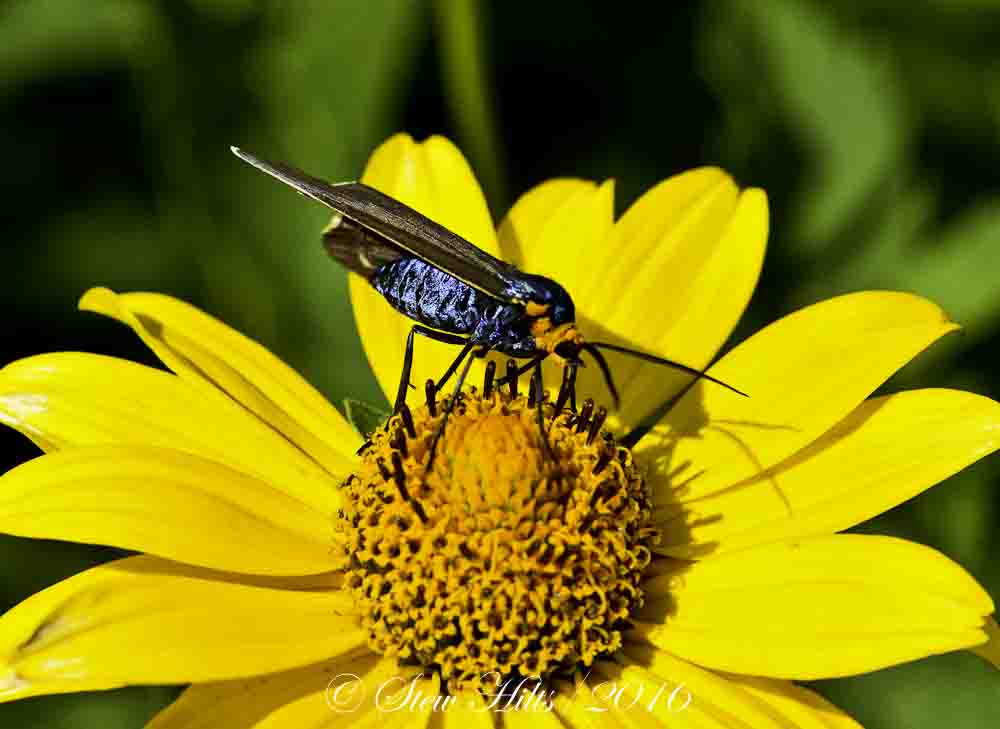
If you catch a look at the body under the wings in the right light, the body is bright blue too.

Lots of other insects favour the Valerian, which is one reason (along with its beautiful strong fragrance) that I let it spread through the garden for a few weeks.  Here a bee is searching for nectar.

I swear the Cabbage White butterflies almost never land.  If you've ever chased one, you know they just keep fluttering away.  If they do ever land, it's deep in the grass.  I was lucky to spot exactly where this one landed, and grab my camera before it moved!

There are small skippers (tiny orange/brown butterflies) in the garden too, but there are so many different species, with what seem to me like very small differences, I'm not even going to guess which one this is.

The most interesting butterfly was this Eastern Comma, a species I've only seen once before, here on a Milkweed blossom.

Luckily, I got a shot of the underwing, with its tiny white spot shaped like a comma - I just realized how it got its name!.

Linking to:

Thursday, July 21, 2016

Summer Sunset

Two weeks ago now, our Photo Group held its annual barbecue and sunset shoot (thanks to our great hosts).  As our hosts live on the east side of Lake Eugenia, we had a chance at shooting the sunset across the water.  The sunset was a 'dud', with no clouds to light up the sky, but I got some interesting shots anyway.

Standing on the dock in the late afternoon sun; I think they're suitably disguised in the reflection.

We had a good visit while we gathered for the potluck, watching the reflections in the lake.

Eventually (this was only two weeks after ths solstice, so sunset was late), the sun did sink toward the horizon, ....

 .... and disappear.

After that it was just a beautiful peaceful view across the lake until dusk settled down.

The breeze died, and the reflection was perfectly clear.

Linking to:

Wednesday, July 20, 2016

The Bridge in Kew Gardens

As soon as I saw the railing on this bridge, I knew I had to write about it, and link it in to TexWisGirl's 'Good Fences' meme.  Kew Gardens in London has long had a lake, though the first one in the late 1700's was later filled in; this one dates from the 1840's when they were building the Victorian greenhouses and had dug some small gravel pits which were used as a starting point.

The bridge on the other hand, is quite new, dating from 2006, and designed to lure visitors to some of the lesser-visited parts of the grounds.

Known as Sackler Crossing (after the generous donors who paid for it), it stretches across the middle of the lake in a graceful curve, linking the new treetop walk with the Rhododendron Dell.

It's certainly a beautiful bridge, in a beautiful setting, but what attracted me was the unusual railing, consisting of flat vertical brass bars, close enough together that from a distance it looks like a solid wall.

Obviously kids, and probably adults too, enjoy running their hands along the top of the railing.

If I lived in London, one thing I would have is an annual membership in Kew Gardens!

Linking to:

Tuesday, July 19, 2016

Canoeing the North Saugeen

We canoed down the North Saugeen, from McCullough Lake to Mooresburg the other day.  It's our favourite river around here, narrow, forested, and feeling like you're in the wild.  And this spring it had suffered a major flood.

Here we are at the small public access point on McCullough Lake, getting organized to head out.  This is just downstream (west) from the village of Williamsford on Hwy. 6, where a major flood this spring danaged buildings, and closed the highway.  It was two extremely heavy rainfalls, on Mar. 28th and 31st that did it.

All that flood drained down this river, so we were expecting to find evidence of it as we paddled, leaving McCullough Lake underneath these big culverts.  We've paddled this route twice before, so we had some basis for comparison.

We soon ran into evidence of the flood - bits of docks mostly I think.  I had heard that many of the cottages around the lake were flooded to some extent.

There were numerous new gravel bars as the current had moved the gravel around, changing the channel in places.  We were wearing our water shoes, expecting to have to get out in the shallow spots.

And get out we did, especially in the first kilometre downstream from the lake.  We were out wading about 7 or 8 times, which is really no problem if you are expecting it and plan for it.   You need your bow and stern ropes in this situation, or the canoe is quickly sideways!

The fun of this river is that the channel is quite narrow in places, with some interesting riffles that you actually have to steer carefully through.  Nothing that could be called proper rapids, but enough to keep you alert and make it enjoyable.

There were an incredible number of dead trees leaning in from the banks.  Looking downstream, it frequently looked just like a jungle of branches.  Only when you got close could you see how to thread your way around them.  This is the low bridge that surprises you by having cross-linked cables about a foot under the concrete, forcing you to duck down very low indeed as you glide under.

Besides the gravel bars, the channel was a mixture of fine bare gravel, and heavy growth of acquatic plants.  Looking into the afternoon light, it was hard to pick out the deeper channel, and a few times we got stuck in the plant growth.

But apart from all that, this river is a really nice paddle, assuming you know how to handle a canoe (the person in the bow really has the more important job, by watching which way to go for the deep enough water, and watching for rocks or logs).

Perhaps the best feature of the river is how clear the water is.  For southern Ontario rivers, usually flowing through farmland, this is incredible.  I don't know if there's a single farm field upstream that reaches the banks of the river.  It flows entirely through forest and wetland.

Before we knew it, we reached the 4th bridge, and were finished.  We enjoy this river so much we'll happily do it every year.  Note for the future - paddle the last two weeks of June, in hopes of slightly deeper water.

Linking to: