Thursday, August 22, 2013

Seasons in the Garden - Brown-Eyed Susans and More


The other group of plants in our garden that indicate late summer is here are the brown-eyed susans and all their relatives.  We have several different horticultural varieties, and for the life of me I can't figure out the correct labels.  I suspect they're mostly varieties of Rudbeckia, but in any case they paint large parts of the garden bright yellow at this time of year.

These are the native brown-eyed susans, thanks to a mixture of prairie wildflower seeds I spread several years ago.  To be honest, I like the picture of them in the meadow where they're mixed in with Queen Anne's Lace and monarda more than the pure stands in the garden, but they're always beautiful.

These ones get called 'black-eyed susans' too, but all of ours have dark brown centres, and they're about 2 feet plus a little tall.  They form large patches and last a long time, spreading by being self-seeding.

The second type we have are these bright yellow ones.  They're taller than the native ones, usually at least 4 feet high, and grow in very large clusters that start falling over eventually.  They form huge yellow patches in the garden, so huge they dominate numerous other shorter flowers. 

These ones have yellow-orange centres, though they turn dark as they age.  But these ones don't seem to self-seed and spread very much, if at all.

 
This variety is taller still, easily 6 feet, and very 'light' as a plant, with thinner stems and leaves.  It self-seeds like mad, and repeatedly pops up in the garden where you don't want it.  You have to be careful with this one or it will take over.

The flower centres are brown, and the flower shape is like coneflowers to me, the petals hanging down.

The last one is enormous, easily 8 feet tall (I'm looking up at it here), and spreading into huge clumps easily 6 feet across at the top.  It does not appear to self-seed or spread at all, but the three clumps we have have just exploded in size this year, and we're having to ask ourselves what to do with them!

This one has quite large flowers with green centres, and is tall enough that you can easily get a picture of it against the sky - in fact that's the only picture you can get.  Together all these bright yellow flowers colour the garden beautifully at this time of year - but they also tell me the end is getting near.

Even though it's Thursday already and I'm almost too late, given all the yellow flowers I can't resist linking this to Monday Mellow Yellows!  Check out other yellow pix by clicking on the last picture above.

And:
 

Tuesday, August 20, 2013

Seasons in the Garden - Coneflowers

There are lots of flowers in the garden that indicate the changing seasons too.  In our garden, two dominant groups, the coneflowers and the brown-eyed susans paint the garden in colours of August for me - mainly purples and yellows, but a few other interesting blooms too.  These are a few of the coneflower varieties we have in bloom at the moment.


Monday, August 19, 2013

Changing Seasons

I've always believed there were at least 8 seasons, and now I'm thinking there are 12.  At almost any time of the year you can find numerous indications that the seasons are changing.  Right now it's the shorter daylight that I notice most.  Evenings in particular seem to end much earlier, and in the morning there's a heavy dew on the grass.  But there are also lots of other indications that we're in late summer.


The big one is the leaves changing colour - just a few yet, but some quite noticeably, like this sumach leaf I saw along the Beaver River last week.

The dogwoods always seem to be among the first to turn, usually to a dark dull purple, here with the sun shining through the leaf making it a little brighter, in our own meadow.

 But it's when the meadow turns yellow with goldenrod that I really know August is moving ahead and late summer is here.  This year it seems to have flown past faster than ever!

While out in the landscape, the grain harvest is mostly over, usually leaving behind these big square bales of straw.  I think most of them are shipped off over the fall and winter for use as bedding in horse barns.  In any case, summer is nearly over.


Linked to:

Sunday, August 18, 2013

Monday Macros

A few close-ups of flowers in the garden taken recently, all August bloomers.

One of our favourite day lilies, 'Tigger', blooms quite late.  We had a dog named Tigger for a good 14 years.

We have several varieties of coneflowers; the red ones growing under the old apple tree are my favourites.

This is Persicaria, an unusual group of plants commonly known as knotweeds; this bloom is about one inch long.

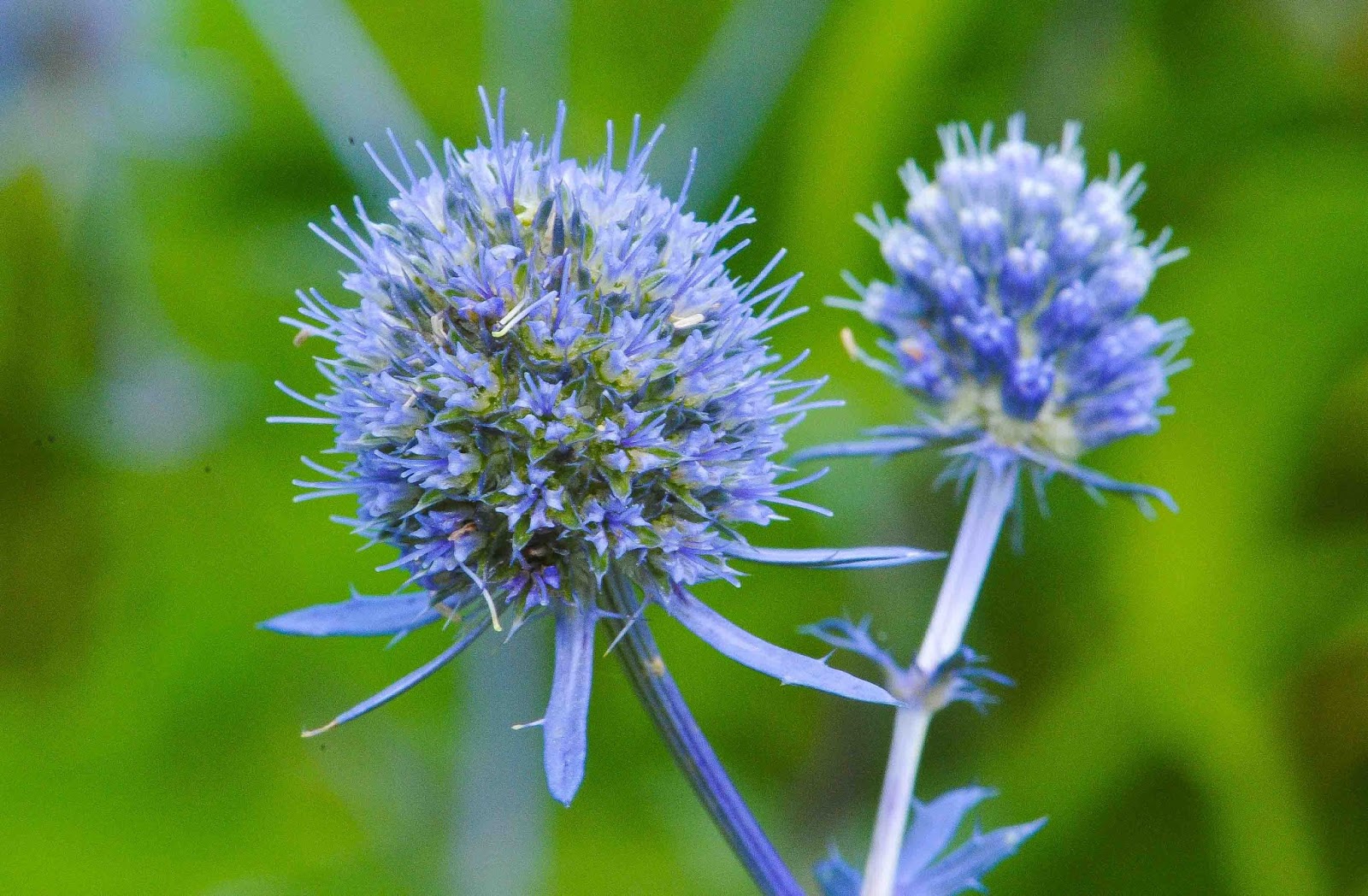
This is sea holly, which adds an interesting light blue colour to the garden; even the stems are blue.

And this is a purple liatris; I love the colour as well as the spiky shape of this one.

 Linked to:

Friday, August 16, 2013

Apple Orchard in the Valley

Today's orchard is a small orchard belonging to a friend, so we get to go and pick apples ourselves every fall if we want.  He stopped by the other day to say that the first of his varieties, the Melbas, were ready for picking, so we dropped by on a perfect sunny afternoon to pick just a few for making applesauce.

As you can see, it really was a perfect afternoon.  We've been getting lots of these brilliant blue-sky days with puffy white cumulus clouds, as the high pressure weather systems roll through, even though it hasn't been very hot.  Perfect weather for me!  His tiny orchard is in the narrower upper valley; you can see the west slope of the valley in the background.  The cleared fields in the distant centre are the ski runs of the abandoned Talisman Ski Resort.

We quickly found the five Melba trees, easily identified by the apples turning red.  He has about 8 varieties of trees that ripen over the next two months, so we may be back later to pick some others.  But now was a convenient time to make applesauce, and melbas are good for that, as they don't really keep well for eating over the winter.  They're an older variety, and great eating early in the season.

Almost the entire crop in this region was killed off by a late April frost last year, so this year's crop looks bountiful indeed.  These trees were heavily laden with lots of excellent apples.  They're mostly small trees, and easy to pick, so we half-filled 4 shopping bags and headed home. We now have 24 jars of apple sauce all ready for the pork chops in mid-winter.

I've been in this orchard many times over the years, sometimes with a group of students we brought to the valley, who helped pick occasionally in return for taking their own bags of apples home.  But once I was accused of being an apple thief by a local who called the police after he saw my car parked along the road!  He didn't realize that I was actually in the orchard with the owner, helping him pick at the time.


Given the beautiful sky, 
I linked this post to: 

Thursday, August 15, 2013

Getting Ready for Apple Harvest

Apples are a big crop in the Beaver Valley; in fact Grey County is the #1 producer of apples in Ontario.  Especially in the lower valley near Thornbury, not too far from Georgian Bay, apple orchards are widespread.  And now is the time to get ready for the harvest, which will go on for the next 3 months.

These are honey crisp apples, not yet ready for picking, but looking good.  They are the best tasting apple variety grown here in my opinion, but also the most expensive - for good reasons; harvest requires repeated picking instead of just one pass through the tree, and they are a relatively new variety, with trees just beginning to bear good crops.

Apples grow well here for several reasons.  The water of Georgian Bay tends to moderate temperature, reducing the chance of spring frost damage to blossoms.    Many orchards are planted on slopes leading down from the escarpment, providing cold air drainage, again reducing the chance of frost damage.  And the gravelly soil of the old beach ridges extending south of the bay is what apple trees like.
 
 
I was struck by the ladders ready for the picking crew.  Commercial orchards here are usually picked by groups of migrant workers housed on each farm, often a group that returns year after year.  This particular farm has a group of 8-12 from Mexico who come each year.  They work long hours, but their family at home depends heavily on the income they bring back.

There are hundreds of acres of apples, in more than a dozen different varieties, a huge job to pick.  You can see the lines of trees disappearing in the distance in this photo.  The typical big old heavily pruned apple trees are disappearing now, with a variety of higher density orchards like this one (or much denser), planted and carefully staked.. 

It may take several years for trees to produce a good apple harvest, and they are only in their prime for 10-15 years I've been told, so the replanting of orchards is an ongoing part of the work for commercial apple growers. You can see that every tree here has been well staked; the rows seem to go on as far as the eye can see.

I've been intrigued to learn about the varieties of apples grown.  This is an 'Earligold', nearly ready for picking.  I used to think that an apple was an apple.  Perhaps I came to know about macintosh or spyes through my parents.  We probably buy apples in the stores mainly by price or colour.  But now I realize that each variety tastes different, may be best used in different ways (as in pies vs fresh eating), and stores well for different times.  Different varieties will be ripe in sequence from now until November, so crews will typically be picking mostly one variety at any particular time.  We only buy the apple varieties we enjoy now, and usually from a local producer.

So the crates are all ready and waiting.  Apples will be marketed fresh or for juice.  The next 2-3 months is the time to go and enjoy fresh apples directly from the orchard.  Thanks to Dykstra Orchards for the visit we made last week, and especially the garden tour.


Wednesday, August 14, 2013

The Flower Bridge

Down one of the less-used sideroads in the valley is an old narrow one-lane iron frame bridge over the Beaver River, and someone decorates it with hanging baskets of flowers every year!

There's a garden centre, Riverbank, just off to our left, and they specialize in hanging baskets of flowers, so every year they hang baskets along both sides of the bridge.  The bridge itself is the kind you slow down for, a lot, and drive over quite slowly, so it's easy to appreciate them.  The first time you see them it's a delightful surprise!

 
As far as I can recall, the baskets are all the same, and all are looking very luxuriant at this time of year.  And as anyone who has grown flowers in hanging baskets knows, it's much more than placing the baskets there in the spring.  Baskets like these need watering virtually every day to stay healthy and keep blooming.

The bridge itself is interesting, with it's old iron support framework, and on this day the pattern of shadows on the deck - but it's the dozen hanging baskets of flowers that make it.

And this section of the Beaver River is a popular canoe route too, so passing canoeists see the flowers as much as motorists.  In fact on this lightly used sideroad, I expect there are more canoeists some days than there are drivers.

If you live locally you can see the flower bridge on the first gravel road to the west south of Heathcote.  It's worth the short detour to see it.