Thursday, September 8, 2011

More Crops!

The grain and canola crops aren't the only ones around here. The corn and soybeans are coming on strong, though they won't be harvested for some time yet. And the other day I noticed a large field of millet, an unusual crop you don't see often.

Corn has been growing steadily since it was planted in May or early June, and though different fields may vary in getting started (see my post of July 8th), by now they've all caught up. By August the corn is tassling, and by now it's pretty well full grown. Harvest waits until the corn has dried out while still standing, depending on how the farmer intends to store or market it.

Soybeans are a late crop, that has to wait til after the last spring frost for planting, so it looks like it's just getting started while other crops are growing strong. But by now it's all caught up, and the soy beans have developed, as you can see in the second of the two photos below. At this time of year it starts turning yellow, and will be harvested in a few weeks. Along with canola, it is the other oilseed crop.


Millet is not often seen in most of southern Ontario, but this field is growing a short ways north of our place. Earlier in the year you couldn't tell it from other grain crops easily, but by this time of year it has quite a distinctive appearance. It has tiny seeds, held in these wavy fronds (which were blowing in the breeze when I took these pictures). Some seed heads turn from yellowy green to reddish brown earlier than others, leaving the field with a mottled appearance of green and brown as it matures. It will eventually be harvested like other grains.


Monday, September 5, 2011

Canola Harvest

At the same time as the grain harvest is going on, the canola crop is also being harvested around here. Canola is not a grain, but is an oilseed crop, similar to soybeans. However, the harvest is quite similar to grain harvests. It is grown for the tiny black seeds, which are used to make canola oil.


Canola fields are those fields that are brilliant yellow when they're in bloom in June and early July (see my post of July 8th). They then turn a light bluish green while the seed pods form and mature. You can see the characteristic colour in this field, and the beans forming in the close-up.


When they're ready for harvest the canola seed pods turn brown. They are usually harvested with a combine, as is wheat.

Saturday, September 3, 2011

The Grain Harvest, Part 2 - Oats and Barley

They're not nearly as common as wheat fields, but there are a fair number of farmers growing oats and barley around here - sometimes just oats or barley in a field, and sometimes mixed together, known as 'mixed grain. This field shows the mixture, much earlier in the summer, in early July, when the oats gave the field a bit of a blue-green colour and the barley provided a soft, feathery appearance.


A close-up shows the difference, the oats being the large individual seeds openly spaced on the top of the stalk, and the barley being much more like wheat, but with long feathery 'tails' or 'glumes' extending upward from the grain stalk. There's an out-of-place stalk of timothy in the upper left hand corner, a common component of hayfields.


The pictures below show a beautiful field of barley, more recently, a few weeks before combining. The fronds of the barley give the field a wavy, feathery appearance, especially in a gentle breeze. The barley turns golden-brown when ready for harvest, just like wheat, and the harvest is similar, with the grain combined first, then the straw baled, mostly for use as bedding for cattle. The second photo shows a combine harvesting a mixed grain field.


A close-up of barley, showing the grain as well as the long feathery 'glumes', already starting to turn gold, and a close-up of oats earlier in the summer, showing the clearly visible separate grains.

Friday, September 2, 2011

The Grain Harvest, Part 1 - Wheat

The biggest parts of the rural landscape around here are the farm fields, and perhaps the most obvious change in the seasons is the sequence of planting, ripening and harvesting of the crops. As we reach the end of August, the grain harvest is nearly finished around here, though there are a few fields left to be combined and baled. Wheat is the biggest grain crop in southern Ontario, but there are fields of barley, oats and mixed grain (oats and barley mixed together) to be harvested as well. Canola is now being harvested too. But wheat is by far the biggest, and it's Canada's biggest agricultural export, because of the enormous acreages on the prairies.

Here the wheat is usually winter wheat, planted in late fall and showing like bright green grass before the first snow. It grows steadily in spring until the grains are clearly formed, and then in mid-July starts to turn golden brown. The fat grains of this wheat are what ends up making the bread you eat.


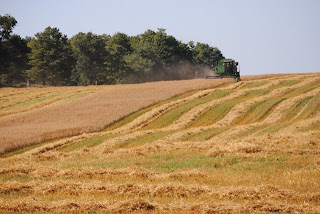
Once the wheat is ready for harvest, the combines move in, cutting off the grains at the top of the wheat stalk, and harvesting them seperately. The stalks are left lying on the ground to be baled as straw; the grain goes into those high-sided red wagons you see in farm fields at this time of year, and moves off, usually to be sold as a cash crop. The combine coming over the hill here is actually harvesting a field of mixed grain, but it's the best picture I have. In the next photo below, combining is finished, and baling has begun.


I think it took me many years, as an urbanite, to realize the difference between hay bales and straw bales. At first glance they look similar, but hay is cut and baled complete, that is with the seed head at the top of the grass included. It's the seed head that provides the protein for cattle fed on hay. With grain, the seeds are harvested separately by the combine, so it's only the stalks of the plants that get baled, as straw. Straw is mostly used for bedding, for all livestock, including horses.

I think I first learned this difference when we used straw for mulch in our garden, because using hay introduces all kinds of grass and weed seeds, but using straw doesn't. So don't use hay for your garden mulch; it defeats the purpose!

Grain mostly gets trucked off the farm (in those big grain trucks that rumble the roads of rural Ontario at this time of year), and taken to a grain elevator. Once it's weighed and graded the farmer gets paid, and the grain is probably exported, either by train or by ship. This is the Goderich grain elevator (the picture was taken, remarkably, the day before the tornado - it doesn't look quite like this any more), but most farmers will truck their grain to an inland elevator serviced by train.


These pictures reflect how virtually all our wheat is harvested, but driving to Goderich two weeks ago (where I got the picture of the grain elevator), we passed two farms where Mennonite farmers were actually stooking the wheat, the old-fashioned way. Picturesque to most of us, but incredibly hard work!

Monday, August 29, 2011

Canoeing the Saugeen

I'm falling behind here; I think it was two weeks ago that we went and canoed a bit of the Saugeen River. It was a great day, sunny, but not too hot, and even though the river is at a low point of the year, there was plenty of water to make it exciting. There is canoeing on the Beaver River, right here in the valley, but it's only a gentle meandering river. The Saugeen is the nearest larger river with a bit of whitewater, and very popular locally; the headwaters of the Rocky Saugeen are only half a mile west of our house.


We started at Walkerton and canoed downstream to the first bridge, about a 3 hour paddle. I'm told this section is one of the best on the river, because of the number of whitewater stretches - gentle whitewater admittedly, but fun. And it's true; much of the trip we felt we were just steering more than having to paddle - my kind of canoeing! I've done whitewater trips in northern Ontario, which can be much more challenging, but this was certainly exciting enough to be really enjoyable.


In the middle of this stretch is a bend of huge sand deposits, leftover from the glaciers I presume, perhaps associated with some ancient shoreline. The river hurries around in a huge bend at the base of the cliff, providing a surprising bit of spectacular scenery in rural Ontario, never seen unless you're in a canoe. And it's also remarkably wild. I think we only saw one shack on the shoreline, and the edge of one cornfield, but we saw at least a dozen kingfishers.


I was paddling my new single 'pack' canoe, the one with a kayak seat and paddle, and it worked really well in the whitewater stretches for the first time. I also learned why they call it a 'pack' canoe - it's not because you can carry packs in it; it's because the original model, built for Teddy Roosevelt who was an avid fly fisherman, was small enough to be packed into the wilderness on the back of a mule!

Wednesday, August 17, 2011

The Meadow has Turned Yellow Again

A few days ago, the meadow (at least parts of the meadow) turned yellow again, this time when the goldenrod seemed to come into bloom all at once. The meadow was last looking this yellow in the spring, when the yellow hawkweed was in bloom everywhere. Goldenrod adds nice colour, but it is allelopathic, meaning its roots put out chemicals that discourage the growth of other plants. It tends therefore to be a tough, self-sustaining weed. On the other hand, it is a host for a number of beneficial insects, including some butterflies.


The entire bloom on a goldenrod is actually made up of hundreds of tiny florets that you almost need a magnifying glass to see. This is just one frond in a bloom that may have a dozen yellow fronds. People often mistake goldenrod for ragwort, a common cause of hay fever.


Another interesting yellow plant is the very tall elecampane, its flower a beautiful yellow sunflower type, with very small but bright yellow rays.


It has huge leaves, perhaps the largest of our native meadow plants, and stands up to 6 feet tall. It likes to grow in wetter corners, where the soil is damp at least in the spring, so it's only found in wet meadows.


Tuesday, August 16, 2011

Interesting Things

We see lots of little interesting things that strike me as photo-worthy here and there. This tree frog visited our chairs under the apple tree, and just sat there all day long. They tend to be more active at night, and the tree frog's call is very neat - a sort of a bark sound. I'm sure many people here them and wonder what sort of bird is that, calling at night.


One day after those weeks of hot dry days in July, it suddenly rained, and everthing turned cooler and greener. What we really noticed was how the lichens on the big boulders perked up immediately. Absorbing moisture, they sprung back to life, and showed up against the rock so much more clearly.


I think this is a damselfly, but I don't know my insects very well. The only one I could find to match the black wings they had is the ...... They were literally swarming around fallen logs along the Nottawasaga River when we canoed it earlier this spring.


And finally, this is a courageious cedar tree - just a little cedar tree in a pasture, until you look closely and realize that its growing straight out of this big boulder.